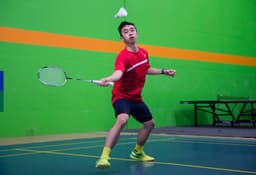
You warmed up fine. The first few rallies felt normal. Then somewhere around 5-8 down you noticed your clears were landing short, your net shots were sitting up, and a player you've beaten twice this season was hitting winners past you without doing anything special.
Everyone has this night. I've had it at national championships with a coach in my corner and a full warm-up behind me. The difference between me and most of the club players I coach isn't that it happens less often. It's that I stopped treating it as a mystery about a decade ago.
An off night is not one thing. It's one of three things, and they need opposite responses. Most players never find out which one they've got, because they spend the whole match trying harder, which is the single worst response to two of the three.
This is about one match. If your game has been missing for a month, that's a different problem with a different fix, and the losing streak diagnostic covers it. This is about the next forty minutes. Rule out the room first, though: drift, dead air, or a hall you've never played in can produce every symptom below without anything being wrong with you.
The night your game doesn't show up 
There's a version of a bad match where your opponent is the reason. They're doing something specific to you, you can see what it is, and you adjust. That's a solvable, pleasant sort of problem, and tactical adjustment is the whole skill.
This isn't that. This is the night where you'd struggle against anyone, where the shuttle is arriving in the wrong place on your racket and you can't say why. The opponent is almost incidental.
The distinction matters because it changes the fix. When you can see what your opponent is doing, the answer is to cycle tactical levers — pace, length, target, formation — until one of them bites. When the problem is your own execution, changing tactics does nothing at all, because whatever you switch to will be executed by the same hands that just missed. You have to find the mechanical fault first.
What makes it dangerous is that it feels like a confidence problem, so players treat it like one. They try to psych themselves up. They tell themselves to relax. Neither instruction has a physical meaning, so nothing changes, and after four more lost rallies the story hardens into "I'm just off tonight," which is where the match ends.
Off nights are physical or mechanical about four times out of five. They feel emotional because losing feels emotional.
The 90-second triage 
Three questions, in this order, because the order is the cheap part. Run them during the next few rallies. You don't have to stop playing to do this.
Are you arriving late? Look at your clears. Not how they feel, where they land. If your clear is dropping around the back service line instead of within a foot or two of the baseline, you're hitting the shuttle from behind your body and slightly too low, and that means your movement is late, not your hands. Length is the honest indicator. It's the first thing to go and it's the easiest thing to see without a camera.
Are you arriving on time and still missing? Then it's contact. The usual culprit is contact height on overheads: you're taking the shuttle six inches lower than normal, which flattens every trajectory you hit and turns a good drop into a mid-court gift. Net shots going up is the same problem at the other end of the court.
Are you arriving on time, hitting cleanly, and losing anyway? Now it's tactical, and now you get to think about your opponent. This is the rarest of the three by a distance.
Here's the part that costs people matches. Almost all of these nights are the first one, arrival. And almost everyone diagnoses it as the second one, technique. So they spend a whole match adjusting their grip and shortening their swing while the real fault is that they're starting their first step a beat after the shuttle has crossed the net.
If it's arrival, the fix in the moment is not to move faster. You can't decide to be faster. The fix is to start earlier, which means splitting on your opponent's contact and hitting the shuttle higher so you buy yourself time back. If your legs are the reason you're late, and it's the back half of the match, that's fatigue rather than form and it degrades in a predictable order.
Stop hunting for the shot that fixes it 
Watch a club player have a bad night and you'll see the same sequence. A drop goes into the net. Next rally, a better drop, also into the net. So they try a smash. Then a cross-court. Then a deceptive one that they've hit successfully maybe twice in their life.
They're auditioning shots, looking for one that will rescue the evening. Every audition is a low-percentage shot played at a bad moment by someone whose timing is already off. The error count climbs, and each error confirms the story.
Count the last ten points. How many ended with your opponent hitting a genuine winner, and how many ended with you putting the shuttle into the net or out the back? On an off night the split is usually seven to three in favour of your own mistakes. You are not being beaten. You are donating.
Which means the fix is subtraction. Take winners off the menu entirely for three or four rallies. Not for the match, just long enough to re-establish a baseline you can build from.
The patterns that hold up when your timing is gone 
These are the shots that survive bad timing, because they either buy time or don't require much of it.
High and deep, cross to the backhand corner or straight, and repeat it. This is the same shot the reset playbook uses to buy reading time, but here you're playing it for a different reason: a high clear is the most forgiving shot in badminton, and forgiveness is what you need. You can hit it from a bad position, off balance, late, and it still does its job. The failure mode is hitting it flat because you're rushed, which is exactly the situation you're in. Aim two feet higher than feels comfortable. It will feel passive. It is buying you the half-second your feet aren't giving you.
Straight until you've won three rallies in a row. Cross-court needs precision and leaves your straight side open for as long as the shuttle is travelling. When your contact is unreliable, every cross-court is a coin flip that also puts you out of position. Straight replies are shorter, faster to recover from, and much harder to punish.
At the net, only play a net shot if you're still moving forward. If you arrive flat-footed and stopped, lift instead. A lift from the net gives up the attack, and you'll lose that rally maybe a third of the time. A net shot from a stationary, reaching position goes up or into the tape far more often than that. Take the worse position over the coin flip.
None of this wins you points directly. That's the point. It stops you losing them, and against most club opponents that alone flips the scoreboard, because they're not built to construct twenty-shot rallies.
What to change now, what to save for the interval 
The mistake is trying to fix everything between two points. You get four windows in a match, and they're different sizes, so the instruction has to be sized to fit.
Inside a rally, you can change exactly one thing: trajectory. Higher, deeper. Everything else is happening too fast to be a decision.
Between points, about ten seconds, you get one instruction, and it has to be a physical action rather than a concept. "Split when he hits it." "Clear to the baseline." Not "focus," not "come on," not "stop making errors." Those aren't instructions, they're weather reports. If you're spiralling after a specific error, the seven-second reset in the pressure guide is the routine to use here.
At 11, the 60-second interval, you can change one tactical thing. One. Two instructions is the same as zero, because under pressure you'll execute neither. Pick the one that addresses whichever branch of the triage you landed on.
Between games, two minutes, this is your real window. Dry the grip, change the shirt if you have one, drink properly, and decide on the plan for the next game rather than the next point. This is also the only break long enough for your heart rate to actually come down, which matters more than the tactical thinking you'll do in it.
Doubles: is it you, your partner, or the matchup? 
Doubles hides the diagnosis, because you only touch half the shuttles and the errors get shared between two people. A few tells worth knowing.
It's you if you're being attacked in the same spot repeatedly and it keeps working. Good pairs find the leak within four or five rallies and then just keep going there. If every third shuttle is arriving at your backhand hip on the defensive side, that's not bad luck, that's a scouting report.
It's your partner if rallies are ending on their side of the court in a repeating pattern. Lifting from the net when they should be blocking, missing the middle shuttle, standing too square in defence. You'll know within a game.
It's the matchup if neither of you is making many errors and you're still losing, because you never get to attack. That's a serve and return problem, or a rotation problem, and it's fixable with an actual rotation adjustment rather than any of this.
If it's you, the useful move is backwards from what you'd expect. Take less court. Serve, then cover your zone honestly and let your partner have the shuttles in dispute. And say it out loud. "I'm not seeing it tonight, feed me flat stuff." Every decent partner I've played with would rather hear that in game one than work it out for themselves in game three.
When to stop playing badminton and just retrieve 
Sometimes the triage doesn't resolve anything. You're late, your contact is low, and neither is improving. There's one option left and it's more effective than most players believe.
Commit to returning everything for one full service run. Not "play safe," which is vague. Literally: do not attempt to win a point. Get the shuttle back over the net, high and deep, every single time, and see what happens to your opponent's error count.
What usually happens is that it climbs. Club players aren't built to construct twenty-shot rallies, and they're not used to being refused. Give them four rallies where nothing they hit ends the point and they'll start reaching for a winner that isn't there. That's the whole mechanism. You're not out-playing them, you're out-lasting them, and it counts the same on the scoreboard.
The caveat is real: this doesn't work against someone genuinely better who's perfectly happy to rally at you all night. Against that opponent, pure retrieving just delays the result, and you're back to the approach for playing above your level. But against a peer on a night when your game is missing, it wins more often than anything else available to you.
The part you can't see from inside the rally 
The hard thing about self-diagnosis on a bad night is that the faculty you'd use to diagnose it is the same one that's malfunctioning. You feel late, so you assume you're slow. You feel like your technique has gone, so you rebuild your swing between points. You're using a broken instrument to measure a broken instrument.
So film one. Not a good match, a bad one, the next time it happens. Then watch it back and do three passes in order: where did your clears land, how many points ended with your error versus their winner, and were your feet on the ground when your opponent made contact. That's the same triage, run properly, off evidence rather than how the evening felt. The match review process has the full version.
You'll usually find the answer was sitting there in the first four rallies, and you missed it for the next forty minutes. Which is fair enough. The only camera angle you had was your own eyes, moving fast, while you were annoyed.
You're going to keep having these nights. I still do. But the diagnosis takes about six points once you know what you're looking at, and a match you diagnose by 4-2 is a completely different match from one you spend an hour losing to a theory about your grip.