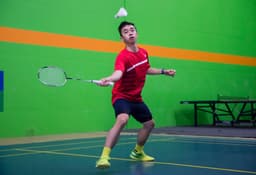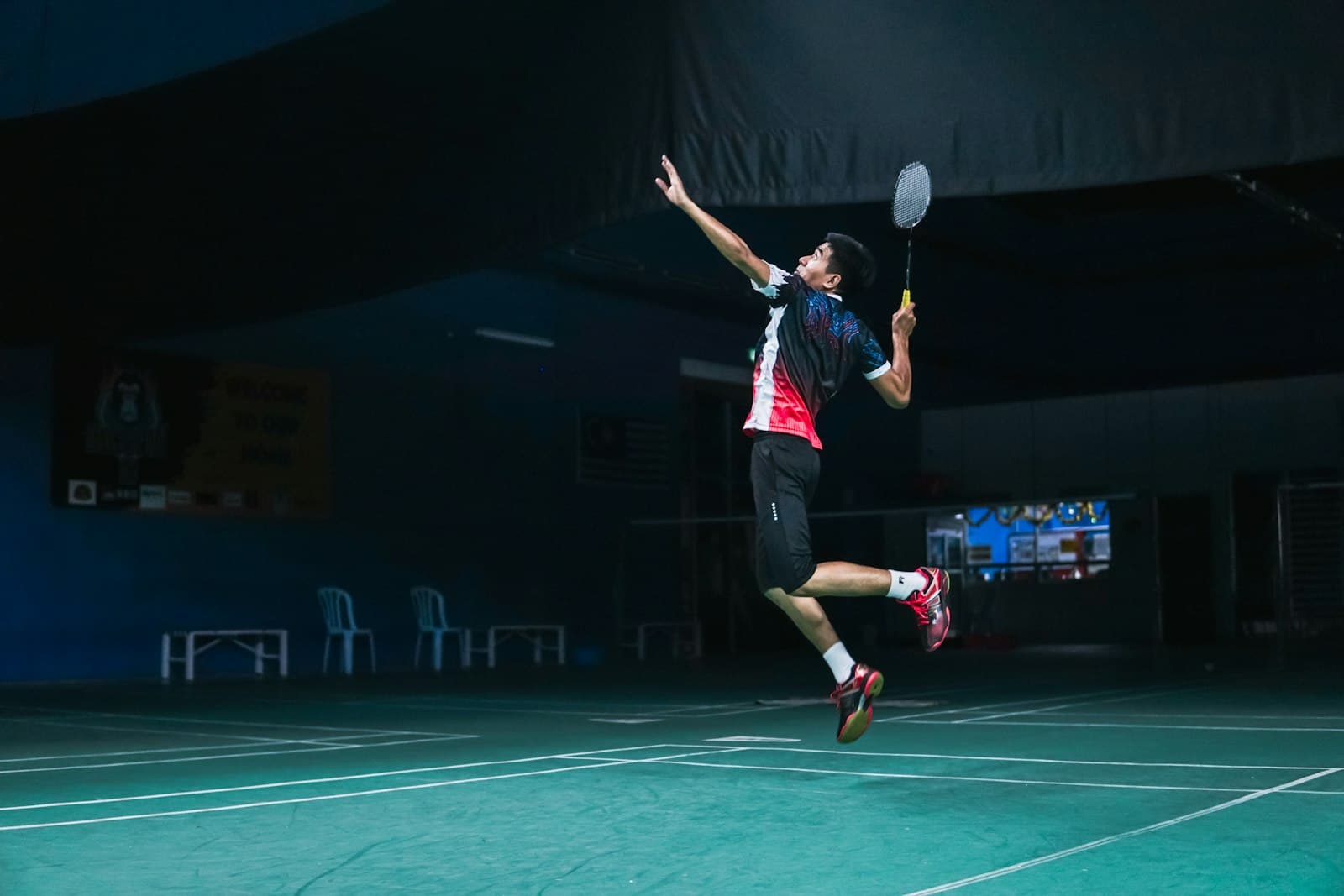
Every few weeks someone sends me two clips of themselves and asks me to explain the difference. The first is from club night. They're loose, they're early to the shuttle, they hit a round-the-head smash that lands on the line and they laugh about it. The second is from a tournament three days later. Same player, same racket, same shoes. They lift everything, they push the first net shot into the tape, and they lose 21-13 to someone they'd beat on a Tuesday.
The question is always some version of "how do I stop getting nervous?" And I understand why, because that's what it feels like from the inside. But when I watch the two clips side by side, nerves are usually the third or fourth thing I see. The first two or three things are structural. They were baked into how this player practiced months before the tournament, and no amount of breathing on the service line was going to fix them.
That's what this post is about. Not pressure. I wrote a whole guide on handling pressure at 18-all, and it stands. This is the part that comes before pressure ever gets a vote: why the version of you that plays on club night and the version that plays in a tournament are different players, and why the second one is usually worse for reasons that have very little to do with your heart rate.
The two versions of you, and why only one gets filmed 
Something I notice about the clips people send me. Almost nobody films club night. They film the tournament, because the tournament is the one that matters and the tournament is where it went wrong.
So they have detailed evidence of the bad version and only a memory of the good one. And memory is generous. The club-night player in your head is a highlight reel. The tournament player is a full match, unedited, with every lift and every dumped net shot in it.
Some of the gap is just that. Not all of it. But before you go looking for causes you need to know how big the gap really is, and you can't know that from a feeling. I'll give you a way to measure it at the end. When I put two honest clips next to each other, the gap is usually smaller than the player thinks and caused by different things than they think.
The practice version isn't the real you either. It's you against opponents you know, in rallies that start softer than tournament rallies, taking risks that cost you nothing. Strip those three conditions away and you get the tournament version. The tournament version isn't you playing badly. It's you playing without three advantages you never noticed you had.
It's mostly not nerves: the four causes in order 
When I sit down with a player's club footage and their tournament footage, I'm looking for four things, and I look for them in this order, because this is the order of how often they turn out to be the main cause.
- Your reads are memorized, not learned. You've played the same eight people for years. What you call anticipation is a lookup table, and a stranger erases it.
- Practice shots cost nothing, so you go for winners too early. In a club game an error is free. In a tournament the same shot selection produces an error count you then blame on nerves.
- Club rallies start loose and tournament rallies don't. The first three shots of every rally are the part of your game you have trained the least, because at club they barely happen.
- Nerves. Real, but usually fourth, and usually amplified by the first three.
"It's not nerves" is going to sound like I'm dismissing something you've felt in your body. I'm not. Your hands did get tight. Your legs did feel heavy. But most of the time that tightness arrived after you'd already lost four points to causes one through three, and it made an existing problem worse rather than creating it. Fix the structure and the nerves have a lot less to feed on.
Let me take them one at a time.
Your anticipation is a lookup table of eight people 
Most club players think they read the game well, and at their own club, they do. They know that Dave lifts cross-court off the backhand every time. They know that Priya's flick serve comes on the second point of every service run. They've spent hundreds of hours building a very detailed model of about eight people.
That model is what you're calling anticipation. And it works, right up until you walk onto a tournament court against someone you've never seen.
What happens next is what I see on the tape. The player's split-step is on time in the club clip and half a beat late in the tournament clip. They read the same footwork, the same body cues, and they don't move early. Not because they're nervous, but because the cue that would have told them "cross-court" at club (Dave's shoulder dipping) doesn't mean anything on this new opponent. Their model returns nothing, and with nothing to go on, they wait for the shuttle to leave the racket. Waiting for the shuttle is a quarter-second late. A quarter-second late is the difference between a comfortable clear and a scramble.
The tell for this cause, if you want to check your own footage: look at your first ten rallies against a new opponent and count how many times you moved before the shuttle left their racket. Then count the same thing in a club game. If the tournament number is close to zero and the club number is high, this is your gap, or a large piece of it.
More club games won't fix this. You've had thousands of those. What you need is to play more strangers, and to play them with the specific intention of building a read from scratch inside the first five rallies. Which corner do they clear from under pressure? What does their body do before a drop versus a clear? You're rebuilding, deliberately and quickly, what you built at club by accident over years. I went into how to do that in the read-your-opponent guide, and the honest summary is that reading is a skill you can train, but only if you practice it on people whose patterns you don't already know.
Practice shots cost nothing, so you attempt winners too early 
This one is the biggest for most of the players I coach, and it's the one they least want to hear.
Think about what a point costs you on club night. Nothing. You lose it, you shrug, you play the next one. Because it costs nothing, you play a particular kind of badminton: you go for the winner on the second or third shot, you attack lifts that are a foot too deep, you try the tight spinning net shot from a bad position because if it works it's beautiful and if it doesn't nobody remembers.
You've been playing this way for years. It's your shot selection now, what your hands do without asking you.
Then you walk into a tournament, where points cost something, and you take the same shot selection with you. You attack the deep lift on shot two, and now the smash goes into the net and it's 3-7 instead of a laugh. You try the tight net shot from a bad position and it clips the tape. Four errors in six points. And now, yes, the nerves arrive, because you're 3-7 down in a match that matters, and you tighten up, and you start lifting everything, and the second half of the game looks like a different person from the first half.
But go back and look at the first half. The first half was your club-night shot selection meeting a scoreboard that kept the receipts.
There's a specific number I want you to pull off your footage. On every rally you lost, note which shot you were on when you attempted the winner, and whether the shot before it had actually earned it. On club night most players attempt winners on shot two or three, off shuttles that weren't short enough to justify it. In a tournament, if you're doing the same thing, your error count is going to look like a nerves problem. It isn't. It's the same decision you make forty times a week, finally getting priced.
Fixing this is uncomfortable, because it means changing how you play club night, and club night is the part you enjoy. It's a two-part change. First, tighten your winner-attempt threshold: only attack when the lift is genuinely short, only play the tight net shot from a balanced position. This will lose you points at club for a couple of weeks, because you were winning some of those low-percentage attempts against people who couldn't punish them. Second, and this is the part almost nobody does: play your club games as if points cost something. Keep score honestly. Don't replay the point you fluffed. If you can make club night feel five percent more like a tournament, the tournament will feel five percent more like club night. That's roughly the size of the gap most players are trying to close.
If you want the reverse of this problem, where you're playing too safe in practice and never trying anything, that's a plateau, and I wrote about it in the why you stopped improving post. The two problems can coexist. Someone can hunt low-percentage winners every rally and still never try a genuinely new shot. But they're different problems and they need different fixes.
The first three shots: club rallies start loose, tournament rallies don't 
Watch a club game start. Someone serves a comfortable high serve, the receiver clears it back, and the rally begins properly on about shot three or four. Even in doubles, the serve is often a friendly low serve to the middle and the return is a friendly push, and nobody's really fighting for the first exchange.
Now watch a tournament rally start. The serve is tight. The return is a rush to the net or a flat push to the corner. The serving pair has drilled their third shot. The first exchange is where the point is often decided, and it's fought at full speed from the first contact.
This means the first three shots of a rally, the part a tournament rally is most likely to be won or lost on, is the part you have trained the least. At club those shots barely happen. You get hundreds of reps of shot six and almost none of shot two.
The tape shows this very clearly. In the club clip the player's rallies are long and they look comfortable in them. In the tournament clip, a large share of the rallies end before shot five, and the player is losing them. They can play rallies fine. The rally just never gets to the part they know how to play.
This is also why a lot of players feel like they "never got into the match." They didn't. Their opponent kept them in the part of the rally they hadn't rehearsed.
What works is boring and specific: practice the first three shots as a unit. Serve and third shot as one thing. Receive and second shot as one thing. Do it against someone who's trying to punish you from the first contact, and do it as a conditioned game so the situation keeps happening instead of showing up once every twenty rallies. If you play doubles, the third-shot post is entirely about the serving pair's side of this, and the whole point of it is that the third shot is a decision made before you serve rather than a reaction after the return.
What is actually nerves, and what to do about that 
Now the fourth cause. I've spent three sections telling you it's mostly not nerves, so let me be fair about the part that is.
Nerves are real, and they show up on the tape as very specific things: a grip that tightens between points and doesn't fully release, a split-step that gets shallower as the score gets closer, a shot menu that shrinks to two or three shots you'd trust with your life. I've watched national-level players get all three at 19-all. It happens to everyone and the question is only how much.
But here's what I've noticed about club players specifically. The nerves almost never arrive on their own. They arrive at 3-7, after the memorized reads failed and the free-shot selection got priced and the first three shots went wrong. Nerves are usually the response to a gap that's already open. They widen it. They rarely open it.
That matters for how you fix it. If you go straight to breathing routines and pre-serve rituals without fixing the structure, you'll be calm and still 3-7 down, because calm doesn't give you a read on a stranger and doesn't retrain your winner threshold. The structural fixes come first. Then, when the score is close and it's actually pressure that's doing the damage, the pressure tools work, because there's less for them to fight.
I'm not going to re-present those tools here. The pressure guide has the four-second pre-serve reset, the seven-second rule after an error, and the way to build 18-all into your training so it's not a foreign country when you get there. Read that one when you've done the work in this one.
One more thing on nerves, because it comes up. Some players tell me they aren't nervous at all and still play worse. Good. Then it's definitely causes one to three, and you've saved yourself a lot of time.
The two-video test: measure the gap instead of guessing at it 
Everything above is a hypothesis until you check it on your own footage. This is the check.
Film two matches. One club game against people you play regularly. One competitive match against someone you don't know, and it doesn't have to be a tournament, an inter-club fixture or a ladder match against a stranger will do. Same camera position for both, ideally behind the court and high enough to see all four corners. The match review guide covers how to film so the footage is useful.
Then go through both clips and pull the same four numbers from each.
Early movement. In the first ten rallies, how many times did you move before the shuttle left your opponent's racket? A big drop between club and competitive footage means cause one.
Winner-attempt shot number. On every rally you lost, which shot were you on when you went for the winner, and was the shuttle actually short enough to justify it? If the number is the same in both clips and the shuttle wasn't short enough in either, cause two. You'll usually find the club clip has the same bad decisions, they just weren't punished.
Rallies that ended before shot five. Count them in each. If the competitive clip has far more, and you lost most of them, cause three.
Errors versus winners over your last ten lost points. How many did you give away and how many were taken from you? This is the one number that tells you whether it's structural or nerves. A player losing to structure gives away points in the first half of the game. A player losing to nerves gives them away at the end, in a cluster, with the shot menu visibly shrinking.
Write the four numbers down for each clip. Most players who do this find that the gap they thought was a personality problem is two of the four numbers, and both of them are things you can practice.
The part you can't see from inside either version 
There's a limit to what the two-video test will show you, and I want to be straight about it.
You can count the four numbers. What you can't easily do is see the connection between them, because the connection lives in things that feel normal to you. Your winner threshold feels like good judgment, because it is good judgment against Dave. Your read on a stranger feels like a read, because you're moving, you're just moving a quarter-second late. The loose start to a club rally feels like the rally starting, because it's the only start you've ever practiced. None of it looks wrong from the inside, in either clip.
That's why the practice-to-match gap is so hard to close alone. The only person who can see both versions of you clearly is someone who has watched both and has no stake in which one is the real you. You're stuck inside whichever one you're currently being.
The players who close this gap mostly do it the same way. They stop asking "how do I stop getting nervous?" and start asking "which of the four is it?" Then they change club night, which is the version they can actually control, until it looks a little more like the version that shows up on the day. The tournament player doesn't need to get better. The club player needs to get a little more honest.