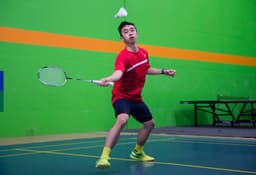
Ask a room of club players to name their biggest weakness and about half will say the backhand. Another quarter will say fitness. The rest split between the net and "consistency," which usually means they're not sure.
When I watch their footage, the backhand is the real answer maybe one time in five. The backhand is usually weak, to be fair. It's just rarely the thing losing them the most points. It's the weakness they can see.
That gap matters more than it sounds. Players spend months grinding the shot they picked, get slightly better at it, and lose to the same people in the same way. Effort was never the problem. They picked the wrong weakness, and they picked it the way almost everyone does.
Why the weakness you'd name is usually the wrong one 
You build your list of weaknesses from memory, and memory is a bad scorekeeper in a sport this fast.
What sticks is the embarrassing miss. The backhand clear that landed on the service line. The net kill into the tape at 19-all. Those moments come with a feeling attached, and the feeling is what you remember on the drive home. A short lift that got smashed two shots later doesn't come with any feeling at all, so it never makes the list.
There's a second filter on top of that. You can only notice what you can see, and from inside the rally you see the shuttle and your racket. You don't see your own feet. You don't see that you were still standing upright watching your net shot when the reply was already in the air. So your list fills up with strokes, because strokes are the only part of your game you get a clear look at while playing.
The third filter is other people. Every club has someone who tells everyone their backhand needs work, and every YouTube channel has a backhand video. If you've heard it enough times, you'll start to believe it about yourself whether the footage agrees or not.
I've had players send me a written list of their weaknesses alongside the footage. I read it after I watch, not before. It's still useful, mostly as a record of what they think, which helps when I explain what I actually found.
Loud weaknesses and quiet weaknesses 
The most useful split I know is between loud weaknesses and quiet ones.
A loud weakness produces a visible error. The shuttle goes into the net, out the side, off the frame. You know immediately, your opponent knows, the person waiting for the court knows. Loud weaknesses end up on your list because you can't miss them.
A quiet weakness produces a shot that lands in but hands your opponent the rally. A lift that reaches the back tramline in your head and the doubles service line in reality. A clear that's high enough but a metre short. A drive that rises six inches above the tape instead of staying flat. A recovery that's half a step slow. None of these feel like errors. The shuttle went over, the rally continued, and then two shots later your opponent hit a winner.
And that's where the accounting goes wrong. When the point ends on their smash, you file it under "they played well." You don't file it under "my lift was short," because the lift happened three seconds and two shots ago and it went in.
| Quiet weakness | What it feels like | Where the point actually ends |
|---|---|---|
| Lifts landing short of the back line | A normal defensive rally | Their smash, two shots later |
| Clears falling a metre short | Fine, it went over | Their attacking drop or smash |
| Slow first step after your own net shot | Nothing, you weren't moving | Your late, weak clear to the back |
| Drives rising above the tape | A fair exchange | Their kill from the mid-court |
| Racket down after you hit | Nothing at all | Your blocked return into the net |
In most club footage I review, quiet weaknesses cost more points than loud ones. Often a lot more. They also almost never appear on the player's own list, because the player has never once experienced them as a mistake.
A weakness only matters if they can make you play it 
Most players skip one question entirely. Can the person across the net actually make you hit this shot?
Some weaknesses are expensive but rare. Say your backhand net kill is shaky. How often does an opponent give you a loose shuttle above the tape on your backhand side at the net? Maybe once a game, and only if they make a mistake first. It's a real weakness. It's also one your opponent can't force on you.
Compare that to a backhand rear-court clear that doesn't reach the back. Any opponent with a decent clear or flick can send you to that corner whenever they want. If they notice, and better players notice within a few rallies, they'll send you there three or four times a game, on purpose, at the moments that matter.
So for every item on your list, ask: how many times per game could the people who beat me make me play this? A weakness they can force is worth five that they can't.
This also explains why a weakness can be harmless for years and then suddenly cost you everything. At your current level, opponents may not be accurate or observant enough to reach it. Move up a level, or enter a tournament, and the people across the net are exactly the ones who will find it. If you want to know which level you're actually at and what the next one punishes, the badminton skill levels breakdown maps that out.
In doubles there's a shortcut: watch where the other pair sends the shuttle when the score is tight. They're telling you what they think your weakness is. Sometimes they're wrong, and the post on being targeted in doubles covers how to tell the difference.
Follow the miss back to where it started 
Once you have a candidate, the next job is finding out whether it's a weakness at all or the last link in a chain that started somewhere else.
The method for this is in the match review guide: for every lost rally, ask what the cause was two shots earlier. I won't repeat it here. What I want to give you instead is the handful of chains that show up in footage over and over, because if you know what they look like you'll spot your own much faster.
The weak backhand clear. The clear lands short. Go back one shot: you hit it with the shuttle already behind you. Back one more: your first step towards the corner came late. Back one more: after your previous shot, a net shot, you stood up and watched it. The backhand was the last link in the chain. The cause was standing still for a moment after your own net shot.
The net shot that keeps hitting the tape. You're taking it below the height of the net, so you have to lift it up and over with no margin. You're taking it low because you arrived late. You arrived late because your split-step was early and you landed flat-footed while they were still hitting. That's a timing issue in the feet, not a touch issue in the hand.
The lifts that keep getting smashed. The lift is short. It's short because you're hitting it while still lunging forward, with no legs underneath you. You're still lunging because your base after the previous shot was a step too far forward, so every shuttle to the net arrives at full stretch.
The doubles drive that pops up. You're hitting the drive from below the tape, so it rises. You're low because your racket dropped to your waist after your last shot and the drive came back faster than you could bring it up. Fix the racket position between shots and the "bad drive" mostly disappears.
The pattern is the same in all four. The error shows up at the end of the chain, and the fix belongs at the start. Practise the backhand clear in the first chain for a month and you'll have a better backhand clear that you still hit late, from behind you, short.
How to decide which weakness to fix first 
By now you'll probably have three or four real candidates. You can't work on all of them, and the motor system is bad at rewriting more than one or two habits at once. So you rank them.
I use three questions.
How many points per game does it cost? Count, from footage, over one full game. Not "a lot," a number. Most players are surprised in both directions: the thing they dreaded costs two points, and something they never thought about costs seven.
Can stronger opponents force it? Use the test above. Multiply the cost by how easily it can be targeted. A weakness that costs three points now and can be forced every rally will cost eight against someone better.
How long will it take to fix? Racket position between shots can change in two or three weeks of deliberate attention. A rebuilt backhand grip and swing is a three-to-six month project, with a stretch in the middle where you're worse than you are now. Both are worth doing. They're not worth doing in the same order.
A typical result from the footage we get looks like this: the player came in wanting to fix their backhand. The backhand cost about three points a game. Short lifts from a too-far-forward base cost about seven, could be forced by anyone who could play a net shot, and took four weeks to fix. The backhand went second.
The rule I'd give you: among the weaknesses that cost the most points, fix the quickest one first. Early wins buy you the patience for the long rebuilds. The one that looks worst on video can wait its turn.
Hide it in matches, fix it in practice 
Finding a weakness doesn't mean you have to expose it every Thursday night. There are two separate jobs here, and mixing them up slows both.
In matches, it's fine to hide a weakness. If your backhand rear corner is short, take more shuttles in that corner round the head, and lift higher so you've got time to get there. Good players hide weaknesses constantly. Nobody gets points for honesty.
But hiding has a cost, and it compounds. Every time you run around your backhand you open up the forehand front corner, and eventually someone notices. Hiding also means you get no reps on the weak shot at full match pace, so the gap stays the same size. You're borrowing against next season.
So the fix belongs in practice: in drills, in conditioned games, in the warm-up hit, anywhere the score doesn't matter. Expect to get worse at it before you get better, especially if it's a technique change. That dip is normal, and the post on changing technique as an adult explains why it happens and how long it usually lasts.
The weakness you can't see from inside the rally 
Everything above works better with footage than without it. Count the points, trace the chains, rank the candidates. Most players who do this honestly will find at least one weakness they had never considered, and it will usually be a quiet one.
It still has a ceiling. You can only trace a chain back as far as you know where to look. If you've never been told that your base drifts forward after net shots, you'll watch the footage and see a short lift, and you'll write down "lifts." That's the symptom again, just better documented.
This is the part an outside eye does quickly. A coach who has seen the same chains in thousands of other players knows which link usually breaks first, and looks there. They can point at the half-second before the miss that you've watched six times without noticing.
If you've already spent a season working on the weakness you'd name, and the people who beat you are still beating you in the same way, there's a good chance you picked the loud one. The quiet one is still there, and it's probably costing you more.