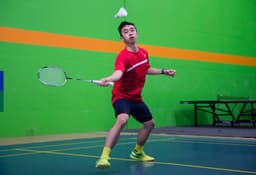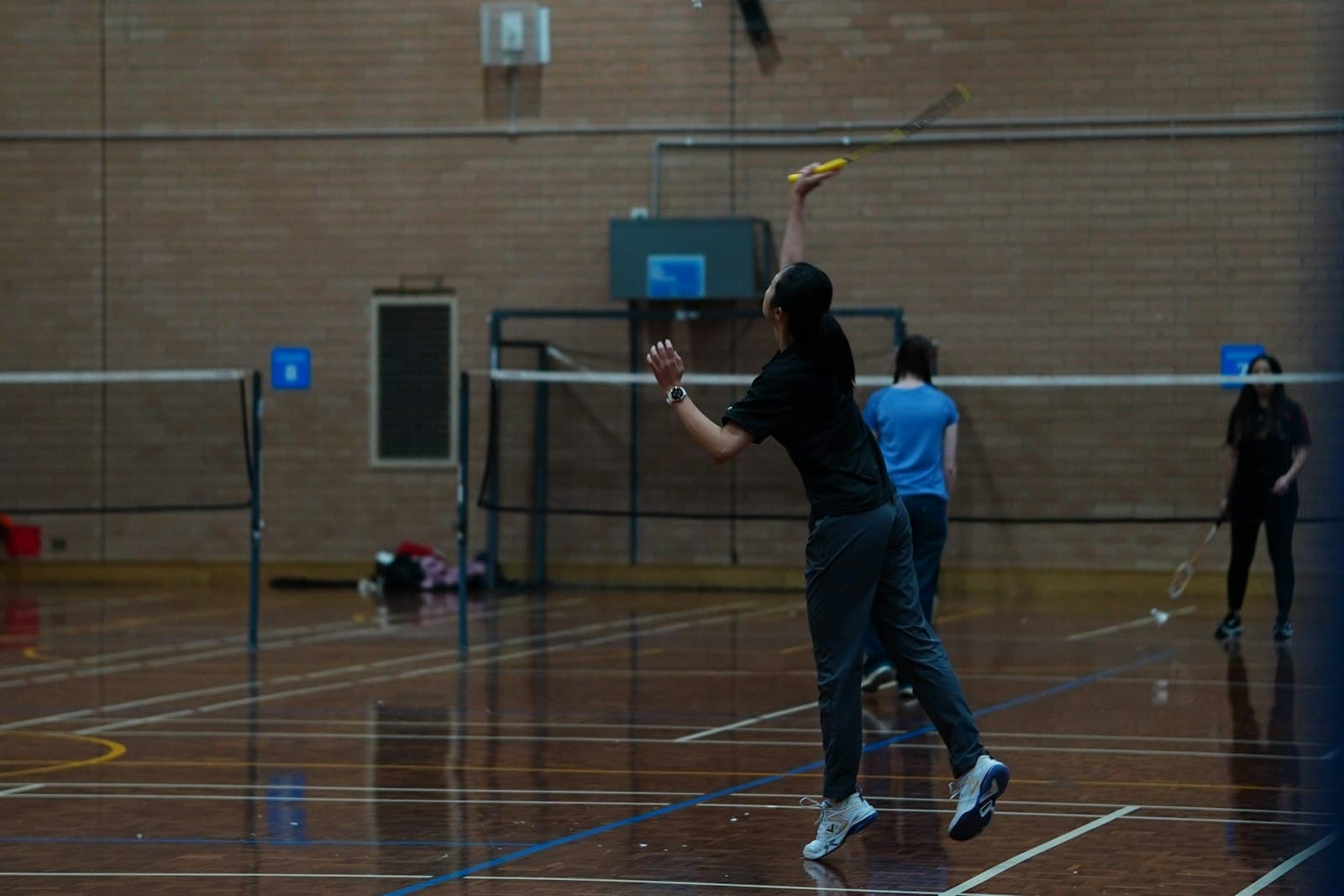
There's a moment I see in club footage all the time. The shuttle is coming to the player's forehand at the net, nothing difficult, and the racket goes up, stops, and then goes forward again. It's a pause of maybe a fifth of a second. The shot that comes out is soft, late and a foot higher than it should be.
Ask the player afterwards and they don't remember a pause. What they remember is "I was overthinking." They're right about that part. They're usually wrong about what overthinking is.
Overthinking is a timing problem 
Most advice on overthinking treats it as a volume problem: too much going on in your head, so quiet it down. Breathe, stay present, clear your mind.
I don't think that's what's going on. Good players think a lot during a match, probably more than club players do. They just do it at different moments, and mostly not in words.
In singles, the shuttle takes roughly a second to travel between the two players in a normal rally. In doubles, at club level, it's somewhere between a third and two-thirds of a second, and less in a drive exchange. Now say a short instruction to yourself in your head, something like "keep the elbow up." It takes about as long as the singles flight. In doubles it takes longer than the gap between shots.
So any thought that arrives as a sentence during a rally is, by definition, late. Your body either waits for the sentence to finish, which is the pause, or ignores it and does the old thing anyway. Either way the sentence was useless.
So here's the definition I work with: overthinking is putting a thought into words while the shuttle is in play. The fix is moving the thinking to somewhere it has time to happen. How much you think barely matters.
The three thoughts that get into a rally 
When I go through footage with a player who says they overthink, I ask them what was actually in their head on the rallies where it showed. The answers fall into three groups, and each one leaves a different mark on video.
Technique cues. "Elbow up." "Turn the shoulder." "Don't flick the wrist." These are usually from a recent lesson or a video, and they're the commonest kind in players who are working on their game, which is to say the players most likely to be reading this. On video, a technique thought looks like a careful swing. The stroke is slower than the player's normal one, the follow-through is shortened, and the shuttle is guided rather than hit. It often goes where it was meant to and lands short, because the player was steering.
Commentary. "That was lucky." "Don't miss this one." "I can't believe I'm losing to him." Commentary is a reaction to the rally so far, and it usually shows up straight after your own shot, good or bad. On video it looks like stillness. You hit a good drop and stand there for a beat admiring it, or a bad clear and stand there regretting it, and that beat is exactly when your recovery should have happened. The next shot is then late, and you'll remember that shot as the mistake.
Mid-rally planning. "If he lifts, I'll go straight." "Next one I'm dropping." This feels like smart play, and in a slow singles rally there's sometimes room for a single word of it. In doubles there isn't. On video it shows up two ways. Either you've decided early and play the planned shot when the shuttle no longer suits it, or you're still deciding at contact and the racket hitches at the top, which is the pause from the opening of this post.
What the three have in common is that none of them is about the shuttle currently in the air. Commentary is about a shot that's already gone and planning is about one that hasn't happened yet. Technique cues are about your own arm, which the rally doesn't care about.
When it isn't overthinking at all 
Before you treat this as a mental problem, rule out the two things that feel exactly like overthinking from the inside and aren't.
You're seeing the shuttle late. If you only pick up where the shuttle is going after it's left the opponent's racket, you have less time than you should, and every decision gets squeezed into the last moment. That last-moment decision feels like hesitation, and players describe it as overthinking. It's actually a reading problem. The tell is that the hesitation clusters on particular shots, often the opponent's net shot or their half-smash, and doesn't care about the score. The guide to reading your opponent covers what to watch before contact so the choice is already made by the time the shuttle crosses.
The stroke isn't automatic yet. If you've been changing a technique, the new version needs attention to work and the old version doesn't. So in a rally your body either runs the old stroke or slows down to run the new one, and the slowing down feels like thinking. This is normal and temporary, and the post on changing technique as an adult explains how long it lasts and where the old stroke comes back. Trying to "stop overthinking" during that stretch just means you'll play the old stroke more often.
A rough way to sort them. If the pause shows up on the same shot regardless of score, it's reading or technique. If it shows up on all kinds of shots but only at certain scores, or after certain events like a bad call or an easy miss, it's in your head.
Why "just play on instinct" is bad advice for most adults 
The usual cure people are given is to stop thinking and play on instinct. It sounds right. Pros don't look like they're thinking.
The problem is what instinct actually is. Instinct is whatever you've automated, and for most adult club players that's a mix of good habits and fifteen years of bad ones. Switching off thought doesn't give you some hidden natural game. It gives you your oldest habits at full speed. For some players that's an improvement over hesitating. For a lot of players it's the lift from the net that they've been trying to stop for two years.
Pros look thought-free because they did the thinking somewhere else. Nearly every situation in a rally has a reply they've drilled until it no longer needs a decision. They aren't choosing between six options at the net. They have one or two defaults, picked by what they see, and the choosing happened in training thousands of times.
So "play on instinct" is fine advice once the instincts are the ones you want. Until then, the more useful question is which decisions you can take out of the rally entirely.
Build the defaults in practice 
A default is a shot you play in a given situation without deciding to. You still choose sometimes, but only when something tells you to. Otherwise the default goes.
Some examples of the kind I mean, for a doubles player:
- Shuttle below the tape at the net in front of you: push it flat into the mid-court, not up.
- Opponent's smash at your body: block it straight, short.
- You're at the back and the shuttle is high and behind you: clear straight and recover.
You can argue with any of these, and against a particular opponent you might be right. They don't have to be the best shot every time. They have to be good enough and already decided, so nothing in your head has to run while the shuttle is in the air.
Pick two or three defaults for the situations where you hesitate most. Then drill them in conditioned games, where that situation comes up again and again and the default is the only allowed reply. It's boring. It's also the fastest way I know to empty a rally of decisions. After a few weeks the reply starts before you've noticed the situation, which is what people mean by instinct.
Decisions you do want to make, like targeting a weak backhand or changing the serve, belong between rallies, not during them. The between-points routine covers how to make one decision in that gap and carry it into the next rally without reopening it.
Where your attention should go while the shuttle is in play 
Telling yourself not to think doesn't work. It's a thought, and it's in words. What works is giving your attention somewhere better to go.
Gabriele Wulf and others in motor learning have been testing this since the late nineties, across golf, darts, volleyball and a lot else, and the result keeps coming back the same: people perform a skilled movement better when their attention is on something outside the body than on the body itself. "Hit the back tramline" beats "extend the arm." For badminton that points somewhere very simple.
While the opponent is hitting, watch their racket and body. While the shuttle is travelling, watch the shuttle. When you hit, look at a spot on the court rather than thinking about your arm. That's the whole system, and none of it needs words.
If your mind needs something to hold, give it a single external word instead of an instruction. "Shuttle." "Racket." "Line." It sounds almost too simple. That's because it's meant to crowd out the commentary and the technique cues, not to tell you anything new.
Count your hesitations 
You can't feel a fifth-of-a-second pause while you're playing. You can see it on video, if you know what you're looking for.
Film one full game. Then go through it once just looking for three things:
- Racket hitches. The racket stops or goes backwards just before contact.
- Frozen recoveries. You stay where you hit for a beat before moving, especially after a shot you'll remember.
- Wrong-shot commitments. You play a shot the shuttle clearly didn't suit, which usually means you'd decided it early.
Log each one with the score and the shot type. One game is usually enough to see a pattern. If they cluster on a type of shot, it's reading or technique. If they cluster at certain scores or after errors, it's commentary. If they cluster in fast doubles exchanges, you're planning mid-rally.
The guide to reviewing your own matches covers how to set up the camera and the rest of the review. For this test, the only thing that matters is watching at normal speed first and then at half speed, because the hitch is often invisible at full speed even on video.
The pause you can't feel 
The frustrating thing about overthinking is that the player is the last to know. From inside the rally, a hitch feels like nothing, a frozen recovery feels like watching your shot, and a planned shot feels like good tactics. You notice the result, the soft reply and the late next shot, and you call it a bad day.
Players often spend months trying to calm their minds when the actual fix was a reading problem, a stroke in the middle of a rebuild, or two missing defaults at the net. Each of those has a different cure, and a calmer mind doesn't help with any of them.
Someone watching from the side can usually tell which one it is within a few rallies. I'd love to say that's coaching genius. Mostly it's that they're not the one inside the rally having the thought.