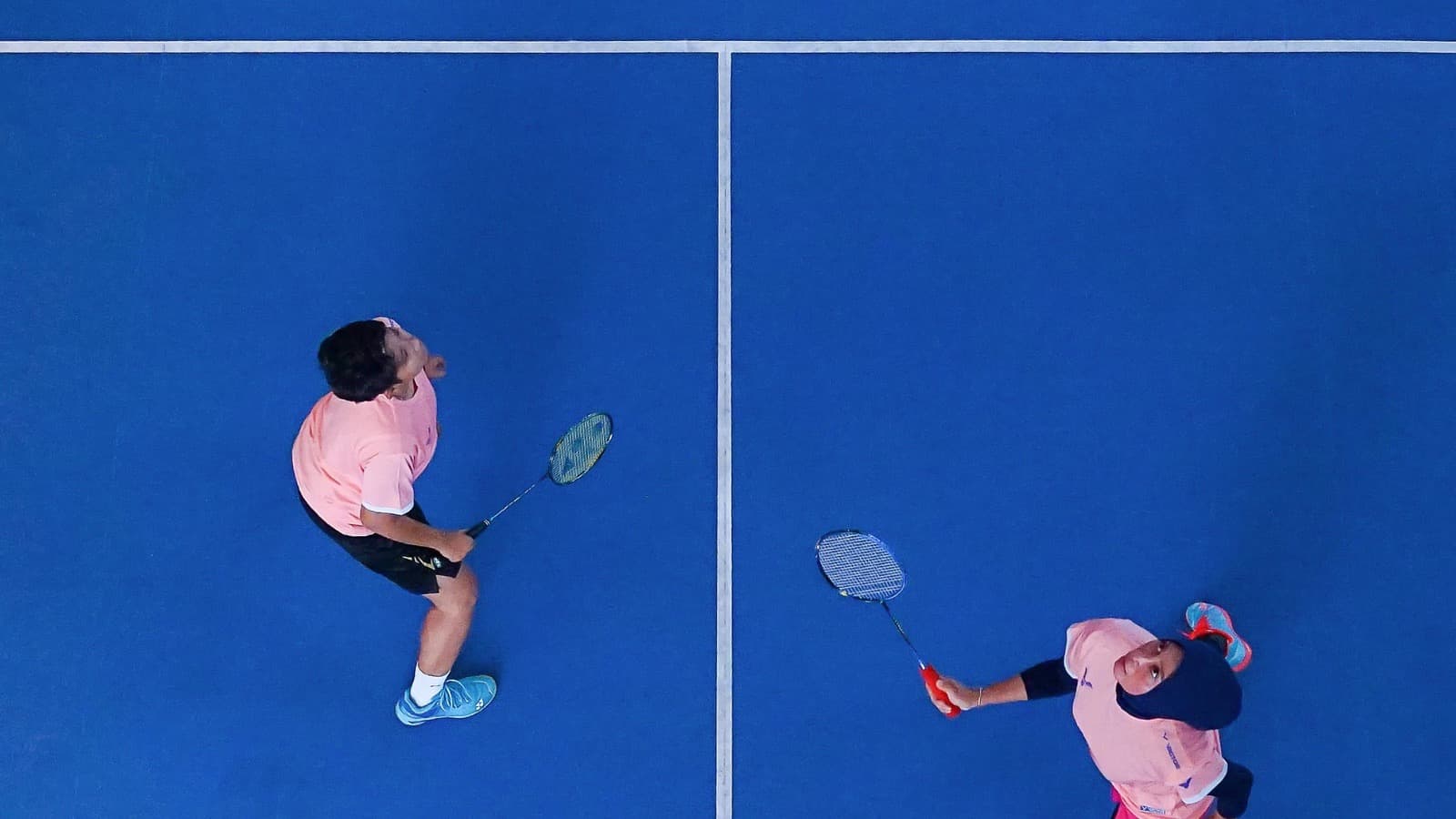
Your partner smashes from rear court. The defender pushes a flat drive between you. You both move toward the same shuttle. One of you gets to it. The other is now four feet out of position. The next shot goes into the gap you both just abandoned. You lose the point. Neither of you knows whose fault it was.
This is the doubles rotation collapse. It's the single most common pattern I see when reviewing club doubles. Most adult pairs have it. Most of them don't know what to fix because the error doesn't feel like one in the moment. You both went for the shuttle, which feels like effort, which feels like the right thing.
I'm Imran Wadia, former Canada Men's Singles #1 and Thomas Cup team member. I played a lot of singles, but I've spent more of my coaching career on doubles than on singles, because that's where most adult pairs leave points on the floor. Together with Justin Ma (7× US National Champion) and Kevin Barkman (former Canada MS #1), we've reviewed thousands of doubles clips inside Shuttle Lab. The pattern is consistent. The fix is consistent. Almost no club pair runs the fix.
This is the field guide to attack rotation in doubles: why your formation falls apart at the moment of attack, what "follow your shot" actually means and when it doesn't apply, when the front player should poach, how to read your opponent's lift before it leaves their racket, and what to do at the attack-to-defense transition that most pairs botch.
Why doubles attack dies when rotation breaks 
You can have the best smash in the club and still lose doubles to a pair with a worse smash. The smash is one shot in a sequence. The sequence is what wins points. In doubles, the rotation between rallies is the actual skill.
Here's what I mean. A rally has shape. Your team is either attacking or defending at any given moment. When you're attacking, one player is at the net (the front player) and one is at the back (the rear player), aligned vertically down the middle of the court. When you're defending, you're side-by-side, splitting the court left-right. The rally is a continuous sequence of attacking moments and defending moments, and the team that wins is usually the team that switches between formations faster.
Most adult pairs lose because they don't rotate at all. They pick a formation at the start of the rally and stay in it. If they're in attacking formation and they get a flat drive between them, both players move to the shuttle. The court behind one of them is now empty. The opponent's next shot goes there. Point lost.
Or the opposite. They're in defensive side-by-side and somebody finally hits a winning attacking shot, a sharp smash that forces a weak return. Neither of them moves up to front-and-back to put the follow-up away. The weak return floats over, lands, dies. Point unforced-error'd.
The smash isn't the problem. The rotation is. Most adults learn the shots first and the rotation never. This is the post that fixes that.
Rotation decides who keeps the attack once a rally is underway. Who gets the attack in the first place is settled earlier, in the serve and return exchange that opens every rally before the rotation ever starts.
Front-and-back vs side-by-side: which one wins points 
Two formations. Two purposes. Most adult pairs use them interchangeably or arbitrarily. They have specific roles.
Front-and-back (F&B), for attacking. Players line up on the same vertical line down the middle of the court. The front player covers everything inside the short service line. The rear player covers the back half. The geometry is depth-first. You're protecting against a counter-attack to the back and you're set up to intercept a weak return at the net.
Side-by-side (S-by-S), for defending. Players split the court left-right. Each covers half the width, top to bottom. The geometry is width-first. You're protecting against smashes to either side of the court.
Why one formation is wrong for the other context:
- F&B against a smash: the front player gets hit by it. They have no time to react and no width to dodge.
- S-by-S after winning the attacking moment: the weak return floats over the net, lands at mid-court, and dies because neither player is positioned to intercept.
Most adult pairs pick one formation by personality. The aggressive partner wants F&B. The cautious partner wants S-by-S. They pick a default at the start of the match and stick to it. This is why their results are inconsistent. The formation should be dictated by the rally state, not partner preference.
The shorthand I tell members: lift = side-by-side, smash = front-back. The shot direction tells you the formation. The team rotates when the shot rotates.
The "follow your shot" rule (and the exceptions) 
The classic doubles instruction is "follow your shot." Hit a smash, step forward to F&B. Hit a clear, step back to S-by-S. The shot you played dictates where your team goes next.
This rule is correct 80% of the time and dangerous when applied blindly.
When it works: deep clears, smashes, drops. These are committal shots. The shuttle is going where you sent it and you can predict the next shot from your opponent. Follow your shot. Set the formation that matches.
When it doesn't: flat drives, deceptive shots, mid-court pushes. These are uncommitted shots. The rally is still mid-exchange, and your opponent might return them flat back at you. If you follow a flat drive forward into F&B and they return it flat at your body, you have no time to react.
The cue I use: if your shot lands in their back half, follow it. If it lands in their front half or anywhere mid-court, hold position and read the next shot.
The thing most adults miss is that "hold position" is an active choice. They feel like they should be moving constantly. They feel exposed standing still. But standing still and reading is often the right play, especially in fast exchanges where moving prematurely puts you out of position for whatever comes next.
This is one of those areas where reading your opponent is the bigger skill underneath. The follow-your-shot rule is the default. The exception is reading.
When the front player should poach (and when to hold) 
The front player has the most active decision-making job in doubles. Every shot that passes overhead is a question: do I intercept this, or do I let it go to my partner?
The rule I tell front players.
Poach when: the shuttle is below net height as it passes you, OR the shuttle is on your half of the court (left or right of center), OR your partner is already committed to a different shot and can't get to it.
Hold when: the shuttle is above net height (your partner has a better angle from the back), OR the shuttle is on your partner's half and they're in position, OR you'd have to leave your front-court coverage to take the shot.
The single biggest poaching mistake adult front players make is poaching everything within reach. The shuttle lifts over your head, you spin around and try to smash it from net position. You miss or you mishit, because you're hitting from the wrong court position with no balance. Your partner had a clean angle from the back. You stole their rally and lost it.
The fix is a hard rule: if your back is to the net, you don't take that shot. Let your partner have it. They have a better swing from rear court than you have from a backwards net position. The poach has to be an advantage play, not a reflex play.
The other side of this is the back player needing to trust the front player to poach. If the front player is doing their job and intercepting low shots, the back player needs to expect that and not move toward the same shuttle. Doubles is a coordination game. Both players are running parallel decision trees and the trees have to match.
All of this assumes a partner you've actually trained the rules into. If you're getting handed a different partner every week at pickup or league night instead, the whole approach has to shift, because you don't have match time to install shared rules in advance.
Reading the lift: how to know the rotation is coming 
You don't wait for the lift to leave your opponent's racket. You see it coming and you've already moved.
Here's what to watch for in your opponent's body cues that they're about to lift.
Their racket position drops below the shuttle. A lift is always struck from below. If the opponent is reaching down, especially under the net cord, the next shot is almost certainly a lift. Start moving to S-by-S the moment you see their racket drop.
Their feet plant. A flat drive or push is struck on the move. A lift is struck from a relatively stable base because you need to generate height. If your opponent's feet stop moving and they set up to swing, the shot is probably a lift.
Their swing arc gets longer. A lift requires a full swing. The arm extends through, the racket finishes high. A drive or push has a much shorter swing. The first 200ms of their swing tells you what's coming.
The broader framework for body-cue reading is in the reading-your-opponent guide. In doubles, the lift read is the same pattern but with one extra layer: both you and your partner need to read it simultaneously. If only one of you reads it, you end up in mismatched formations. Both of you reading it together is what makes a doubles pair feel "telepathic" from the outside. It's not telepathy. It's both players seeing the same body cue and running the same decision.
Everything above is reading one opponent's shot. There's a separate, team-level read worth building alongside it, scouting the other pair's formation and rotation as a unit, which tells you where their whole system is weak rather than just what their next shot is.
The attack-to-defense transition most pairs botch 
Here's the rally moment where most club doubles points are lost. Your team has been attacking. Front-and-back. The opponent's reply is a deep lift over both of you. Now you're under attack instead of attacking.
The transition should be:
- Front player drops back into the rear half on their own side
- Rear player slides to the other rear half
- Both end up in S-by-S, splitting the court width
This takes about 1.5 seconds and has to happen during the flight of the lift. If the lift is steep and high, you have time. If it's flat and shallow, you don't have time and the opponent is already attacking before you've reformed.
Common failures:
Failure 1: the front player stays at the net. They got there once and they don't want to give it up. The opponent smashes from rear court. The front player is dead center in the smash line.
Failure 2: both players drop to rear-corners. Mid-court is now empty. The opponent plays a half-smash to mid-court that nobody can reach.
Failure 3: they rotate the wrong way. Front player drops back to the same side as the lift, rear player slides to the opposite side. Now you're both on the same half of the court and the opponent kills the open side.
The fix is to drill the transition specifically. You don't drill it in match play because you only see two or three transitions a game and you can't slow them down. You drill it standalone: a feeder lifts your defense, you and your partner rotate from F&B to S-by-S as a unit. Twenty reps, then switch sides. The muscle memory is what saves the rally when there's no time to think.
Rotating into defense cleanly is only half the skill. The other half is getting back out of it, and turning a rally where you're defending into one where you're attacking is the doubles defense game I break down separately.
Mixed doubles wrinkle: why the woman doesn't always stay front 
The default assumption in mixed doubles is that the woman plays front and the man plays back. The default is right most of the time. The default is also wrong some of the time, and pairs that play it rigidly leave easy points on the floor.
The actual rule isn't "woman front, man back." It's "stronger attacker plays back, more agile player plays front." In most adult mixed pairs these line up. The man is bigger, hits harder smashes, plays the rear. But not always.
The exceptions worth knowing.
She's the stronger attacker. If the woman in the pair has a better smash and more rear-court footwork than the man, switch the default. The man plays front. He's still poaching low shots, just from the position the woman would normally hold. The opponents will try to attack her at the net once they see this. If her front-court reflexes are decent, you'll trade well.
The shuttle is on the same side as the rear player's stronger hand. If the rear player is a right-hander, they hit harder from their right-rear corner. If the shuttle is on the left-rear corner, the rotation should bias toward the partner covering more of the rear-left. Mixed doubles is full of these compensations.
You're under attack and need to defend. Both players go side-by-side regardless of gender. Same as in regular doubles. The mixed wrinkle is in the attacking formation, not the defending one.
This is an area where adult mixed pairs over-rotate to "follow the rule." Pros bend it constantly. The rule is a default for new pairs. As you play together more, the formation should drift toward whichever player is in the best position at any given moment, not toward gender. The woman-front rule is a guideline, not a law. The mixed doubles positioning guide goes deep on the asymmetric role logic, serve-receive, and the specific rotations that make a mixed pair feel coordinated instead of contested.
Drills to wire rotation into muscle memory 
You cannot fix rotation in match play. The transitions happen too fast, and you don't notice them at all until you're three points behind. The fix has to happen in standalone drill work.
Three drills, in order. Each one isolates one piece of the rotation chain.
Drill 1, slow rotation walkthrough (5 minutes). No shuttles. You and your partner walk through F&B to S-by-S transitions on call. Caller says "smash" and you set up F&B. Caller says "lift" and you transition to S-by-S. The walkthrough is slow and verbal. The point is to get the spatial mental model clear before adding speed.
Drill 2, lift trigger drill (10 minutes). Partner feeder lifts unpredictably. You and your partner are in F&B attacking formation. The moment the lift comes, you rotate to S-by-S. Then defender feeder smashes, you defend, you rotate back to F&B on your own attacking shot. Continuous rotation drill, no points scored, focus on transition speed.
Drill 3, live doubles with verbal calls (15 minutes). Play a practice doubles match, but every rally one of you (alternate per rally) calls out "front" or "back" or "side" loudly between shots. You're forcing the team to acknowledge the current formation out loud. Sounds silly. It works. After ten sessions of this you'll start calling the formation in your head during real matches without saying it out loud.
This drill stack runs about thirty minutes and pairs well with the doubles footwork drills. Footwork is the movement layer. Rotation is the decision layer. Drill them in sequence, not separately. The movement without the decision is shadow footwork that doesn't win rallies. The decision without the movement is theory.
When rotation is invisible to you but obvious on tape 
What rotation looks like on tape is unmistakable once you know what to watch for. If you've been reviewing your own doubles film, pause at the moment your shot lands and count: are you and your partner in the right formation for what just happened? Half the time the answer is no, and the shot before would have been the moment to fix it.
This is where outside eyes matter the most. From inside the rally, both players are convinced they were in the right spot. The wrong-spot feeling doesn't fire in your body the way a missed shot does. You don't feel a missed rotation. You only notice it when the next shot goes into the gap you left. By then the point is already in flight.
From outside, the formation breakdown is visible in two seconds. A coach watching tape can pause the moment your team committed to the wrong formation and ask the question you couldn't ask yourself in the rally: what shot did your partner just play? What should the rotation have been? Where did it actually go?
Doubles rotation is one of those skills that's invisible to good singles players. You can have world-class footwork, a clean smash, a strong defense, and still lose to a worse pair that rotates better. The shots you can drill on a court alone. The rotation you cannot. It only exists with a partner, and only emerges when you and your partner are both running the same mental model. Get that mental model aligned, and the games start winning themselves.