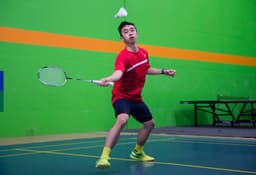
You're up 18-15 in the third game. Two points from winning a match you should win. You serve, win the next point. 19-15. Forty seconds later you're down 19-21 and you cannot remember what just happened. Your hand was sweating. You were thinking about the warm-up the next morning. You blocked four shots into the net in a row. You lost a match you were three points away from closing.
Most adult players I talk to have a version of this story. Many have several. They will tell you it's a pressure problem and they're right, but they will also tell you it's a "mental" problem they can't fix, and they're wrong. Pressure leaks are physical, predictable, and trainable. The reason most adults don't fix them is that the leaks are invisible from inside the point.
I'm a 7× US National Champion, peak BWF #126. I played the 2023 World Championships. Kevin Barkman (former Canada Men's Singles #1) and Imran Wadia (Thomas Cup team member) have spent decades on tour with me. We've all been at 18-all. We've all lost matches we should have won, and we've all spent thousands of hours figuring out the small physical things that made the difference.
This is the field guide to what's happening in your body at 18-all, why your A-game shrinks, the four-second routine pros run between points, and the seven-second rule for the rally after a bad one. Most of it is unglamorous. None of it is magic. All of it is fixable.
Why 18-all feels different from 5-all 
At 5-all your sympathetic nervous system is a quiet hum. By 18-all in the third game, it's running the show.
Specifically: your heart rate is 15-30 bpm higher than your aerobic baseline, even when you haven't moved in twenty seconds. Your peripheral vision narrows by ten to twenty degrees. Your fine motor control degrades. Your time-perception compresses, so the rally feels both faster and slower than it actually is. You're holding your breath without noticing. Your jaw is clenched. Your hand is colder than it was at the start of the third game.
None of this is a flaw. It's the same response that kept your great-great-grandparents alive. The same chemistry that helps a sprinter run a personal best can also make a badminton player tighten up so hard they can't release a backhand. Whether it helps or hurts depends on whether your skill expression has been trained against this exact physiological state.
Most adults haven't trained against it. They practice in the local club hall, win some, lose some, and the only time their body actually rehearses the 18-all chemistry is in the rare close match that goes to a third game. That's two or three reps a year. Then they wonder why their hand goes cold.
Every layer of this is observable, every layer is trainable, and every layer compounds with every match you play with the right framework.
The two pressure leaks every player has 
Almost every player I review has a dominant pressure leak that falls into one of two patterns. The first is the speed-up player. The second is the shut-down player. The fix is different for each.
The speed-up player. When the score gets tight, your tempo accelerates. You serve faster. You skip the legal time between points. You play your shots a quarter-second earlier in the rally than you would at 5-all. You feel like you're playing aggressively but actually you're playing rushed. The unforced errors that come from this are usually shanks, deep clears that go out, and net shots that pop too high. The cause is your nervous system trying to escape the moment by ending the rally faster.
The shut-down player. When the score gets tight, your tempo collapses. You play conservatively. You only hit safe shots, high clears, deep blocks, the same drop you've used a hundred times. You stop attacking at all. You feel like you're "controlling the rally" but actually you're handing it over. The unforced errors that come from this are usually short clears that get smashed and weak lifts that get killed. The cause is your nervous system trying to avoid the risk of making a mistake.
You are usually one or the other. Some players are both, depending on the score state, but the dominant pattern is the one to identify and fix first.
Quick diagnostic: think about the last three close matches you lost. Were you missing on the front edge of your shot, too early, too aggressive, shanking? Speed-up. Or were you missing on the back edge, too tentative, too soft, defensive? Shut-down.
Almost every fix in this post is downstream of correctly naming your pattern. If you're a speed-up player and you read this looking for advice on "controlling tempo to avoid mistakes" you'll skip past the section that's actually for you.
The pre-serve reset: a four-second routine 
The single most useful tool I can give an adult player is a four-second pre-serve routine that fires before every point in the third game. It's small. It's boring. It works.
The four seconds break down like this.
Second 1, exhale. Long, slow, deliberate. Out through the mouth. This single action drops your heart rate two to four bpm and resets the chemistry just enough to let you make a clean read on the next rally. Your nervous system is wired so that exhalation is the down-regulation signal. Most players hold their breath at 18-all without noticing.
Second 2, grip check. Loosen your hand on the racket. Squeeze, then release to a 3 out of 10 grip. Most players' grips at 18-all are at 7 or 8 out of 10. That's why your wrist isn't snapping on shots that were fine in the warm-up. You can't accelerate a racket if your forearm is locked.
Second 3, foot ground. Both feet flat. Weight evenly distributed. A small bounce, deliberately, to break the standing-still tension. Most players are heel-loaded under pressure, which compromises the first step.
Second 4, name the next shot. Out loud, in your head. "I'm serving short to the T, then I'm pushing flat to her backhand if she lifts." That single sentence does two things: it forces you to make a tactical commitment, and it occupies the part of your brain that would otherwise fill with the score.
Four seconds. Fits inside the legal time you already have between points. The hardest part is remembering to run it when your body is screaming. The fix for that is repetition: every practice rally, run the four seconds. Make it the air you breathe, not the parachute you pull at 18-all.
Shot selection under pressure: why your A-game shrinks 
Under pressure, your shot menu shrinks. This is universal and predictable.
What disappears first: the high-risk attacking shots. Your around-the-head smash. Your half-court drop. Your deceptive net shot. The shots that require a millisecond of confidence to execute, your nervous system protects against, because the cost of missing one feels bigger than the cost of just playing a safe clear.
What survives: your defensive shots and the one or two attacking shots you've trained to the point of not needing confidence. For most adults this means a forehand smash and a forehand clear. Everything else gets quietly shelved at 18-all.
This is fine if you know it's happening. It's catastrophic if you don't.
The mistake is to fight your shrunk menu by trying to play the full menu anyway. You'll miss. You'll lose the point worse than if you had just played the limited shots well.
The correct response is to play the shrunk menu well. Three shots, deeply trained, executed without hesitation, beats the full menu played hesitantly. If your trained closing pattern under pressure is "high serve, defend, neutralize with a clear, attack only off a short shuttle," you play that pattern and only that pattern. You don't try the deceptive drop you've been working on in practice. The deceptive drop hasn't earned its 18-all minutes yet.
There are four levers you can pull during a match: pace, length, target, and formation. Under pressure, the rule is: pull only the levers you've trained against pressure. The other levers you save for next year, when you've trained them.
Reading the score: push, neutralize, slow it down 
The score state changes the right tactical choice. Most adults play the same way at 5-all and 19-all, which is one of the larger reasons they lose close matches.
Here's the rule of thumb I run.
You're ahead by 3+ in the third (e.g., 18-15). This is a neutralize state. Your job is to win the rally without taking risks. Long lifts, central placement, deep blocks. You're forcing your opponent to take the risk of attacking from a defensive position. Most close-match losses come from the leading player attacking unnecessarily and giving the trailing player a chance to win the rally on a counter. If you're up three, your opponent has to win three rallies in a row to take the game. Make them win three in a row. Don't gift them one.
You're behind by 3+ in the third (e.g., 15-18). This is a push state. Take risks the safer player wouldn't. Half-smashes from rear court. Tighter net shots. Drives instead of clears. The score is already going against you, so a missed risky shot costs less than a successful one would gain. Most adults panic-play here and try to win the rally with one big shot. The right play is to introduce uncertainty into the rally and force your opponent into a decision they don't want to make.
You're tied within one point (e.g., 18-18). This is a slow it down state. Run your pre-serve routine. Take the legal break. Default to your most-trained shots. The pressure on both players is symmetric, and the player who plays a half-second more deliberately almost always takes the next point.
This is why pros at 19-all look weirdly calm and adult club players look frantic. The pros are running a different tactical model, not just experiencing pressure better. The score-state model gets even more specific in the last five points. The closing-out guide covers the shot-selection shifts, the 30-second between-point routine, and the four steps to debrief a match you blew.
After a bad point: the seven-second rule 
Every match has the rally that didn't go your way. You ate a smash, you shanked a clear, you missed a serve. The next ten seconds determine whether you lose one point or three.
Between the bad point and the next serve, you have seven seconds, sometimes eight, sometimes six, depending on how slow the previous rally ended. In those seven seconds, you do four things in this order.
Seconds 1-2, exhale and reset grip. Same as the pre-serve routine. Reset the body before resetting the head.
Seconds 3-4, name what just happened. "I lost that point because I lifted short." Specific, factual, no judgment. The point of naming is to take the bad rally out of your subconscious and put it in your conscious mind, where you can decide what to do with it. If you don't name it, it sits in the back of your head leaking emotional bandwidth into the next rally.
Seconds 5-6, pick the adjustment. "I'll lift deeper next time, even if it costs me on length." Specific commitment to a single change. Not a list of three things. One change.
Second 7, back to the pre-serve routine. Exhale, grip, ground, name the next shot. Identical to any other point. The bad point is closed.
The thing that turns one bad point into three is rumination. You replay it. You doubt your shot selection. You start playing scared on the next rally. The seven-second rule is a hard cut: you process the rally, you adjust, you serve. The point is closed. The next point is its own rally, and your job is to play it like the bad one didn't happen.
Pros who appear "mentally tough" almost always have a version of this routine. The toughness isn't a personality trait. It's a trained closure ritual.
That's the fix for one bad point inside one match. If the rumination is stretching across several straight losses instead of one rally, that's a different problem with a different fix, and rebuilding confidence after a losing streak is the guide for that version of it.
Practicing pressure: simulating 18-all in training 
You cannot expect your skills to hold up at 18-all if you only ever train them at 5-all. The motor system needs reps against the actual physiological state, and most adult practice doesn't provide any.
Three drills I tell Shuttle Lab members to add to their practice rotation. Each one creates artificial pressure inside an otherwise normal session.
Drill 1, score-state sparring. Start the practice match at 18-18. Play to 21. Run it five times in a session. You're forcing your body to repeatedly experience the 18-all chemistry without having to play three full games to get there. After ten or fifteen of these, the chemistry stops being novel.
Drill 2, penalty rallies. During practice rallies, designate a "penalty" outcome, losing this rally costs you ten push-ups, the next session's coffee, whatever has light teeth. The artificial stake creates a small pressure response. Not a full pressure response, but enough that you can practice running the four-second pre-serve routine while your hands are slightly cold.
Drill 3, tournament-condition warm-up. Before a tournament match, play one practice game at full intensity with whoever is available. Don't half-pace it. Get your heart rate to where it'll be in the match before the match starts. This pre-loads the chemistry so that 18-all isn't the first time your body experiences it that day. The pressure-handling work in this post is what happens inside the rally; taper and readiness are what happen around it.
If you want to know whether this is working, film one of your matches and watch your behavior at 18-all. If you can see your pre-serve routine running on tape, you've trained it. If you can't, the routine is still aspirational.
Why you can't fix this alone 
Pressure leaks are micro-behaviors that live in your body for fractions of a second. The grip retightening between points. The exhale you didn't take. The two-step instead of three-step recovery to base. The foot stutter at the T before your opponent serves. These show up on tape immediately. They are invisible to you.
I learned this hard. I spent two years on tour losing close matches and not understanding why. My coach would point at the moment in tape where my pre-serve grip retightened from a 3 to a 7 out of 10, and I'd realize my whole body had been clenched and I hadn't noticed. The next match I'd consciously check my grip and it would still tighten without me feeling it. Pressure leaks are below the threshold of conscious awareness. That's the whole problem.
The same thing applies to the patterns that show up in the rallies you don't lose to a single tight shot, the ones where you slowly leak the lead between 16-all and 19-all. There's a pattern-reading framework for catching those when you're watching an opponent. Catching them in your own play is the harder version, and you can't do it from inside the rally. You catch them by watching tape, or by having someone else catch them for you.
You will not catch your pressure leaks by trying harder. You'll catch them by having someone else watch.
The mental game in badminton is not a personality trait. It's a set of small physical behaviors that either are or aren't trained against the 18-all state. Most adults treat it like character. Pros treat it like footwork: a thing you can drill, observe, and improve. The first step is seeing what your body actually does when the score gets tight, which you cannot do from inside the rally. Once you see it, the work starts. Until you see it, you're guessing.