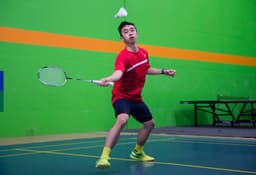
The first thing almost every adult I've coached does wrong when they watch their own match footage: they look at the wrong moments. They watch the point where they shanked the smash, feel bad for twenty seconds, skip ahead. That isn't review. It's reliving.
I've reviewed thousands of adult players' match footage over the last decade, most of it inside Shuttle Lab, the rest through coaching work before that. I'm a 7× US National Champion with a BWF peak of 126 and a lot of years watching top players watch their own tape. Self-review works, but only if you know what to look for and you have a process for finding it. Most club players do neither.
This is that process. The camera angle, the passes to do in order, the specific things a coach's eyes go to that yours don't, and the ceiling where self-review stops being enough.
Why your eyes lie to you when you watch your own match 
Your memory of the rally you just played is wrong in specific, predictable ways.
When you're on court, your brain is filtering hard. It's tracking the shuttle, your opponent's body, your racket, the score. It's throwing away everything else: your foot position, where your weight is, the exact angle of your hips. You don't have the bandwidth to encode all of it. After the rally, your brain fills in the gaps from expectation, not from what happened.
The most common mistake: you remember the last two seconds of the rally, not the first five. You remember how you lost the point. The weak backhand, the netted drop, the wide clear. You don't remember the setup that forced it.
On film, the real cause is almost always two or three shots earlier. A late split-step at rally start. A rushed recovery after a decent shot. A positioning habit that made the final error inevitable.
This is why "I know what I did wrong, I just can't fix it" feels true but usually isn't. You know what you did wrong at the end. You don't know what you did wrong in the middle of the rally, where the mistake was actually born.
How to film so the footage is actually useful 
Most adults film from a useless angle. Phone on the bench, low, off to the side. You can see the front court but the rear is compressed. You see your feet but not your opponent's. Footage like this tells you almost nothing.
Here's what works.
Angle: directly behind one player, on the doubles side-line extension, at about head height. High enough that you see the full court from above, not just the net band. A small tripod or a stack of racket bags works fine. Film one side consistently, so the player you want to review is facing away from the camera for one game and toward it for the next.
Distance: 15 to 20 feet behind the baseline if the hall allows it. Close enough to hear the shots (audio helps surprisingly much), far enough to see the full court in frame.
Length: one game is plenty. Ten to fifteen minutes of singles or 2 vs 1. Don't film entire sessions. You'll never watch them back. Shorter clips are the ones you actually review.
What to skip: warm-up, coaching rallies, drills. Film competitive games, not practice sessions. The stakes change your habits, and those are the habits worth seeing.
One more thing: film yourself losing. Losing footage is more useful than winning footage. When you win, your mistakes don't get punished, so the cause-and-effect chain is invisible. When you lose, every mistake turns into a point, and the chain is there in front of you on tape.
The three passes: outcome, pattern, technique 
The first time you watch your match back, you'll try to absorb everything at once. Don't. Do three separate passes. Your brain can only hold one question at a time.
Pass 1, outcome. Watch at 1x speed. Pause at the end of every rally and ask one question: why did this point end? Was it my error, forced or unforced, or was it my opponent's winner, earned or lucky? Write the answer down. Five words per rally, maximum. By the end of the game you'll have 30 to 40 notes that look like "netted forehand drive under pressure" or "opponent smashed through weak defense."
This is your data. Patterns will show up immediately.
Pass 2, pattern. Watch the full game again at 1x, but now only look for repeats. Where do I keep losing? Which shot keeps breaking down? Which opponent position keeps forcing my error? Most players I review have two or three dominant failure patterns that account for roughly 60% of their lost points. Finding those patterns is the whole value of doing the review in the first place.
Pass 3, technique. Drop the footage to 0.5x speed. Watch the rallies where your pattern failure showed up, and look at what your body was doing two or three seconds before the error. Your split-step timing. Your recovery path. Your hip rotation on the clear. This is where the actual learning is. You'll see your own body doing things you didn't know it did.
Do not combine the passes. You cannot look for outcome and technique at the same time. The brain will default to the dramatic moment, the shanked smash, and miss the quieter cause, the flat-footed split-step half a rally earlier.
What a coach looks for in the first 90 seconds that you probably miss 
When I open a member's clip, the first minute and a half I watch isn't about finding errors. It's about reading the player's patterns.
Things I'm actually watching for in that first 90 seconds:
Base position. Where does this player stand between shots and between rallies? Is their base near the middle, or do they drift toward their stronger side? Most club players drift toward the backhand corner unconsciously, which creates a two-foot forehand court exposure they don't know they're giving up.
Split-step frequency. Do they split every time their opponent is about to contact, or only sometimes? Adult players usually split on "important" shots like smashes and clears, and skip it on "easy" ones like drops and net shots. That skip is where late footwork is born.
Follow-through posture. Where is their body weight at the end of each shot? Leaning forward into the recovery, or planted on the back foot admiring the result? Almost nobody is in textbook recovery posture 80% of the time. The percentage matters.
Serve return stance. It tells you exactly how the player thinks about the rally that's about to start. A defensive stance means they're expecting to be under pressure. An attacking one means they're looking to capitalize. Mismatched stances for the level of serve they're receiving are a pattern worth flagging.
None of this is about highlight-reel errors. It's about the five hundred small decisions a player makes in 15 minutes that add up to the score at the end.
You can learn to watch for these on your own tape. It takes practice. The first few times you'll miss them. After ten matches of reviewing yourself with this lens, they'll start becoming visible.
The rally-loss audit: why did this point end? 
Here's the tool I want you to steal.
For every rally you lose, answer three questions in order:
- Whose fault was it? Mine, opponent's, or neutral?
- If mine, what was the direct cause? Shot execution, positioning, or decision-making?
- What was the upstream cause from two shots earlier?
Question 1 sorts your real errors from things that were actually your opponent's wins. This alone fixes the overconfidence trap most adults fall into. You think you're losing to opponent brilliance when you're often handing points away.
Question 2 separates bad shot execution from bad positioning. These get fixed differently. "I need more drills" and "I need better footwork" are different prescriptions, and most players confuse them.
Question 3 is where the review earns its keep. The upstream cause is the thing you cannot see live but can see on tape. The clear went wide because you arrived late. You arrived late because your split-step was skipped. You skipped the split because you thought the drop was easy.
Write the triples down. On paper or a notes app, not in your head. By the end of one match you should have 25 to 40 of them. Those triples, reviewed across three matches, will give you the two or three fix priorities worth working on for the next month. Not ten. Two or three.
Spotting your tells — the shots you telegraph without knowing 
This is the part of review where an outside eye has the biggest advantage, but you can get most of the way on your own if you look hard.
A tell is any body cue that gives away your shot before contact. Good opponents read tells in real time. Great opponents train for them. You give them off every rally whether you know it or not.
Common adult-player tells I see on footage:
The backhand elbow drop. Your hitting elbow drops six inches before a backhand clear but stays neutral before a backhand drop. Pros read this in the early backswing and start moving before you contact. If your backhand elbow isn't leading the racket head at all, that's not a tell, that's a technique gap worth fixing first.
The smash setup. You plant both feet and square your shoulders before a smash, but rotate into a clear. That setup takes an extra beat, and opponents who notice it will hunt the smash direction during your prep.
The net-front grip switch. You switch from forehand to backhand grip when the shuttle is still a foot over the net, which broadcasts your intent on a net kill. Grip transitions should happen earlier, during your push, not at contact.
To find your own tells on tape, pause one frame before your contact on shots that were read easily by your opponent. What's your body telling them? Usually something your coach brain didn't know it was broadcasting.
The mirror of this exercise is applying the same lens to your opponent. The reading your opponent guide covers the framework from the other side — the three layers of reading, the four sequences every club player runs, and the cues pros watch for in the half-second before contact.
Split-step timing is where many of these tells originate. If you haven't worked through the split-step in badminton guide yet, that's where the fixes usually start.
Translating what you saw into next week's practice 
A review that stays a review is worthless. The one that changes what you do in the next session is the whole point.
After you've run the three passes and built your rally-loss triples, you should come out with two or three specific fix priorities. Not ten.
A fix priority is a sentence shaped like this: when X happens, I will do Y instead of Z.
Examples from real Shuttle Lab reviews:
When my opponent attacks my backhand rear corner, I will use a scissor-kick chassé instead of running backward.
When I hit a rear-court clear, I will push off my back foot immediately instead of watching the shot land.
When receiving a low serve, I will split-step at contact instead of a half-second before.
Specific. Trigger-to-action. Immediately testable the next time you step on court.
If the footage shows you kept losing points the same way without adjusting, the cause is upstream of any individual fix priority. When nothing is working covers the reset for exactly that pattern, and the pressure handling guide covers what your body is doing that makes the adjustment harder to execute than it looks on tape.
Work on no more than two at a time for four to six weeks. The motor system can't rewrite ten habits at once. It can rewrite two, slowly, with deliberate repetition in real match play.
If your fix priorities end up being footwork-heavy, which they often do for intermediate players, the complete footwork guide is the order I'd drill them in.
Review your footage again after six weeks. If the two fixes are showing up consistently, pick the next two. If not, go smaller and more specific until they do. If it's been months and nothing is sticking, the cause is usually upstream of any single fix — the intermediate plateau diagnostic covers the four reasons club players stop improving and where to look next.
When self-review stops working and you need someone else watching 
You will hit a ceiling with self-review, and it's a real one. Most players hit it somewhere between their sixth and tenth match.
The ceiling feels like this: you watch your match, you can see that something went wrong, but you can't see why. You know the backhand was late. You don't know if it was the split-step timing, the grip transition, the rotation, or something subtler. The cause is invisible from your own point of view because the faulty pattern also feels normal to you. It's your pattern. Your body has been doing it for years.
This is where an outside eye stops being optional. Someone who has spent thousands of hours watching players move around a court sees things you cannot see from inside your own game. Not because they're smarter. Because they're reading the pattern without feeling it.
Inside Shuttle Lab, the review is done by me, Kevin Barkman, or Imran Wadia, depending on who picks up the clip. We'll tell you exactly what your split-step, recovery, and positioning are doing, with timestamped notes on the clip. The thing you've been unable to see for ten matches usually shows up on the first watch.
You can do a lot on your own. You should. Most of the fixes on the first few matches are ones you will find yourself if you film carefully and do the three passes. Don't skip that work.
But when the improvement curve flattens and you can't diagnose the cause, that's the moment to stop staring at your own tape alone. The players I've watched break through the intermediate plateau all did the same thing. They filmed themselves, they studied hard, and then they asked someone who'd been there to look at what they couldn't see.