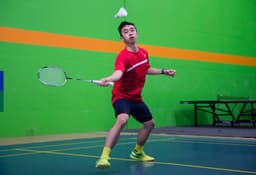
Badminton footwork is the thing that separates a decent club player from a player who actually wins matches. I've won seven US Junior National titles, played eight years as a pro, and coached adult players for another decade. Every single match I review, this shows up. Footwork is also the thing almost nobody practices, because it doesn't feel like "real" badminton. You go to the hall, you want to hit shots, you want to play games. Shadow footwork feels like homework.
Between me, Kevin Barkman (former Canada Men's Singles #1), and Imran Wadia (former Canada MS #1, Thomas Cup team member) inside Shuttle Lab, we've reviewed thousands of adult players' matches. Your technique is better than you think. Your footwork is worse than you think. That gap is where your games are being lost.
This is the guide I wish I had when I was 15. Not a listicle of "5 drills to improve footwork." A full map of how pros actually move, why the movements work, the handful of drills that genuinely move the needle, and how to practice the whole thing if you only get on court twice a week.
Why is footwork the real bottleneck for every adult badminton player? 
Most club players blame the wrong thing when they lose a rally. You think you missed the clear because your backhand is weak. You think you dumped the net shot because your racket face closed too early. Eight times out of ten, the real cause is upstream: you got to the shuttle late, out of balance, with your body weight in the wrong place.
Technique is what you do when you arrive on time. Footwork is the thing that gets you there on time.
Here's the test. Next time you play a game, pay attention to the rallies you lose, not the shots. Rewind the last two or three seconds in your head. Were you moving forward into the shot, or already leaning back to recover? Were you planted on both feet when you hit, or falling sideways? Were your hips square to the net, or twisted?
If you're like most club players I watch, the answer is: my footwork was late, and everything downstream of that was compromised. The backhand didn't fail. The split-step failed two seconds earlier, which forced the backhand in the first place.
How do pros move around the six corners of a badminton court? 
The singles court has six positions you need to cover: front-forehand, front-backhand, mid-forehand, mid-backhand, rear-forehand, rear-backhand. In doubles the zones shift but the logic is the same.
The way most club players cover these zones is by running to them directly, foot-over-foot, the way you'd run to catch a bus. That's not how we move.
Rear court (both sides): chassé or jump step. A chassé is a gliding sideways step where one foot leads and the other catches up, hips staying square to the net. That's what lets you cover ground without crossing your feet. You rotate your hips, push off the front foot, and travel backwards with your body already turned. When you arrive, you're behind the shuttle with your hitting shoulder loaded. From a forehand rear corner you finish on your back foot (right, for right-handers); a good smash usually involves a small scissor kick as you rotate through the shot.
Mid-court (both sides): one lunge or a half-chassé. These shots come fast, so the whole movement is often one step out from base, one step back. Economy matters more than distance.
Front court (both sides): the lunge. This is where you eat the most court per step. A full lunge with a long front leg, low hips, and an outstretched racket gets you to the net without losing your center of gravity forward.
The rest step in between: base. Centered, feet wider than shoulder-width, knees soft, weight on the balls of your feet. You're never actually still at base. You're always in a micro-bounce, waiting to push.
Read that paragraph about base again. Base isn't a pose. It's a loaded spring. Your hips should feel like they're about to leave the ground a quarter-inch at any moment. If you're standing flat-footed watching your opponent hit, you're already late.
Quick reference:
| Zone | Movement | Key cue |
|---|---|---|
| Rear court | Chassé or jump step | Rotate hips, travel backward already turned |
| Mid-court | One lunge or half-chassé | Economy over distance |
| Front court | Full lunge | Long front leg, low hips, outstretched racket |
| Base | Loaded micro-bounce | Never flat-footed |
How do you get split-step timing right in badminton? 
If you only fix one thing from this entire guide, fix your split-step. For the frame-by-frame breakdown, including the three most common timing mistakes and the solo drills to train it, see the split-step in badminton guide.
The split-step is a small jump you do the instant your opponent is about to make contact with the shuttle. Both feet come off the ground slightly, you land on the balls of your feet with a little wider stance than neutral, and in that half-second your body loads a spring you can immediately release in any direction.
This is the single most important movement in badminton. Recovery, anticipation, every first step toward the shuttle: it all cascades out of a good split-step.
Here's the mistake 90% of club players make: they split too early, or they don't split at all.
Too early means you've already landed before your opponent hits. You're flat-footed when the shuttle starts moving, which means you have to re-load before you can push, and you've added a quarter-second to your reaction. That's enough to turn a comfortable return into a scramble.
Not at all means you watch your opponent hit while standing on two flat feet, then try to push off cold. Cold pushes are slow, and you'll be a full beat behind.
The correct timing: split so your feet land on the ground at the exact moment your opponent's racket contacts the shuttle. If you time it right, your feet are loaded and your brain is already processing the shuttle's direction. You're ready to push at the instant the shuttle starts moving.
The correct depth: small. Don't jump high. Your feet barely leave the ground. The goal is to load, not to lift. A big dramatic split wastes energy and delays your push.
The correct stance on landing: feet a few inches wider than shoulder-width, knees soft, weight forward. Not planted. Ready to fire.
How do you recover to base after every shot without losing tempo? 
Getting to the shuttle is the glamorous half. Getting back to base is the half that decides who wins the long rallies.
Pros recover before they finish their shot. The recovery motion is built into the follow-through. You hit, the racket decelerates, and in the same breath your body is already pushing back toward base.
Most club players do the opposite. They hit, they watch their shot, they drift back toward the middle. By the time they realize their opponent has already answered, they're caught in transit and have to lunge for a shuttle that should have been easy.
The three core recovery patterns:
From rear court: chassé back, staying square to the court. Don't turn your back to the net. Don't jog. A proper chassé recovery gets you back to base in two or three steps with your eyes still on your opponent.
From front court: drive off the lunging leg. The lunge sends you forward; the push-off sends you back. Don't stand up first, then walk back. That's two movements. Make it one.
From mid-court: depends on which direction you came from, but the principle is the same: the step you took to arrive is the opposite of the step you take to leave. Equal and opposite.
The part nobody talks about: base isn't always the geographic middle of the court. If your opponent is attacking from your rear backhand corner, your "base" shifts a half-step toward that side because the highest-probability next shot is a steep one coming at you. Smart recovery doesn't mean returning to the same spot every time. It means returning to the most likely next position.
What are the best badminton shadow footwork routines? 
Shadow footwork is footwork practice without a shuttle. You move around the court as if you were playing, hitting imaginary shots, recovering, splitting, pushing, lunging.
I know it feels stupid. Do it anyway. Ten minutes of focused shadow is worth an hour of sloppy game play when you're trying to build a motor pattern. If you want to see what a proper rep looks like, the walkthrough below is what the routine should feel like — use it as your reference.
Here's a progression. Pick the level that matches where you are.
Beginner routine (5 minutes, no warm-up needed) 
Mark the six corners on the court (tape or cones). Start at base. Push to front-forehand, lunge, recover. Back to base, split. Push to front-backhand, lunge, recover. Continue cycling through all six corners in order. Focus on the split-step between each push. Don't rush. Quality over speed.
Intermediate routine (10 minutes) 
Same six corners, but now your partner (or you, using an app) calls corners randomly. You split, read the call, push to the called corner, hit an imaginary shot, recover. The random element forces real reading, which is the whole point of footwork anyway.
Advanced routine (15 minutes, two sets of 6) 
Call pattern-based sequences: "rear backhand clear → front forehand drop → mid backhand drive → rear forehand smash → front backhand push." Five or six shots per sequence. Run two sets of six. By the end of each set your legs should be burning and your split-step should still be sharp.
The thing that changes between beginner and tournament-ready isn't the drill. It's how honest you are about each rep. Intermediate players phone in their recoveries to save energy. Advanced players treat every imaginary shuttle like the real one.
What footwork drills work if you only play badminton twice a week? 
Most Shuttle Lab members play two to three times a week. You have a job. You have a family. You can't do what a 17-year-old pro does.
Here's what actually works on that schedule: concentrated, short, high-intensity footwork sessions instead of long low-quality ones.
Three drills I'd recommend in rotation, any one of which you can fit into a 15-minute block at the start or end of a court session.
Drill 1: Six-corner sprints (6 minutes, interval format) 
Start at base. Sprint to a corner (no imaginary shot, just the movement), sprint back. 20 seconds on, 10 seconds rest. 6 rounds, cycle through all corners. This builds the cardiovascular base you need to still have footwork integrity in the third game.
Drill 2: Reactive start drills (5 minutes) 
Stand at base. Partner claps or shouts a direction ("front left"). You split, react, push to that direction. No actual shot. Just the push. 15 reps, rest, 15 reps again. This isolates the single most important piece (the push off the split) and lets you do 30 perfect reps in five minutes.
Drill 3: Wall forehand shuttle drops (4 minutes) 
You against a wall. Drop a shuttle, let it bounce once, hit it forehand into the wall, return to base. Repeat. Any shuttle you can't reach from base in one lunge, you let go. This forces clean footwork and good base positioning. If you're missing shuttles, your base is wrong, not your technique.
How does badminton footwork differ in singles vs doubles? 
The base movements are the same. What changes is the zone you're defending and the tempo you're defending it at.
Singles: you own the whole court. Your base is center, a half-step behind the short service line. Your footwork pattern is mostly long movements: rear corners, front corners, clearing out the full 44 feet of court length. You have slightly more time per shot (around 0.8-1.2 seconds between contacts in a rally). Split-step timing is less punishing because rallies are longer and rhythm-based.
Doubles: you own a half (defense) or a quadrant (attack). Your base shifts with the rotation. Your footwork is shorter, snappier, more lateral. Time between shots is brutal. 0.3-0.6 seconds at the club level, even less at the top. Miss a split-step in doubles and you're already two shots behind.
The specific differences worth internalizing:
- Doubles defense (side-by-side): your split-step is wider and lower. You're preparing to dig a flat drive or a smash, both of which require a loaded lateral push.
- Doubles attack (front-back): the front player barely moves backwards — they're cutting shots off, not running around. The back player covers depth. Both need sharp diagonal footwork, not big chassés.
- Mixed doubles: the man covers depth, the woman covers front. Positioning is weighted toward the man's backhand side to protect against smashes.
- Singles: you need one more thing neither doubles format does: pace control through footwork. Slowing a rally down is done with footwork as much as shots. Arrive at the shuttle earlier and you can hit high, soft, and centered, which resets the exchange. The signal to slow a rally down is usually plain: you've arrived late twice in a row, or you've lost three straight points from the same corner.
This is why pure singles players often look awkward in doubles and vice versa. It's not technique. It's that their footwork is trained for a different tempo and zone. For the front-player and rear-player patterns, defensive side-by-side positioning, and how to drill doubles footwork with one partner, see the badminton footwork for doubles guide.
How do you diagnose your own badminton footwork? 
Here's the hard part. Footwork is the one area where self-diagnosis almost always fails.
You can feel your grip. You can feel your racket face. You cannot feel whether your split-step timed correctly, because it's happening too fast and in too many variables at once. By the time you're conscious of the movement, the rally is over.
A few things you can actually check on your own:
-
Film yourself. Phone on a tripod. Play a singles game with someone of similar level. Watch it back at 0.5x speed. Count your split-steps. Count how many were correctly timed (feet land when opponent contacts) vs early vs skipped. The first time you do this, you will be horrified. That's good. Horror is the start of progress. For the full review process — the camera angle, the three passes to do in order, and what a coach's eye actually looks for — see the match footage review guide.
-
Check your base position. Are you returning to the same spot every time, or drifting? Pause the video at the moment your opponent hits — are you in a balanced loaded stance, or planted?
-
Check your recovery. After you hit a rear-court clear, how many frames until you're back at base? Pros are back by the time the shuttle is descending. Club players are often still recovering when their opponent is hitting the reply.
These diagnostics will get you 30-40% of the way. The remaining 60% is the subtle stuff, the habits you can't see because they feel normal to you. That part needs an outside eye. If footwork drift is one piece of a longer stall, the intermediate plateau diagnostic maps the other three reasons a game stops moving.
What order should you practice badminton footwork in? 
If you're starting from scratch, don't try to fix everything at once. The order that works:
Weeks 1-2: split-step timing only. Every time you watch your opponent hit, split. Don't worry about anything else. Build the habit until it's automatic.
Weeks 3-4: recovery. Focus on returning to base after every single shot, in one clean movement. Don't chase technique yet. Just get back.
Weeks 5-8: pattern play. Start adding the six-corner shadow routines. Three times a week, ten minutes each. Build the motor patterns until they don't require thought.
Months 3+: reactive drills and tempo. Now you're ready for the harder stuff: reading, anticipating, controlling rally speed through footwork. If you play doubles, this is also when the front/back rotation patterns start clicking — the footwork foundation has to be there first.
The whole arc is about three months of deliberate work. Less if you're younger or already have a sport background. More if you're fighting ingrained habits from years of club play, and if your body isn't recovering the way it used to, the adjustments go beyond just this drilling schedule.
It's the single highest-leverage thing you can do for your game, and almost nobody does it. Most club players will watch this and keep drilling their backhand clear instead. That's fine. Their loss is your lane.
If you put in the three months, I guarantee you'll beat players you currently lose to. Not because you got better at hitting. Because you got to every shuttle earlier, with better balance, with more options. That's the game.