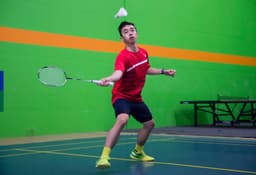
You're up 11-9 in the third game. You've been winning rallies the same way for an entire match: tight crosscourt drops on a defender who keeps drifting toward the backhand corner. Then the next four points, none of it works. He's reading the drop. Your shots are coming back at you faster than they should. You're suddenly down 11-13 and you don't know what changed.
This is the moment most matches are decided. Not by who has better strokes. By who can figure out what's going wrong while it's still happening.
I'm a 7× US National Champion, peak BWF #126. I've spent eight years on the international tour and another decade coaching adult players. The one thing pros do that almost no club player does: we adjust mid-match, in the gap between rallies, on a tight schedule and with imperfect information. The single most overlooked tactical skill in adult badminton is real-time adjustment, and it's the one that swings the matches you should have won.
This is the field guide. What to watch for in the first four points, the three signals that tell you it's time to change something, the four levers you can actually pull, and a reset playbook for when the wheels are coming off.
Why most players lose matches they should have won 
Watch any club tournament for an afternoon. You'll see the same scene a dozen times: a player who's clearly more skilled goes 8-3 up, the opponent makes one tactical adjustment, the scoreline runs the other way, and the better player loses 19-21 looking confused.
Almost none of them lose on technique. They lose because the opponent figured out what was working against them and flipped the matchup. The skill gap was real and irrelevant.
Adult badminton has a structural blind spot here. Practice is built around stroke quality and footwork. Almost nothing in club training prepares you for the mid-match cognitive task: reading what's happening in the last five rallies, identifying the cause, and changing the next rally on purpose. The skill is invisible. Pros have it because they've been forced to develop it across thousands of high-stakes matches. Most adults have never been put in a position where they had to.
The practical consequence is that you can be the better player on every metric and still lose because you couldn't see the match shifting. That's the gap this post is about closing.
The first four points: what to actually watch for 
You don't have to wait for the match to go sideways to start adjusting. The first four points usually tell you most of what you need to know about who you're playing.
Things I'm specifically watching during a new opponent's first four service exchanges:
Their preferred opening. Do they serve high and want a clear-attack rally? Short and want a flat exchange? Flick and want to surprise? Most club players have one default they fall into when they're not under pressure. Your first four points teach you what theirs is.
Their pace tolerance. When you push the rally faster (drives, half-smashes), do they cope or scramble? When you slow it down (clears, lifts, deep blocks), do they relax into rhythm or get bored and overhit? Pace is the single most underused lever in adult matches because most players have only one speed.
Where they recover. Watch their feet between rallies. Are they returning to the same spot every time, or drifting toward one corner? A two-foot drift toward the backhand side is essentially a free attacking lane on the forehand. They almost never feel themselves doing this.
What they protect. When the score is even, where do they place safe shots? Watch the deep clears. If every clear they hit is to your forehand corner, they're protecting their backhand. That's the corner you attack later when the match gets tight.
The whole reading-your-opponent framework goes deep on the layers of style, pattern, and tells. The four-point opening is the rapid-fire version of that work, the read you do in real time before the match settles into its own pattern.
Reading your opponent's patterns in real time 
After the first four to six rallies, your opponent's playing pattern starts repeating. The same shot sequences come back. Your work shifts from learning their game to predicting their next shot under pressure.
Specifically what I'm tracking by the middle of game one:
- Their pressure shot. When they're under attack and have to scramble, what's their default get-out shot? Most adults have one: a crosscourt clear, a straight lift, a desperate net shot. That shot is where they live when they're hurt, and it's where you can hunt them.
- Their winning sequences. What's the two-or-three-shot pattern they keep ending points with? A drop-net-net-kill? A clear-smash-block? Once you've seen the same sequence finish two rallies, you can break it on the third.
- Their tells. A grip change before a backhand drop. A shoulder drop before a clear. The small body cues that telegraph the next shot half a second early. Pros watch tells in real time. You can train this if you know what to look for.
You're not memorizing. You're noticing. The shift between an intermediate and an advanced player is mostly in the second category. They're seeing the same patterns but acting on them five rallies sooner.
Three signals it's time to change tactics 
Most adult players change tactics either too late (the match is already lost) or too randomly (they're throwing shots at the wall and hoping). The fix is to identify the trigger that demands a change before the score makes the change for you.
The three signals I tell every Shuttle Lab member to watch for.
Signal 1: You've lost two or three consecutive points the same way 
Not three random points. Three points where the same shot of yours got punished, or the same opponent attack scored. That's a pattern, and a pattern that scores twice will score four more times if you don't break it. The change is upstream of the next point you serve, not after the next point you lose.
Signal 2: Your opponent is contacting your shot before you've finished moving 
This is the real-time signal that you're being read. If their racket is already up before your shuttle has crossed the net, they're not reacting, they're predicting. Something about your shot prep is leaking your intention. Change the shot pattern, change the tempo, or change the placement, but do not throw the same shot a fourth time.
Signal 3: Your own habits are showing up uninvited 
The crosscourt smash you said you wouldn't try because it's risky, you tried it anyway and lost the point. The body smash you keep going for on your weakest defender even after she's adjusted. When your default reflexes are running the show, you've stopped making decisions and started reacting. That's the moment to slow the game down and reset, even if the score still looks fine.
A clean rule of thumb: if you couldn't tell me in one sentence what your tactical plan is for the next rally, you don't have one. That's a signal too.
The four tactical levers: pace, length, target, formation 
Adult players talk about adjusting tactics like it's a creative act. It isn't. There are roughly four levers you can pull. Most players don't pull any of them in a typical match.
Lever 1: Pace 
The simplest and most underused. If your opponent is comfortable in long rhythm rallies, you flatten the game. Drives instead of clears. Punch clears instead of high. Half-smashes instead of full ones. The opposite is true if they're trying to play fast and you can absorb their attack: lift everything high and centered, slow it down to a pace they can't sustain. Most matches have a tempo one player wants and one player doesn't. Find theirs and play the other one.
Lever 2: Length 
The depth of your shot is a separate lever from pace. Tight net shots vs deep clears. Half-court drops vs corner ones. If your drops have been landing two feet inside the service line, push them tighter, even if you net a couple. The opponent's pickup angle changes, and so does their next shot. Two feet of length is the difference between a winnable rally and a losing one.
Lever 3: Target 
Where you're hitting the shuttle, regardless of pace or length. Most adult players have a default placement (crosscourt forehand) and they hit it without thinking. Switch to body shots. Switch to the line they're not covering. Watch where they recover and put the shuttle in the gap. The gap moves as the match progresses. If you're not updating the target, you're feeding their patterns.
Lever 4: Formation (doubles only) 
If you're playing doubles and a pattern keeps breaking down, the formation is sometimes the answer. Side-by-side defense getting eaten by smashes? Move to a rotating defense. Front-back attack getting countered with flat drives? Push the front player back a half-step. The doubles footwork guide goes into the patterns. Mid-match it's enough to know that formation is a lever, not a fixed setting.
Most matches need a change of one or two of these, not all four, not none.
The reset playbook when nothing is working 
There's a worst-case scenario you need a plan for: you've changed two levers, the score's still going the wrong way, and you're starting to play tense. This is the moment most matches are decided, and it's the moment most adults have nothing in the playbook.
Here's what I tell members to run.
Step 1, slow everything down. Take the legal time you have between points. Use the towel. Let your heart rate drop. The faster you're moving between rallies, the more you're playing on autopilot, and autopilot is what got you here. For the body-level mechanics — the four-second pre-serve routine and what your nervous system is actually doing at 18-all — see the pressure handling guide.
Step 2, default to high and central. Lift everything high to the center of the back court for two rallies. You're not trying to win these rallies. You're buying time and forcing your opponent to play your shot, which gives you a clean canvas to read the next adjustment from. Pros do this constantly. Adults rarely do it because it feels passive.
Step 3, name the cause out loud (in your head). What specifically is going wrong? Not "I'm losing" — that's not actionable. "He's hitting straight smashes to my backhand and I'm dumping the block into the net." That's a sentence you can pick a response to. Adults play through fog because they never force themselves to name what they're seeing.
Step 4, pick one change and commit. Not three. One. The most likely high-leverage change based on what you just named. Run it for the next four rallies and watch what happens. If it works, ride it. If it doesn't, change again. If you cycle through three single-change resets and none of them work, the opponent is tactically better than you tonight. That's a different problem than panic, and it deserves a different post.
The reset isn't about winning the next point. It's about getting your decision-making back online so you can win the points after that.
Why mid-match adjustments are the hardest skill to self-coach 
Here's the honest part. Reading the match in real time is the single skill where self-coaching plateaus the fastest.
Stroke fixes you can drill alone. Footwork drills you can run in shadow. Even pattern reading you can train by reviewing match film, which I went into in detail in the match-review guide. But the live decision, what change to make right now in the thirty seconds between rallies, is the one your own eyes can't help you with, because you're inside the rally that's the source of the problem.
I learned this hard. Through my early international career I'd lose matches I should have won and not understand why. Watching tape afterwards I'd see exactly what I should have done. A coach would point out the moment in rally 14 of game two where I should have switched to slower, deeper clears, and I'd nod, and the next match I'd miss it again. Real-time decision-making isn't a thing you can think yourself into. It's a thing you have to be coached into seeing.
This is why match-reviewing your own footage gets diminishing returns somewhere around the intermediate plateau. You can see what went wrong with your strokes, your footwork, your positioning. The decision-tree of what you should have changed and when, that's the layer that needs an outside voice in your ear.
How to debrief after the match so next time is easier 
The goal isn't to fix every match in real time. That's a pro standard, and it takes years. The realistic adult-player goal is to get one degree better at it every match, and the way to do that is the post-match debrief.
I tell members to do this within twenty-four hours of any meaningful match.
Question 1, what was the score moment that decided the match? Not the final point. The point or rally where the momentum actually shifted. That's the rally to study.
Question 2, what did your opponent change at that moment? And did you see them change it in real time, or only realize it now? If you only see it now, that's a tell you missed. Note it for next time.
Question 3, what should you have changed two rallies earlier? Be specific. Not "I should have played better." More like: "I should have switched to slower, deeper clears to flatten the rally, instead of trying to hit through her by going faster."
Question 4, what's the one tactical lever you didn't pull but could have? This is the question that changes future matches more than any other. You probably had the lever sitting right there. You didn't pull it because you didn't see the trigger. Now you've named it.
Three or four of these debriefs and you'll start seeing the same triggers live, mid-rally, in a real match. The thing that used to take you twenty-four hours of hindsight to identify, you'll now feel coming a rally before it does. That's the actual definition of getting better at this.
The matches you'll remember from this season aren't the easy wins. They're the ones where the score should have gone against you and you found the change in time. That isn't luck. It's the trained skill of reading the match while the rally is still happening, and it's a skill you can build, slowly, every time you play.