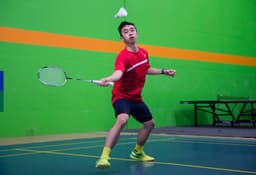
Ask a club player what's wrong with their backhand and you'll get the same answer almost every time: "I just need more reps." I've reviewed thousands of adult backhands on video, and reps are rarely the problem. Most club players have hit ten thousand backhand clears in their life. What they haven't done is hit ten thousand backhand clears with the grip, the setup, and the swing sequence in the right order. Reps on a broken pattern just make the broken pattern more automatic.
I'm Justin Ma, 7× US National Champion, BWF peak of 126. The backhand is the shot I get asked about more than any other, because it's the one shot where the gap between "technically correct" and "close enough" is the most visible. A slightly-off forehand clear still mostly works. A slightly-off backhand clear falls short, sails wide, or turns into a lift your opponent smashes. There's very little margin for error, which is exactly why it feels weak. It isn't weak. It's unforgiving of the three specific mistakes almost everyone makes.
This is the technical breakdown I give Shuttle Lab members who ask about their backhand. The real cause of a weak-feeling backhand, the grip most players get wrong, the setup that has to happen before you swing, the backhand clear and the backhand drive broken down separately because they're different shots wearing the same name, how to find your own faults on video, the drills that actually build the pattern, and when to use the backhand at all versus running around it.
Why your backhand feels weak, and it isn't your arm 
Here's the diagnosis I give almost every adult who asks about a weak backhand. It's not your arm strength. I've coached players with skinny forearms who hit a heavier backhand than players twice their size, because the backhand doesn't run on muscle the way a forehand smash does. It runs on sequence: grip, then body rotation, then elbow lead, then wrist release, in that order, each one loading into the next.
Break the sequence anywhere and the whole shot loses power, not just the part you broke. This is the part that confuses people. You think your wrist is weak because the shuttle dies at the net instead of clearing to the back. Your wrist is probably fine. The power that should have reached your wrist got lost two steps earlier, usually at the grip or the rotation, and by the time the shuttle leaves your strings there was nothing left to release.
The forehand hides bad sequencing because you have your whole body behind it naturally, shoulder open to the target, big muscles doing most of the work even with sloppy technique. The backhand has no such cushion. Your body is turned away from where you're hitting, you're working from a compact, awkward position, and there is no muscle group big enough to bail out a broken sequence. That's the real reason it feels weak. It's not that the backhand demands more strength. It's that it has zero tolerance for a mistake the forehand quietly absorbs and hides, right up until it doesn't.
The grip: the foundation almost everyone gets wrong 
Before anything else, the grip. If your grip is off, nothing downstream matters, because the racket face is starting from the wrong angle before you've even begun the swing.
Most club players hit backhand shots using a forehand grip that they've simply rotated their wrist to compensate for. It sort of works at slow speed and falls apart the moment you need real pace or a tight angle, because you're fighting your own grip through the whole swing instead of letting it set the racket face up for you.
The correct grip is the bevel grip, sometimes called the thumb grip. From a neutral forehand grip, rotate the racket in your hand until your thumb sits flat against the back bevel of the handle, the wide, flat panel rather than one of the edges. Your thumb becomes the primary driver of the shot. This is the single biggest technical difference between a backhand that feels weak and one that doesn't: the thumb, not the wrist, supplies the final push through contact.
Body position and elbow lead: what has to happen before you swing 
The swing doesn't start at the racket. It starts with your feet and your elbow, and if either of those is wrong, the technically perfect racket motion still produces a weak shot.
Turn your back to the net. This feels wrong to most club players, because every instinct in badminton says face where you're hitting. On the backhand, you don't. Pivot so your back shoulder points at the net and your hitting side is fully turned away. This is what lets your body uncoil into the shot instead of arm-only pushing it.
Lead with the elbow, not the racket head. As the shuttle approaches, your elbow should rise first, tucked in close to your body, with the racket head trailing down and behind it. Most weak backhands start with the racket head leading, which flattens the swing path and turns what should be a whip into a push. Elbow up, racket down and behind, in that order, is the single cue that fixes more backhands than any drill.
Let your body rotation start the shot before your arm does. The uncoil from your turned-away shoulder is what generates the first third of your power, before your arm even fully extends. Players who skip this and go straight to an arm swing are working with a fraction of the power that's actually available to them.
The backhand clear: full swing mechanics for height and depth 
The clear is the shot most players mean when they say their backhand is weak, because it's the one that's supposed to travel the length of the court and instead dies at mid-court.
Set up with the bevel grip, elbow led, back to the net, weight loaded on your rear foot. As the shuttle arrives, extend your arm outward and slightly upward, uncoiling your rotated body through the shot, and the sequence should feel like a whip cracking, not a push. Your elbow extends first, then your forearm rotates through, and your wrist releases last, at the very end of the chain, adding the final snap that sends the shuttle deep and high.
The most common fault I see on tape: players extend their arm and wrist together, at the same time, instead of in sequence. That collapses three separate sources of power into one weak push. The fix is almost entirely about timing, not strength. Slow the motion down in practice until you can feel the elbow extend a beat before the wrist releases. Speed comes back once the sequence is correct. It never comes back while the sequence is wrong.
The backhand drive: a different shot wearing the same grip 
The backhand drive gets taught like a smaller version of the clear, and that's why so many players hit a weak one. It isn't a smaller clear. It's a compact, fast shot with a completely different swing shape, and trying to generate it with a clear's long, loose motion is why it comes out slow and floaty instead of flat and fast.
The drive uses the same bevel grip and the same elbow-lead principle, but the swing is short. Instead of a full extension, you're meeting the shuttle out in front of your body with a compact punch, wrist and forearm doing most of the work rather than a big body uncoil. Think about a whip crack from the wrist alone, not the full-body unwind of a clear. The backswing is small, almost nothing, because a big backswing on a drive telegraphs the shot and slows down a rally that's supposed to be fast.
The fault I see most on the drive: players use the clear's full swing on a shuttle that doesn't need it, and the shot arrives late and loose instead of flat and quick. If you find yourself winding up for a backhand drive the way you would for a clear, you've mixed up the two shots, and the giveaway on tape is always the same: too much backswing for how little time the shot actually has.
Common backhand faults, and how to spot them on your own video 
You can diagnose most of this yourself if you know exactly what to look for on film, the same way the match footage review guide walks through for footwork and tactics generally.
Film from directly behind you or from a 45-degree side angle, close enough to see your grip hand and your elbow clearly. Slow the footage to half speed and watch your backhand shots in isolation, ignoring everything else in the rally.
Fault 1: racket-head-first swing. If the head of your racket is visibly ahead of your elbow as you start the swing, that's the flattened whip I described above. Pause the frame right as your swing begins and check which one is leading.
Fault 2: simultaneous arm-and-wrist extension. Watch for whether your forearm and wrist snap at the same instant instead of in sequence. This is hard to see at full speed and obvious at 0.5x. If your wrist looks locked through the whole swing instead of releasing at the end, this is your fault.
Fault 3: facing the net instead of turning away. Check your shoulder line the moment before contact. If your chest is still square to the net rather than turned, you're arm-only hitting the shot and losing the body rotation that should be doing a third of the work.
Drills that actually build the pattern 
Shadow reps with the wrong sequence just cement the wrong sequence faster. These drills isolate the specific pieces that are usually broken.
Grip check, thirty reps (2 minutes). No shuttle. Hold your racket at your side, rotate into the bevel grip, check your thumbnail direction, reset, repeat. This sounds too simple to matter. It matters, because the grip has to become unconscious before anything built on top of it will hold up under pace. Expect your backhand to get worse for a few weeks while that happens. Changing a grip you've used for years always costs you something before it pays.
Elbow-lead shadow swings, twenty reps per side (5 minutes). Stand in your backhand-ready position and shadow the swing in slow motion, exaggerating the elbow-up, racket-head-trailing position before you extend. Freeze at the top of the elbow lead for a full second each rep. You're building the habit of pausing there even though a real rally won't give you the pause.
Wall clears, fifteen reps (5 minutes). Standing about ten feet from a wall, drop-feed yourself backhand shuttles and clear them into the wall, focusing entirely on sequence: elbow, then forearm, then wrist, last. Don't chase power. Chase order. Power that follows correct order is free. Power you force onto incorrect order is a ceiling you'll never break through.
Drive-versus-clear discrimination drill, ten reps each (8 minutes). Have a partner or feeder call "drive" or "clear" as they feed you backhand shuttles. React with the correct swing shape for each, full extension for the clear, compact punch for the drive. This is the drill that fixes the "using a clear swing on a drive" fault, because it forces you to choose the right shape under a small amount of pressure instead of only ever grooving one shape in isolation.
When to play the backhand versus running around it 
Not every shuttle to your backhand corner should be played as a backhand. Part of good technique is knowing when the technique doesn't need to be tested at all.
Round-the-head, a forehand shot played from over your head on the backhand side, is the right call when you have time to get there and you want to keep the offensive option alive, because your forehand smash and drop are almost always stronger weapons than your backhand equivalents. If the shuttle is deep and you have the recovery time, running around it and hitting forehand is often the higher-percentage tactical choice, not a technique failure.
The backhand is the right call when time is short, when a round-the-head would pull you badly out of position, or when the shuttle is tight enough to your body that a round-the-head swing has no room to operate. In fast doubles exchanges and in singles rallies where you're pressed, the compact backhand, especially the drive, is often simply faster to execute than the bigger movement a round-the-head requires. If you're regularly finding your deep backhand corner is the one that strands you, the four-corner singles guide covers why that corner is so often a player's structural weak point and how opponents learn to target it on purpose.
This is a judgment call that gets easier once the backhand itself stops being scary. Most club players run around everything they can, not because it's tactically correct, but because their backhand feels unreliable and they're avoiding it. Fix the technique and the decision becomes tactical again instead of defensive. You start choosing the backhand because it's the right shot, not avoiding it because you don't trust it.
The frustrating thing about a weak backhand is that you can feel exactly where it goes wrong and still be unable to name the cause, because the whole sequence happens in under half a second and your body has been doing its broken version of it for years. That's not a strength problem you can out-train. It's a pattern problem, and patterns are exactly the kind of thing that's obvious from outside your own swing and nearly invisible from inside it.