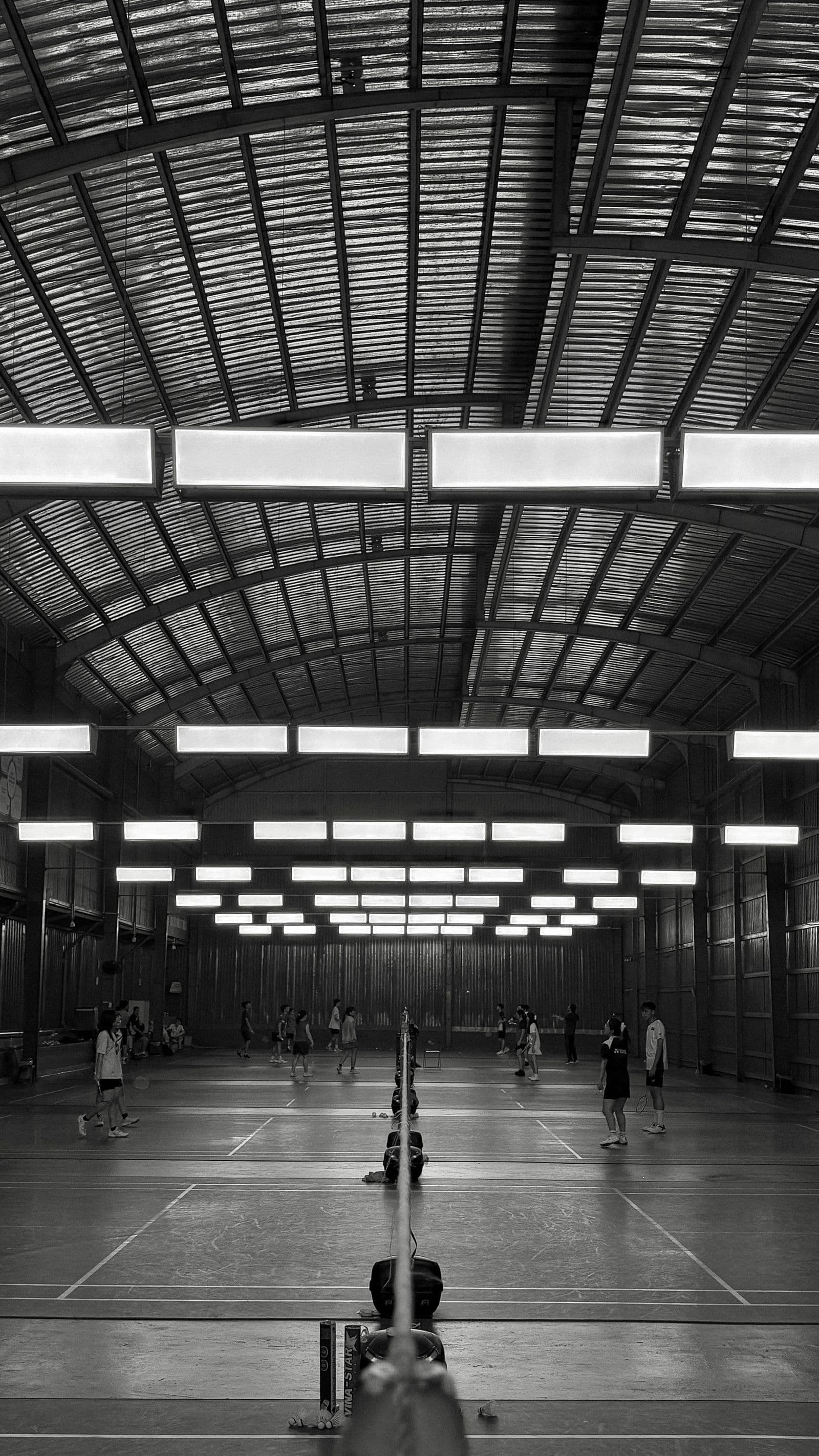
Neither pair is attacking. Neither pair is defending. The shuttle is going back and forth at chest height, flat and fast, drive, push, drive, push, four or five shots in a row, and then someone pops one up half an inch too high and the rally is over in the next two shots. Nobody planned that lift. It just happened, because somewhere in that flat exchange, one of the four players picked the wrong shot for the situation they were actually in.
This is the part of doubles that gets almost no coaching attention, because it doesn't look like a formation problem and it doesn't look like a technique problem. It's a decision problem, made three or four times a second, and most players are making that decision on habit instead of on what the shuttle is actually telling them.
I'm Imran Wadia, former Canada Men's Singles #1 and Thomas Cup team member. Doubles is where I've put most of my coaching hours, and the flat exchange is the phase of the rally I get the fewest good questions about, not because it doesn't matter, but because players don't know there's a decision to analyze. They think the flat rally is just reflexes. Together with Justin Ma (7× US National Champion) and Kevin Barkman (former Canada MS #1), we've reviewed thousands of doubles clips inside Shuttle Lab, and the flat exchange is where a shocking number of points quietly get given away, shot by shot, well before the smash anyone remembers.
This is the field guide to that decision. Why the flat exchange matters more than its reputation, what a drive, a push, and a block each actually do to the rally, the one factor that should be making the choice for you, reading the front player before you commit, when a drive is the wrong answer even though it feels aggressive, and how to drill the decision so it holds up at full speed.
Why the flat exchange decides more doubles points than it should 
Quick distinction before anything else, because it matters. This isn't about defending a smash. The doubles defense guide covers the block, drive, push, and lift as answers to a downward shot that's already attacking you, where the goal is turning defense back into attack. The flat exchange is a different rally state entirely. Nobody has hit down yet. The shuttle is traveling roughly parallel to the net, both sides are neutral, and the question isn't "how do I survive this attack," it's "how do I win this exchange before either side is forced to lift."
Club pairs treat the flat exchange as a formality, something to get through until somebody finally lifts and the real rally starts. That's backwards. The flat exchange is where the lift gets decided. Whoever plays it better forces the other side to hit up first, and whoever hits up first hands over the attack, so the flat exchange is quietly the most decisive phase of a huge number of doubles points, dressed up as a boring in-between.
The reason it doesn't get coached is that it happens too fast to talk about in real time. A flat exchange runs three to five shots in two or three seconds. Players default to whatever shot they always hit, drive if they're aggressive, push if they're cautious, and the choice stops being a read of the situation and becomes a personality trait. That's the gap this post is trying to close.
The three options: what a drive, push, and block actually do 
Same three shots as the defensive toolkit, but played in a different rally context, so what they're trying to accomplish is different too.
The drive. Flat, fast, hit hard and low over the net, usually at a body or through the gap between opponents. In the flat exchange, the drive's job is to take time away. You're betting that your opponent can't handle the pace and will either mishit, get jammed at the body, or pop the reply up. A drive doesn't need to be a winner to work. It just needs to be uncomfortable enough that the reply comes back weak.
The push. A softer, more controlled flat shot, usually aimed at a gap or at the feet of an incoming player rather than hit for pure pace. The push's job is precision over speed. You're using placement, not force, to make the next shot hard, sending it somewhere your opponent has to move for rather than just absorb.
The block. In the flat exchange, a block is a touch shot, a soft, controlled redirect that drops the shuttle just over the net rather than driving it back. Its job is to change the rhythm entirely. After three fast drives in a row, a block forces the opponent to come forward and adjust their timing completely, which is often where the exchange actually breaks.
The real decision factor: shuttle height at contact, not habit 
Here's the single most useful reframe I can give you. The shot you should play in a flat exchange isn't a preference. It's dictated by where you're contacting the shuttle relative to the net, full stop.
Above net height, with room: drive. If you're meeting the shuttle clearly above the tape and you have space to swing, you have time and angle advantage. Take it. A drive from this position is genuinely low-risk, because you're hitting down or level, not up.
Roughly at net height, tight: push or block. If the shuttle is arriving right at the tape, you don't have the angle for a hard drive without risking the net. This is where most club players make their first mistake, forcing a drive from a position that only supports a push or a block, and netting it or popping it up trying to generate the pace.
Below net height: you're out of drive and push territory entirely. Your only real flat-exchange options are a tight net shot or a lift, and if you're finding yourself here often, that's not a shot-selection problem anymore, that's a positioning problem, usually meaning you're taking the shuttle a fraction too late.
The players who look instinctively good in a flat exchange aren't reacting faster than everyone else. They've internalized this height rule so completely that the correct shot feels automatic, when what's actually happening is they're reading contact height and letting it choose the shot instead of overriding it with a preference.
Reading the front player's position before you choose 
Height decides what's mechanically available to you. The front player's position decides which of those options is actually smart.
If the opposing front player is crowding the net, aggressive and forward, a hard drive at their body is dangerous, because a well-positioned front player intercepts pace beautifully, and a drive at a ready front player often comes straight back at you faster than you sent it. Against a crowding front player, the push into the gap behind them, or a drive aimed at the back player instead, is the higher-percentage choice.
If the opposing front player is passive or standing deep off the net, that's exactly when the hard drive works, because there's nobody there to intercept it and the back player has to cover ground to reach it. A drive through a passive front player's territory is one of the highest-value shots in the exchange, and it's the shot most club players don't take because they're locked into whatever shot they were about to hit regardless of who's standing where.
This is a genuinely fast read, a glance that has to happen in the same beat as your height read, but it's learnable. The players who consistently win flat exchanges are tracking both pieces of information at once: where am I contacting this shuttle, and who's standing where to receive whatever I send back.
When a drive is the wrong answer, even though it feels aggressive 
The drive feels like the aggressive, winning choice, and club players default to it under pressure because passive shots feel like giving ground. That instinct is wrong often enough that it's worth naming directly.
A drive is the wrong answer when you're stretched or off-balance and forcing pace anyway, because a rushed drive with bad footing usually nets or floats, handing over exactly the lift you were trying to avoid. It's wrong when the front player is set and ready, for the interception reason above. And it's wrong when you've already driven twice in the same exchange and the pattern is obvious, because a third straight drive is the shot your opponent is now anticipating, not reacting to.
The players who reliably win flat exchanges aren't the ones with the hardest drive. They're the ones willing to play the boring push or the soft block at the exact moment their instinct is screaming to go harder. Discipline in this phase looks passive from the sideline and wins the rally anyway.
The block-and-push combo: taking the net back 
The single most underused pattern in club doubles flat exchanges is using a block specifically to reset the tempo, then following it with a push to finish what the block opened up.
Here's the sequence. You're in a fast drive exchange, and instead of matching pace with another drive, you play a soft block that dies just over the net. Your opponent, timed for a fast flat shot, now has to come forward and adjust to a completely different rhythm, and their reply is very often loose, either sitting up slightly or landing shallow in the midcourt. That's your push. Not a drive, a push, placed into the gap the block just opened, because the block already did the hard work of breaking their timing. The push just has to finish it.
This combo works because it attacks the one thing club players never account for in a flat exchange: rhythm. Everyone practices the shots. Almost nobody practices changing speed on purpose, and a deliberate change of pace in the middle of a fast exchange is disproportionately effective precisely because it's rare.
Drills to train this decision under real speed 
You cannot learn to read shuttle height and front-player position by thinking about it during a match. The exchange moves faster than conscious decision-making. These drills build the pattern so the read becomes automatic.
Height-call drive drill (8 minutes). Partner feeds you flat shuttles at random heights, some above net height, some right at the tape. Before you swing, call out loud which zone you're in, "above" or "tight," then play the shot that height dictates, drive for above, push or block for tight. The verbal call slows you down just enough to build the habit before speed removes the thinking time.
Front-player-read rally (10 minutes). Play live flat exchanges two-on-two, but the two front players alternate between standing aggressively forward and standing passively back, changing every few rallies without announcing it. The drivers have to notice the front player's position and adjust their target, drive at a passive front player's zone, push around an aggressive one. This trains the second read on top of the first.
Pace-change drill (8 minutes). Run a continuous flat drive rally between two pairs, and on a random call, one side has to switch to a block instead of continuing the drive. Both sides then have to adjust, the blocking side following with a push, the receiving side adjusting their timing to the sudden slow ball. This is the block-and-push combo in isolation, repeated until the rhythm shift stops feeling awkward.
What reviewing your own drive exchanges on video reveals 
The flat exchange is close to impossible to self-diagnose live, and that's not a knock on you, it's a function of the timescale. Three to five shots in two or three seconds doesn't leave room to notice your own pattern while you're inside it. You find out you always drive under pressure the same way you find out most habits: after the fact, and usually only if someone points it out.
On video it's obvious almost immediately. You can pause the exact frame where you contacted the shuttle and check the height against what you actually played. You can see the front player's position in the same frame you missed it in live. The match footage review guide covers the general process, filming angle, the pass structure, what to look for, and the flat exchange is one of the clearest places that process pays off, because the fix is almost always a single repeated habit hiding inside two seconds of rally you don't remember playing.
Once you can see your own default, the flat exchange stops being reflexes you can't control and starts being a decision you're making on purpose. That's the entire difference between a pair that survives the flat exchange and a pair that wins it before the smash ever happens.