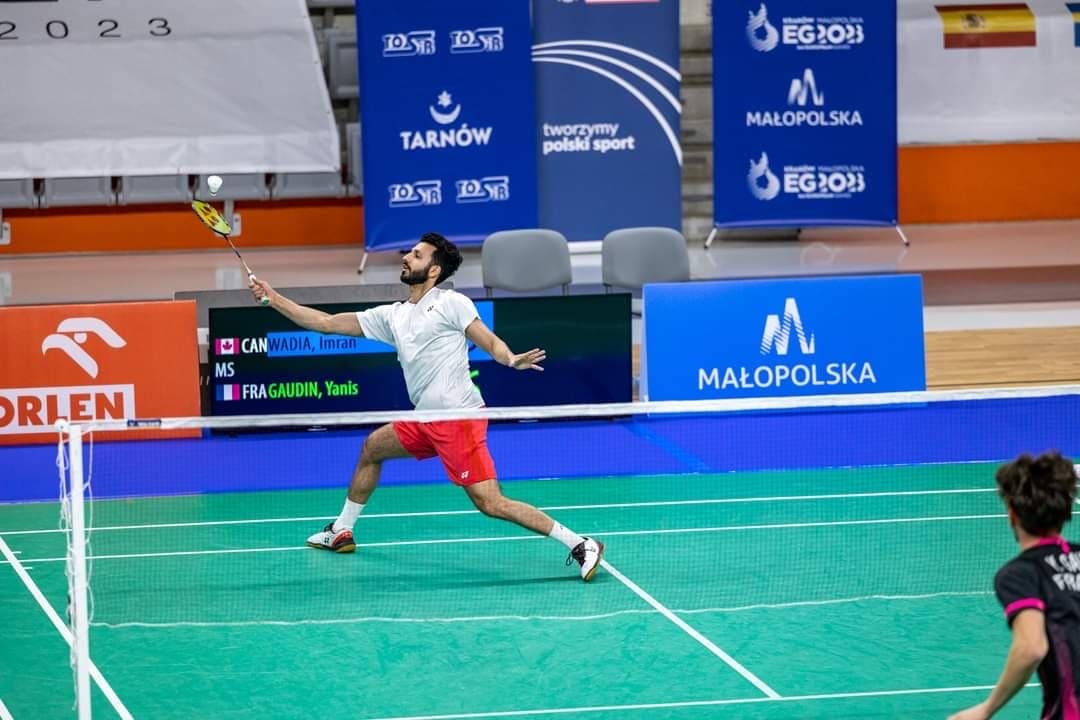
You get to the club, sign up for the next game, and the person running the sheet pairs you with someone you've never hit a shuttle with in your life. No warm-up rally together, no ten minutes of drilling to feel out their game, just straight into 21 points against two players you also don't know. This is most people's actual doubles experience. Almost everything written about doubles assumes a settled pair who trains together, and that assumption is exactly backwards for the way the format gets played at most clubs, most leagues, and most pickup nights.
I'm Imran Wadia, former Canada Men's Singles #1 and Thomas Cup team member. Doubles is where I've put most of my coaching hours, and one of the most common situations I get asked about isn't formation or rotation, it's some version of "I got paired with a stranger and we looked terrible together even though we're both decent players individually." That's not a skill gap. It's a different skill nobody's teaching, because the coaching content out there is written for pairs who already have twenty hours of court time together.
This is the guide to that specific situation. Why playing with a new partner is genuinely a different discipline than playing with a regular one, the fast read you need in the first few rallies, the safe defaults to lean on until you know more, the communication that works without any shared history, the collision points that sink unfamiliar pairs specifically, adjusting mid-match as you learn their game, why rigid systems make this worse instead of better, and what to actually drill on your own so you're ready for whoever you get paired with next.
Why this is a different skill, not a smaller version of regular doubles 
Established pairs solve doubles by pre-agreeing on almost everything. Who takes the middle, who covers what on a flick serve, what the default formation is when the rally gets scrappy, how aggressive the front player should be. None of that is available to you with a stranger. You're solving the same tactical problems, formation, rotation, coverage, with zero of the information a regular partnership takes for granted.
That changes what actually matters. A regular pair's advantage is a shared, drilled system executed fast. Your advantage with a new partner has to come from somewhere else entirely, reading fast, defaulting safely, and adjusting without needing a conversation to do it. Trying to force a regular-pair style system onto a stranger in your first game together is why so many individually good players look clumsy together. You're applying the wrong tool to the situation.
The players who are actually good at this, the ones who look competent with any partner, aren't running a system. They're running a fast, general-purpose read-and-adapt process that works regardless of who's standing next to them. That process is learnable, and it's what the rest of this guide is teaching.
The 90-second read: what to learn about a stranger before the first serve 
You have almost no information walking onto the court with someone new, but you have more than none, and the first few rallies are your best chance to gather it cheaply.
Watch their warm-up shots. Even a thirty-second knock-up tells you their basic level, whether their overhead is compact or a big obvious swing, whether they look comfortable at the net or awkward there. This is rough information, but rough information beats no information.
Watch which side they gravitate to. Most players have an instinctive lean toward forehand or backhand court, net or back, even before a formation gets discussed. If they're drifting toward the front without being told, that's useful data. Confirm it rather than assume it, but use the lean as your starting hypothesis.
Ask one question, not five. "You want front or back to start?" is enough. You don't need their whole playing history in the thirty seconds before a match starts. One clarifying question, then let the first few rallies do the rest of the talking.
The read doesn't stop at the first serve. It continues through the first three or four rallies, where you're watching for real information under real pressure instead of warm-up information under no pressure. A player who looked shaky in the knock-up and confident in the first rally, or the reverse, is telling you something the warm-up couldn't.
Safe default formations until you actually know their game 
Until you've gathered enough information to deviate, default to the formations that fail the least badly, not the ones that maximize upside. Optimizing for a stranger's exact strengths on point one is guessing. Defaulting to the safe shape is a plan.
Start front-and-back on your own serve, side-by-side on defense, the standard shapes covered in the doubles attack rotation guide. These aren't exotic. They're the default for a reason: they're legible to almost any partner regardless of their background, so you're not asking a stranger to execute something unfamiliar under pressure.
Take the more conservative role yourself until you know better. If you don't know whether your new partner is stronger at net or in the back, don't assume you should have the aggressive role by default. Offer them the choice, or take the position that costs less if you're wrong. A skilled player playing a slightly conservative role is a minor inefficiency. An unskilled player thrown into a role they can't handle is a lost game.
Assume nothing about their serve-receive habits. The standard opening exchange — low serve, receiver taking it early, a third shot that keeps you attacking — is the safest starting template with a stranger precisely because it's the most common baseline. Deviate from it once you've actually watched what they do, not before.
Communication that works without any shared history 
Established pairs communicate in shorthand built over dozens of matches. You don't have that shorthand, and trying to invent a complicated one in real time under match pressure just adds noise.
The fix is a small, universal vocabulary that works with almost anyone, because it requires zero prior agreement to understand.
"Mine" and "yours," said early and loud. The single most useful two-word system in doubles. Say it the instant you've decided, not after you've both already committed to the same shuttle. With a regular partner you can sometimes get away with silent assumption. With a stranger, assumption is how collisions happen.
"I've got the middle" as a default you state once, early. Rather than negotiating every middle shot live, tell your new partner in the first game which side you'll take on center shuttles, based on your dominant hand, and stick to it until something forces a change. One sentence removes an entire category of collision.
Feedback between points, not during them. The same principle that works for established pairs works even better for strangers, because you have no baseline trust to fall back on yet. A few seconds between points, "let's keep it flatter," "take more of the middle," builds the shared understanding a regular pair already has, compressed into real time instead of built over months.
The collision points that sink unfamiliar pairs specifically 
Some errors are universal to doubles. A few are specific to playing with someone you don't know, and they're worth naming because they don't show up the same way with a regular partner.
The middle shuttle, worse than usual. Every doubles pair fights over the middle sometimes. Strangers fight over it constantly, because neither of you has any information about who the other expects to take it. This is exactly why stating your middle default early matters more here than in any other doubles context.
Mismatched formation assumptions. You think you're in front-and-back. They think you're both covering side-by-side because that's what they're used to defaulting to with their regular partner. This isn't a skill failure on either side, it's an information failure, and it only gets fixed by confirming the formation out loud rather than assuming shared understanding that doesn't exist yet.
Over-covering for a partner you've misjudged. If your early read of their level was wrong, either direction, you'll either crowd their court trying to compensate for a weakness they don't actually have, or leave gaps assuming a strength that isn't there. This is a downstream cost of a bad or rushed 90-second read, which is exactly why that first information-gathering window matters as much as it does.
Recalibrating once you've actually learned their game 
By the third or fourth point, you have real information the pre-match read couldn't give you, and the players who keep improving through a match with a stranger are the ones who actually use it.
If your partner turns out to be sharper at the net than you assumed, shift toward giving them more of the front-court decisions rather than sticking rigidly to whatever you defaulted to at 0-0. If their overhead is weaker than the warm-up suggested, adjust your own coverage to protect it, the same defend-the-weaker-partner logic that applies in any format, just discovered in real time instead of known in advance.
The mistake I see most is treating your opening read as fixed instead of provisional. You gathered thirty seconds of information before the match and three or four points of real information into it. Both are worth less than the ten minutes of information you'll have by 11-8. Keep updating.
Why rigid systems backfire with someone you just met 
The instinct for a detail-oriented player is to try to build a fuller system fast, more calls, more pre-agreed rules, more structure, treating the first few points like an accelerated version of the training a regular pair would get over weeks. This usually makes things worse, not better.
A complicated system requires shared understanding to execute, and shared understanding is exactly what you don't have yet with a stranger. Every additional rule you try to install in the first five minutes is another thing that can be misunderstood under pressure, and a misunderstood rule costs more than no rule at all, because now you're both hesitating, waiting for the other to execute something that was never actually agreed on clearly.
The pairs who look surprisingly good together on short notice aren't running more structure. They're running less, a small number of safe defaults, clear in-the-moment calls, and a willingness to adjust, rather than a system that needed practice time they never got.
What to drill on your own so you're ready for anyone 
The specific formations and calls in this guide help, but the actual transferable skill is the read-and-adapt process itself, and that's something you can sharpen without a regular partner at all.
Watch doubles matches, even ones you're not playing in, and practice guessing a player's level and tendencies from their warm-up and first few points, the way you'd assess a new partner. Then check yourself against how they actually play out. This is the same muscle covered in the reading your opponent guide, just aimed at a partner instead of an adversary, and it improves the same way, with reps and honest correction.
Play with as many different partners as you reasonably can, on purpose, rather than always signing up next to the same one or two people. Every unfamiliar pairing is a rep at the actual skill this guide is about. Players who only ever play with the same partner never build the fast-read muscle, because they never have to.
The players who thrive in pickup and league settings aren't the ones with the best individual shots. They're the ones who can walk onto a court with a total stranger and look like a functioning pair within four points instead of forty. That's not chemistry you can drill into two people in advance. It's a skill each of you can build on your own, and it travels with you to every single partner you'll ever be paired with next.