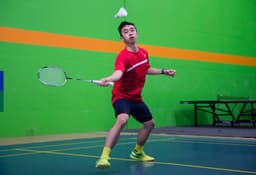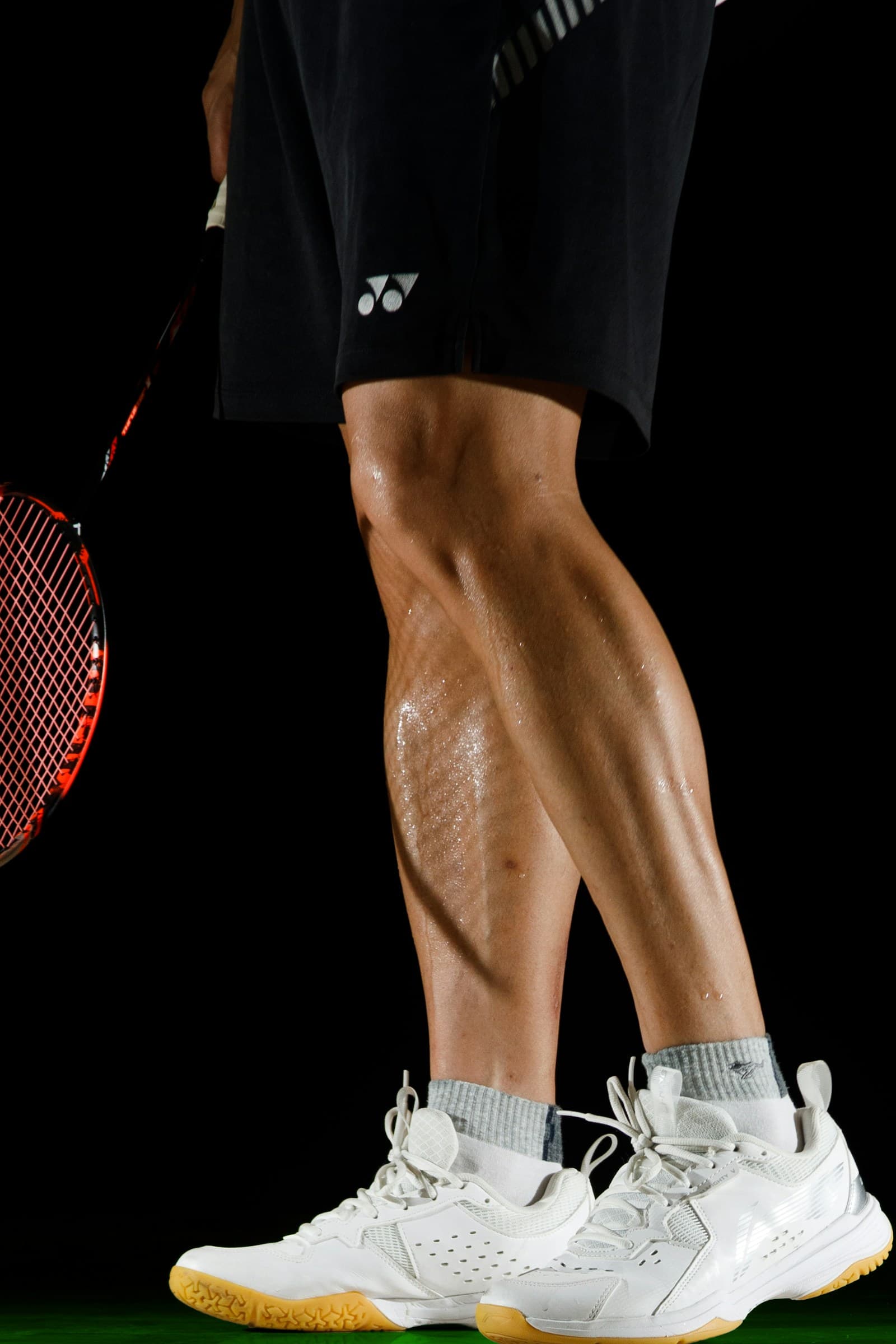
I've spent eight years playing pro badminton and another decade coaching adult players. If you let me pick the single technique most responsible for slow, late, out-of-balance play at the club level, I don't have to think about it. It's the split step in badminton.
Not technique. Not fitness. Not grip. The split step. And the thing that frustrates every coach is that it's also one of the easier fixes in the sport. You don't need a trainer. You don't need new shoes. You need to understand when to leave the ground and when to land.
This is the guide I wish every new Shuttle Lab member read before their first footage review. Most of them are losing a quarter of a second on every rally because their feet are flat on the floor when their opponent hits the shuttle. Fix your split step and everything downstream gets faster: your reaction, your recovery, your shot selection under pressure. If you haven't covered the fundamentals of badminton footwork, start with the complete guide first — this post assumes you know the basics and zooms in on the single most important piece.
What is the split step in badminton? 
The split step is a small, deliberate hop. You leave the ground with both feet, land on the balls of your feet slightly wider than your resting stance, and in that half-second the muscles in your legs load like a spring you can release in any direction.
It's not a jump. It's a pre-load. Most club players who think they split step are actually just shifting their weight, and the weight shift doesn't load the spring the way an actual hop does.
Watch any pro match at half speed and you'll see it on every single rally. Every time the opposing player is about to contact the shuttle, the receiving player has both feet briefly off the ground. When they land, they land ready. The shuttle moves, and their first step fires instantly.
Now watch a club match at half speed. Most players are standing on two flat feet at the moment of contact, then trying to push off from a dead start. They add between 0.2 and 0.4 seconds to every reaction. Over a rally of six or seven shots, that's two full seconds of deficit. That's why they feel "slow" without being out of shape.
Why does the split step make you faster (even though it looks like a pause)? 
The short version: your muscles can't fire efficiently from a flat-footed stance. They need to stretch before they contract. That stretch is what the split step gives you.
Physiologists call it the stretch-shortening cycle. When you hop and land on the balls of your feet, your calf and quad muscles get briefly loaded with elastic tension. When you push off from that loaded state, the push generates more force than a cold, flat-footed push could. The numbers vary by study but the elastic contribution is usually around 15–20% of your total push force.
That's why it looks like a pause but actually makes you faster. You're trading a stationary 0.2 seconds for a far more powerful first step. A first step that's 15% faster and lands you a few inches further on every lunge adds up across a rally.
The counter-intuitive part: if you try to react faster by skipping the split step, you get slower, not faster. Cold starts from a flat stance are always slow. The brain has less time to read the shuttle, the legs have less stored force to push with, and your first step ends up short.
When exactly should you split step (before or after your opponent hits)? 
This is the part almost everyone gets wrong.
The correct answer: your feet should land on the ground at the exact moment your opponent's racket contacts the shuttle. Not before. Not after. That instant.
If you land before contact, you've already committed your stance. By the time the shuttle starts moving, you've been flat on the ground for 100–200 milliseconds. The spring is no longer loaded. You're effectively starting cold.
If you land after contact, the shuttle is already traveling and you're still in the air. You can't push off mid-flight. By the time you touch the ground, the shuttle is closer than it should be and you're rushing.
Landing on the exact frame of contact means you land loaded and ready, with the shuttle just beginning to move. You have 150–200 milliseconds of flight time on the shuttle to read direction and fire your first step. That's a lot of time at the neural level.
The timing skill is in the takeoff, not the landing. You're trying to time your jump so the apex and descent finish when the shuttle is hit. That means leaving the ground slightly before your opponent's backswing completes, with the feeling that you're "just early" on the hop.
How high should your split step be? 
Low. Much lower than most people think.
Your feet should barely leave the ground. A centimeter or two of air time is plenty. The goal is to unload the weight from your feet long enough for the muscles to stretch, not to jump for altitude.
A high split step costs you three things. One, it takes longer to land, which makes the timing harder to hit. Two, it burns energy you need for the rally. Three, it commits your weight vertically when you actually want it coming forward.
Pros look almost like they're bouncing on their toes with a tiny vertical shake. The motion is compact and efficient. If your split step is visibly separating you from the ground, you're over-jumping.
The easy cue: think "shake, don't jump." You're trying to unload the weight briefly, not get air.
What does a correct split-step landing look like? 
Four things, in order of importance.
Feet wider than your resting stance. On the landing, your feet should be a few inches wider than hip-width. Too narrow and you can't push laterally with any force. Too wide and you lose the ability to drive forward.
Weight forward, on the balls of your feet. Not flat. Never planted on your heels. The contact point on the floor should be the balls of your feet and the front edge of your toes. Your heels might not even touch.
Knees soft and bent. Think of the knee bend as loading a bow. Straight legs can't spring. You want a slight, active bend — maybe 15 degrees from straight — not a deep squat.
Hips square to the incoming shuttle. Not twisted to one side. A twisted torso forces your first step diagonally, which wastes motion. Stay neutral, let the first step choose the direction.
If your landing feels comfortable for more than half a second, you're doing it wrong. The split-step landing is inherently temporary. You're there just long enough to unload, read, and push. If you feel settled, you're late.
What are the three most common split-step timing mistakes? 
After watching probably two thousand club-level match reviews across Shuttle Lab members, these three account for most of the footwork problems I see.
Mistake one: splitting too early. You hop during your opponent's backswing, land before contact, and stand flat for a full beat before the shuttle moves. The most common cause is anxiety. You want to be ready, so you pre-commit. But you've wasted the spring. Fix: wait later than feels comfortable. Your brain will tell you you're going to be late, but you won't be.
Mistake two: not splitting at all. You watch your opponent hit from a flat stance, then try to push off cold. Most common in defensive situations where you're already tired or unsure. The first step is visibly slower than it should be. Fix: commit to splitting on every single rally, even when you're gassed. Especially when you're gassed. A tired split is still faster than a rested flat-footed start.
Mistake three: weight shift instead of a real hop. You shift your weight side to side and think that counts. It doesn't load the muscles. Both feet stay on the ground the whole time. Fix: film yourself. If your filming partner can't see a frame where both feet are in the air, you're not actually split-stepping.
All three are instantly diagnosable on video. None of them are fixable without seeing your own footwork from the outside — the self-diagnosis protocol in the complete footwork guide walks through exactly what to film and what to look for.
How do you train split-step timing alone at home? 
You don't need a court. You don't need a shuttle. You need a wall, a phone, and three minutes.
Drill one: mirror split-step rhythm (2 minutes, daily)
Stand in front of a mirror or a blank wall. Every 1.5 seconds, execute a split step. Land on the balls of your feet, wider than hips, weight forward, knees soft. Immediately return to your starting stance and repeat. No push-off, no first step. Just the hop and the land, over and over.
The goal: make the motion automatic. You want to be able to split step in your sleep. If it requires conscious thought during a rally, it's too late.
Drill two: visual cue timing (3 minutes, 2–3 times per week)
Stand at home plate distance from a wall. Bounce a shuttle or a ball off the wall. Your job: split step at the exact moment the ball contacts the wall. Land loaded. No push. Just the timing of the hop against the contact point.
This teaches your brain to sync the jump to an external contact event, which is the actual skill you use in a rally. Almost nobody trains this specifically. Most players train the mechanics of the split step but never the timing against an opponent's contact.
Drill three: shadow reactive (4–5 minutes, at the club)
Partner claps or shouts a random direction as you split step. You land, react to the call, push one step in that direction. No shot, just the push. Fifteen reps per round, two rounds.
The split step is the only one of the three I'd rate "essential." The other two accelerate the fix but the rhythm drill alone will get you most of the gains.
How does the split step change between singles and doubles? 
Same mechanics. Different rhythm.
In singles, the rally tempo is slower. Clears and drops come 0.8–1.2 seconds apart. You have time between shots to reset your base, consciously time the split step, and recover rhythm. A singles split step can be a hair deeper and more deliberate. You're playing a longer song.
In doubles, the tempo collapses. Flat drives, pushes, and punch clears come 0.3–0.6 seconds apart at the club level, faster at the top. You can't afford a deliberate, deep split step because you won't have time to land and recover before the next contact. Doubles split steps are smaller, faster, and sometimes wider (especially in defense, where you're bracing laterally).
The other thing that changes: in doubles, you might split step twice on a single opponent's shot. Once when their front player prepares to intercept, once if the shuttle gets past the front player to the back. Your split timing shifts with whoever is about to contact.
For a full breakdown of the doubles-specific footwork patterns, see the Badminton Footwork for Doubles guide. The split step mechanics carry over directly, but the rhythm and positioning are different enough that they deserve their own treatment.
What is the week-by-week order to fix your split step? 
Week one: drill one (mirror rhythm) every day. Two minutes. No cheating. Build the motor pattern in complete isolation from rallies.
Week two: add drill two (wall bounce timing). Still no rallies. You're training the brain to sync the hop to an external contact point.
Week three: play a match and consciously split step on every single opponent's shot. You will miss some. That's fine. Keep trying. By the end of week three, it starts to happen without thought.
Week four: film a match. Watch at half speed. Count how many split steps were timed correctly (feet land on contact), how many were early, how many were missed entirely. Honest count.
If that number isn't above 70% correct after four weeks of deliberate practice, the diagnostic is almost always the same: weight shift instead of real hop. Both feet aren't leaving the ground. Re-run drill one with the specific goal of seeing both feet airborne in the mirror, every rep.
The split step is the single highest-leverage fix in badminton because it's upstream of everything else. You can't have good recovery footwork if your first step is slow. You can't defend pace if your feet are flat. Fix this one thing and every other footwork problem gets smaller on its own.
For the rest of the footwork system — six-corner movement, recovery, shadow routines — see the complete badminton footwork guide. The split step is the foundation. Everything else is built on top of it. Once the movement layer is reliable, the in-match decision layer becomes the next ceiling, and reading what your opponent is about to do is where that starts.