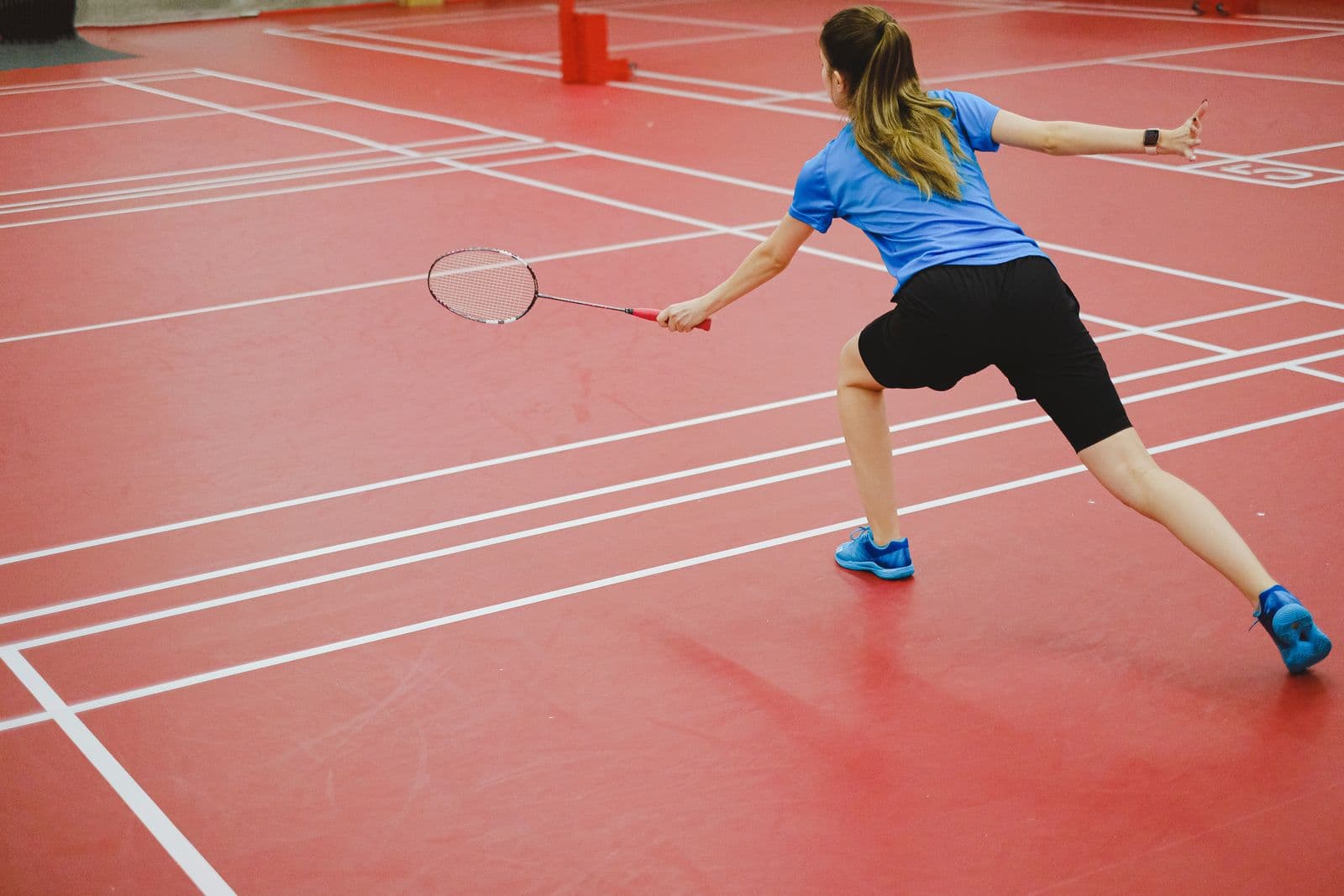
Every tall player I've coached has been told the same thing since they were fourteen. You've got a great reach. You should be smashing more.
It's the least useful advice in the sport, and it's why so many six-foot-two club players have a big smash, a decent clear, and no idea why they keep losing to someone eight inches shorter who never hits a winner.
I've spent eight years as a pro and a decade reviewing adult players' matches, and the tall players in that pile fail in a pattern so consistent I can usually call it before the second rally. It's not their smash. It's not their defence in the abstract. It's that height solved so many problems for them early that they never built the habits everyone else was forced to build, and then somewhere around club level the problems came back.
Kevin wrote the short player's version of this post, and the two are worth reading together because they invert cleanly. His argument is that short players spend years playing a tall player's game in a shorter body. Yours is the opposite. You spend years playing a game that works because of your height, right up until you meet someone good enough that it doesn't.
This is also not about beating a tall opponent. That's a different problem from the other side of the net, and it has different answers.
What your height actually buys 
Two things. Be precise about this, because most tall players think it's more and play accordingly.
A higher contact point in the rear court. You can hit down from a position where a shorter player has to hit flat or up. That means you can attack from deeper in the court, and it means your steep angles are available from places theirs aren't.
Reach at full extension. At the net and in defence, the court is effectively smaller for you. A shuttle that a shorter player has to take three steps to reach, you take in two and a lunge.
That's the list. Height does not buy you racket speed, first-step acceleration, change of direction, hand speed in a flat exchange, balance, or anticipation. Several of those it actively makes harder, which is the part nobody mentions when you're fourteen.
The trap is that both real advantages are positional, and positional advantages are the easiest kind to give away. Take the shuttle late and your higher contact point disappears, because you've let the shuttle drop into the same slot everyone else hits from. Arrive off balance and your reach disappears, because reach at full stretch with your weight going backwards produces a shot that sits up.
The shot at your hip 
Ask a tall club player where they're weak and most say defence, vaguely, or the net. The honest answer is more specific than that, and it's the same for nearly all of them.
You are worst at the shuttle arriving between your knee and your ribs, on your racket side, at pace.
Everyone has a dead zone there. Yours is bigger, because the distance between your comfortable overhead position and your comfortable low position is greater, and because getting your elbow out of the way of your own torso takes longer when your forearm is longer. A flat drive at your hip forces you to choose between a cramped backhand and a forehand you don't have room to swing.
Good players find this in about four rallies. It's why the flat game gets played at you, and why you often lose to players who by any other measure hit the shuttle less well than you do.
What to actually do about it. Two adjustments, and neither is a new stroke.
The first is your ready position. Most tall players hold the racket head too low, around waist height, because that's where their hands naturally hang. Bring it up so the head sits somewhere around chest height with the elbow already away from your body. You're pre-clearing the space you're going to need.
The second is a step, not a reach. The instinct at the hip shot is to jam the racket in front of your body while your feet stay planted. The fix is a small step across with the racket-side foot, which turns a cramped body shot into a proper forehand with room to swing. It costs you nothing and it's the single highest-value habit a tall player can install.
Why your drops arrive late 
Tall players hit slow drops. Not soft, which would be fine. Slow, meaning the shuttle takes too long to cross, and by the time it does the opponent is already there.
The cause is almost always contact point, and specifically that yours is too far behind you. You can still reach a shuttle that has travelled past your ideal hitting position, so you do, constantly, without noticing. A shorter player physically cannot, so they either move their feet or they miss, and that constraint teaches them something you never had to learn.
Contacting behind your head does three things to a drop. It flattens the angle, so the shuttle travels further before it lands. It kills the racket-head speed you can generate, so the shuttle floats. And it telegraphs, because the shoulder rotation that gets you to a shuttle behind you looks nothing like the one you use for a clear.
The fix is unglamorous: get your feet behind the shuttle so contact happens in front of your leading shoulder, the same as everyone else. If you've spent fifteen years reaching for shuttles you should have moved for, this will feel like a lot of unnecessary work for the first month.
There's a second-order effect worth knowing. Once your contact moves forward, your drop and your clear start looking the same again, which is the whole point. A tall player with a genuinely disguised drop from a high forward contact is very hard to play, because the higher contact makes the steep version available and the disguise makes it unreadable.
Changing direction costs you more 
Here's the physics you don't get told. A longer limb takes more force to accelerate and more force to stop. Your legs are levers, and the longer they are the more work each change of direction costs.
This shows up in one specific place: the second and third direction change in a rally. Tall players are usually fine on the first one. What kills them is a rally that goes net, rear corner, net again, because each reversal costs more than it costs the shorter player, and after four of them you're a half-step late and the fifth one is a winner against you.
Most tall players interpret this as being unfit. It isn't, or not mostly. It's that they never built the movement economy that would make each change cheaper, because for years they could cover the gap by reaching.
Two things carry disproportionate value for you.
Split-step earlier. If your acceleration is slower, your reaction has to start sooner to arrive at the same time. Landing your split at the instant of your opponent's contact matters for everyone; for you it's the difference between arriving balanced and arriving stretched. The footwork guide has the timing and the drills, and tall players get more out of that section than anyone.
Fewer, bigger steps. Shorter players shuffle. You shouldn't. Your best movement pattern uses fewer contacts with the floor, each covering more ground, with the chassé doing the work in the rear court and one long lunge at the front. Every extra foot contact is another acceleration you have to pay for.
The net is not where your height helps 
At the net your reach lets you take the shuttle earlier and higher, which is genuinely good. What it costs you is recovery. A tall player's lunge covers more ground, which means the recovery from the bottom of that lunge is a longer, heavier movement out of a deeper position. You get there faster and you leave slower.
The practical consequence is that tall players get stranded at the front. You play a good tight net shot, your opponent lifts, and you're still unfolding out of the lunge while the shuttle is dropping behind you. Then you hit the rear-court shot late, from behind your body, and we're back to the previous section.
So the rule for you at the front is to be decisive. Take the shuttle high and kill it if it's available, or play tight and get out. What you cannot afford is the drawn-out net exchange where you keep making tidy shots from a deep lunge. That's a rally shape that costs a tall player more per shot than it costs their opponent, and playing more of it is how you lose to a smaller, quicker player who's perfectly happy to stay there all night.
Where you belong in doubles 
Doubles is where height pays best, provided you're in the right half of the court.
Your job is the rear court in attack. The higher contact point that lets you hit down from deeper is worth more in doubles than in singles, because the whole format is built around whether your pair can sustain a downward attack. A tall player who can attack from a metre further back extends every attacking sequence the pair plays. The attack rotation guide covers the rotation itself; what matters for you is recognising that the back is your seat, not a punishment.
Where tall players get hurt in doubles is defence, and it's the hip shot again with less time attached. In a flat exchange from side-by-side defence, the shuttle comes at you fast, at hip height, with no time to step across. This is the single most common way good pairs beat a pair with a tall player in it.
Stand a little deeper than your partner in defence. Half a step is enough. It buys you the fraction of a second you need to get your elbow clear, and it costs you almost nothing, because your reach covers the lift that the extra depth would otherwise expose.
What to look for on your own video 
Film one game from the side, roughly level with the net, and watch it with three specific questions. None of this needs a coach to spot once you know it's there.
Where is the shuttle when you contact it on overheads? Pause at the moment of contact on every rear-court shot and look at where the shuttle sits relative to your head. If it's above or behind you on more than a couple of them, that's the late-contact habit, and it's costing you your drop, your disguise, and your recovery all at once.
Count your feet on direction changes. Pick five rallies and count the floor contacts between your last shot and your next contact. Tall players who move well do this in three or four. Tall players who reach do it in one, then take six to recover.
Watch what happens to the rally after a shot at your hip. Not whether you got it back, most club players do. Whether you won the rally. My guess, and it's a reliable one, is that the hip shot is where the point turns even when you return it, because you return it from a cramped position with your weight going the wrong way.
The reason this needs video is that all three are invisible from inside the rally. When you reach for a shuttle behind your head, it doesn't feel late, it feels easy, and that's exactly why the habit survives fifteen years. The shot goes back. You don't lose the point on that shot, you lose it two shots later, and by then the cause is gone from memory.
That's the thing about being tall in this sport. Your height covers your mistakes for long enough that you stop making the corrections everyone else made at seventeen, and then you spend your thirties being beaten by people you're physically better equipped than. The reach was never the problem. It's what you stopped learning because you had it.