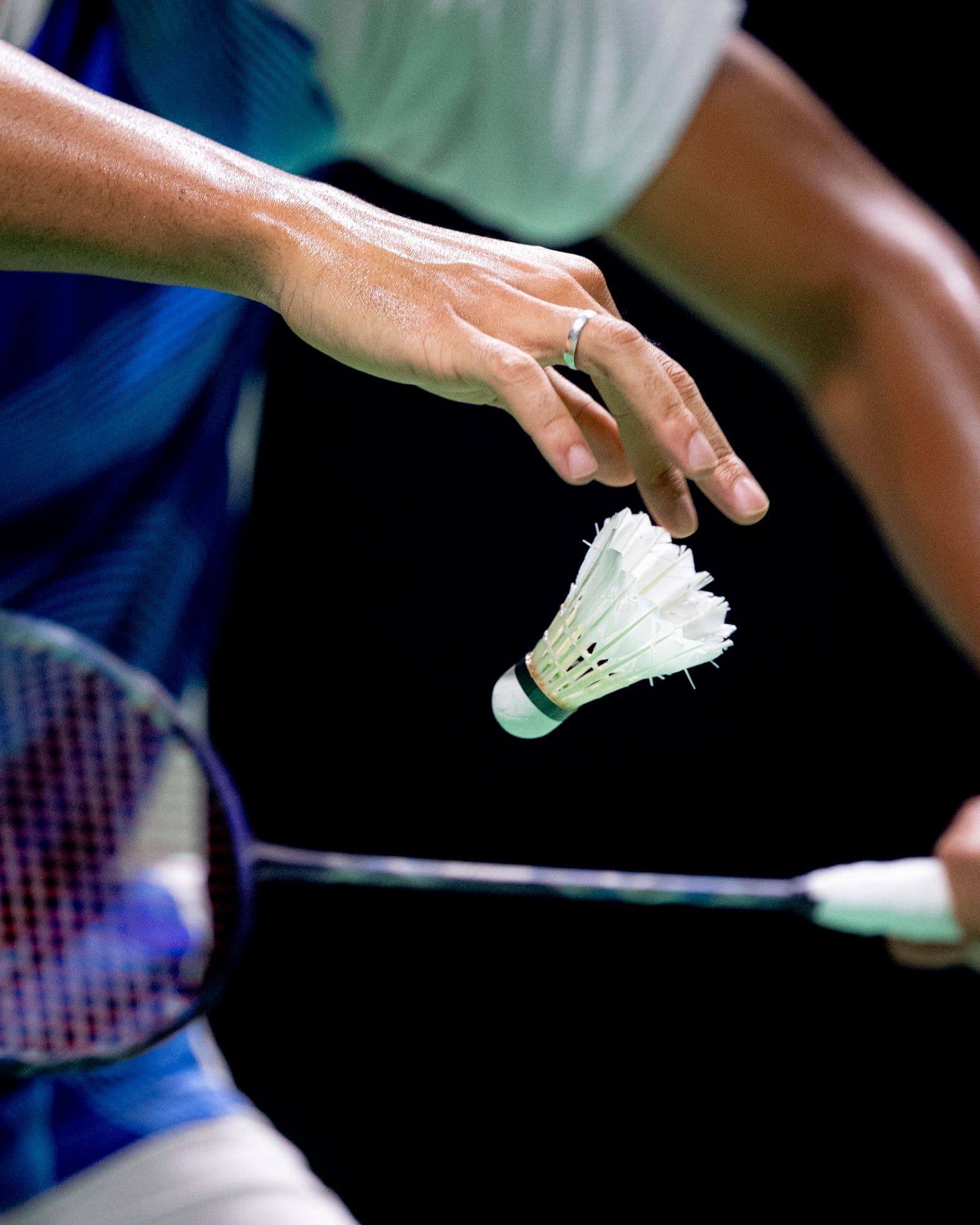
A club player emailed me a match video last year with one line of context: "I think I'm just too slow for this level." He was 34, played twice a week, and had lost in the first round of his local tournament to someone he thought he should have beaten.
I watched the whole third game. He was not slow. His top speed across the court was fine, better than plenty of players who beat him. What he was, on almost every rally he lost, was late by about a third of a second at the moment his opponent struck the shuttle. He was still standing upright, watching, when he should have already been loaded and pushing.
That gap is not a fitness problem. You cannot fix it with sprints.
I've spent eight years as a pro and a decade coaching adult players, and "I'm too slow" is the most common self-diagnosis I hear. I'm talking here about players who were never quick to begin with, which is a different situation from a game that used to be fast and isn't any more. If your speed is something you've lost rather than something you never had, the adjustments in adapting your game as you get older are the better starting point. It's also the one that's wrong most often. Not because these players are secretly fast, but because speed sits at the end of a long chain, and the failure is usually further up the chain where nobody's looking.
The three problems hiding under "I'm slow" 
When a player tells me they can't cover the court, they're describing a symptom. Underneath it there are three separate mechanical problems, and they need three completely different fixes.
Reaction delay. The time between your opponent's contact and the moment you start moving. This is where most "slow" players actually lose. If you're flat-footed at contact, you have to load before you can push, and loading costs you roughly a quarter of a second. Over a twelve-shot rally that compounds into arriving late on every shuttle.
Movement speed. The actual time to travel from base to the corner. This is the one everybody assumes is the problem. It's genuinely the problem for maybe one player in five.
Recovery lag. How long it takes to get back to a useful position after you hit. Plenty of players get to the shuttle fine and then stand there admiring the shot. They're not late to the first corner. They're late to the second one, because they never left the first.
These feel identical from inside the rally. All three produce the same sensation of the shuttle arriving before you're ready. But if you have a reaction problem and you spend three months doing shuttle runs, you will get fitter and you will still lose the same rallies.
Fix the wrong one and you've spent a season on the wrong training, which is how most players end up convinced they've hit a physical ceiling.
Work out which one you actually have 
You need video for this. Phone on a bag at the back of the court, one full game, side-on if you can get it.
Then watch it three times, looking for one thing each time.
First time through, watch your feet. Pause at the exact frame your opponent contacts the shuttle. Look at your feet. Are they in the air or just landing from a split-step, or are they flat on the floor? Count how many of twenty rallies you were flat. If it's more than about six, your problem is reaction, and it's the cheapest one to fix.
Second time, watch your route. Find five rallies where you were properly loaded at contact and still arrived late. Watch the path you took. Did you run to the corner foot-over-foot, or did you chassé? Did you take four steps where two would do? Most players who are loaded on time and still late are losing it to step count, not leg speed.
Third time, watch the second after you hit. Watch only what you do in the second after your racket meets the shuttle. Are you already pushing back toward the middle, or are you watching your own shot land? This is the one players are most surprised by, because you genuinely cannot feel yourself doing it.
The reason I make people do this on video rather than by feel is that the sensation of being late is identical in all three cases. Your body reports "the shuttle came too fast." It does not report why.
Cut the court down before you try to cover it 
Base position is not the middle of the court. It's the point that minimises your worst-case travel given what your opponent can actually do from where they're standing. Those are different, and the gap between them is free court coverage.
If your opponent is deep in their forehand rear corner, hitting off their back foot, under pressure, they cannot realistically hit a sharp cross-court drop to your forehand net. The angle isn't available to them at that body position. So standing dead centre means you're reserving speed for a shot that isn't coming.
Shift half a metre toward the shots they can actually play, and you've bought yourself the equivalent of a step. You didn't get faster. You made the court smaller.
A slower player who shades correctly covers more court than a faster player who stands in the middle out of habit. I've watched it happen in matches for years, and the faster player usually leaves convinced they got outrun.
How to build this. Pick one thing to shade on, and only one, for a whole session. The easiest is opponent contact height. If they're taking the shuttle below net height, they're lifting or netting, so step forward. If they're above it, step back. Don't try to read six variables. Read one until it's automatic, then add another.
The footwork guide goes deep on the mechanics of base and recovery. What I'm describing here sits on top of it: not how to return to base, but where base should be in the first place.
Take the shuttle earlier instead of moving faster 
There are two ways to reduce the time you have to travel. Move quicker, or start the journey sooner by meeting the shuttle further from your own baseline.
The second one is available to everybody. It costs no athleticism at all.
Most club players let the shuttle come to them. They wait for it to descend into a comfortable hitting zone, usually somewhere around chest height and well inside their own court. Every centimetre the shuttle drops on its way to you is time your opponent gets for free, and time you then have to spend recovering.
Meet it earlier and the whole rally compresses in your favour. A drive you take at head height rather than shoulder height arrives back at your opponent maybe a quarter of a second sooner. That's the same quarter-second you were trying to find in your legs.
This is clearest in the midcourt. A shuttle you intercept at the front of the midcourt is a shot your opponent has to answer immediately. The same shuttle, allowed to fall to your knees at the back of the midcourt, is a lift you're forced into.
The catch is that taking the shuttle early demands you be loaded early, which loops straight back to the split-step. You cannot intercept anything from flat feet. This is why I keep sending players back to reaction work first. It isn't only about arriving on time, nothing else on this list works until it's fixed.
The shuttle is your clock 
You control how much time you have, and you do it with what you hit rather than with your legs.
Every shot you play sets the duration of the next exchange. A high, deep clear to the corner might hang in the air for well over a second. A flat drive gives you a fraction of that. When you're the slower player, trajectory is the biggest lever you have on the tempo of the match, and most players pull it in the wrong direction under pressure.
The instinct when you're scrambling is to hit something fast, because fast feels aggressive and aggressive feels like the answer to being outpaced. It's backwards. A fast shot from a bad position comes back faster, and now you're scrambling from further behind.
Length is what buys you time, not pace. A clear that lands within half a metre of the back line forces your opponent to travel the maximum distance and gives you the maximum hang time to recover. A clear that lands two metres short gives them a free attack and gives you nothing.
This is why length under pressure deserves more training time for a slower player than almost any other single shot. It isn't glamorous. It's the difference between resetting a rally and losing it.
The corollary: stop trying to end rallies from your own rear court. A slower player who half-smashes from the back on shot five is manufacturing exactly the scramble they can't afford. Clear it, reset, and take the attack when it's actually available.
Choose rallies you can win 
Some patterns punish slow players. Some don't. You get to influence which ones you play.
The pattern that hurts you most is the long diagonal. Front forehand to rear backhand and back again, over and over. It's the maximum travel distance on the court, and it's what a good opponent will run you on the moment they work out you're the slower player. If you find yourself repeatedly moving corner to corner across the longest axis, you are losing a race you already know you lose.
The pattern that suits you is anything flat and central. Drive exchanges through the middle compress the court and reward hand speed and anticipation over leg speed. Front-court pressure does something similar. If you're at the net taking shuttles early, the rally is happening in a zone four metres wide instead of the whole court.
None of this means playing passively. It means the risks you take should be the ones that shorten the court rather than lengthen it.
There's a real discipline cost here. Choosing the rally you want means declining shots that feel available, and club players hate declining anything. But a slower player who plays only the patterns that suit them beats a faster player who plays everything, most of the time.
Doubles: position beats pace 
Doubles is more forgiving of a slow player than singles, because half your court coverage is decided before the shuttle is hit.
In defence, side by side, you're covering roughly half the width and you have the whole rally to see the smash coming. Being a step slow costs you far less here than it does in singles, and reading the smasher's body angle covers most of what speed would have.
The front-and-back attacking formation is where slower players get exposed, and it's usually because they took the wrong role. If your movement speed is the genuine limitation, the front position asks less of you: a smaller zone, short movements, and it rewards reading the shuttle early rather than covering ground. The rear position asks for repeated full-court rear-to-mid travel, which is precisely the thing you're worst at.
Most pairs assign these roles by seniority, or by who asks first. Pick the one your movement actually fits, and tell your partner why you want it.
If the speed gap is between you and your partner rather than between you and the opponents, that's a different problem with its own answers, and we covered it in the post on playing doubles across an age and speed gap.
Where slow-player tactics stop working 
I want to be honest about the ceiling, because most articles on this topic aren't.
Everything above buys you a level, maybe two. Shading correctly, taking the shuttle early, controlling trajectory, choosing your patterns: that's a real edge and it will beat plenty of quicker players who never thought about any of it.
What it won't do is survive a genuinely strong opponent who is also tactically disciplined. At that level they will refuse the flat rally you want, hit good length so you can't intercept, and run the long diagonal until it works. Against that, tactics buy you time but not a result, and some of the gap has to close physically.
The other limit is that this only works if you diagnosed correctly at the start. A player with a recovery problem who spends six months learning to shade their base will improve slightly and stay frustrated, because they were never short of court coverage. They were short of a step off their own shot.
That's the hard part. Of the three problems, you can feel exactly none of them while you're playing. The rally is over in eight seconds, your attention is on the shuttle, and the thing that went wrong happened behind you, or a shot and a half earlier, or in the half-second before your opponent hit. Every player I've reviewed who was sure they were slow had a specific, nameable, fixable mechanical failure instead. Almost none of them could see it on their own.
Get a camera on your next match, even a bad one from a bag on the floor. Watch the twenty rallies you lost and try to name which of the three failed. You'll probably find the word "slow" was covering for something a lot more specific, and a lot more fixable.