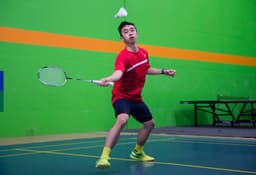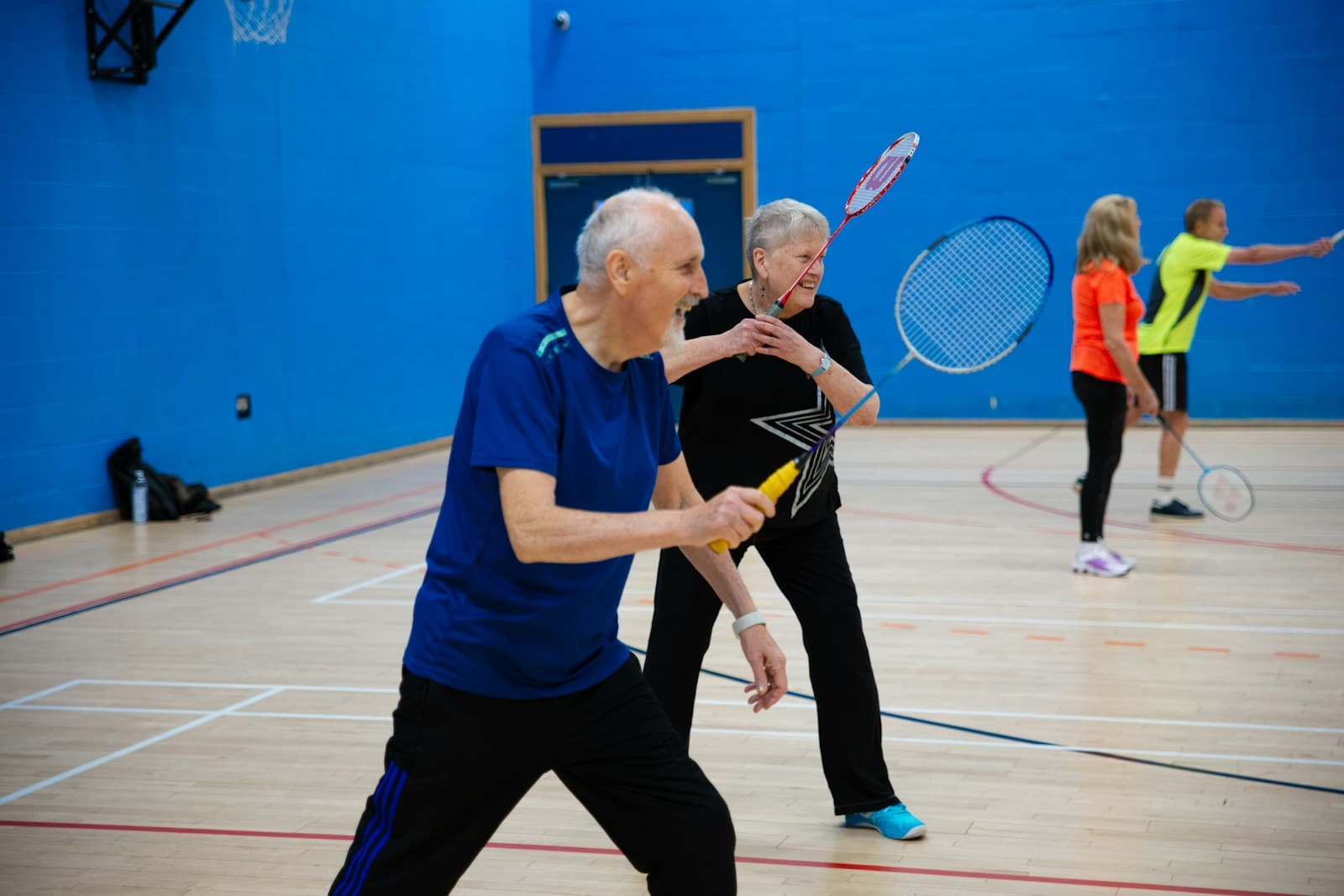
Most club players I review are playing doubles with singles footwork. They're covering the whole court. They're running to the back corners on every clear. They're lunging for shuttles their partner should be taking. It looks tiring, and it looks slow, and it's the single biggest reason club doubles pairs lose to pairs who are technically less skilled.
I've played doubles at the pro level for eight years. Kevin Barkman (former Canadian Men's Singles #1) and Imran Wadia (former Canadian MS #1 and Thomas Cup team member) have both played international doubles for their country. Between us, we've reviewed probably a thousand club-level doubles matches inside Shuttle Lab. The pattern is unmissable: the pair with better footwork discipline wins, almost regardless of stroke quality.
This guide breaks down what doubles footwork actually looks like. Not "footwork in general with some doubles notes." The actual patterns. Front player vs rear player. Attack vs defense. How and when to rotate. And the three mistakes that turn good individual players into a bad doubles pair.
If you haven't read the foundational work yet, the complete badminton footwork guide covers the six-corner framework, split-step mechanics, and base movements. This post assumes you know that language and builds on it.
How is doubles footwork different from singles footwork? 
Three things change. Zone, tempo, partnership.
Zone. In singles you own the full court, 44 feet by 17 feet. In doubles you own roughly half that at any given moment. The specific half depends on whether you're attacking (front/back split) or defending (side-by-side split). You never cover the whole court alone, but you also can't drift into your partner's territory without miscommunication.
Tempo. Singles rallies average 0.8–1.2 seconds between contacts at the club level, sometimes slower. Doubles rallies compress that to 0.3–0.6 seconds between contacts, sometimes faster. You don't have time to reset base consciously between shots. Your footwork has to be pre-loaded and nearly automatic, or you miss the next contact.
Partnership. Your footwork isn't just your footwork. If your partner rotates forward to cut off a drive, you need to rotate backward to cover. If your partner gets caught out of position, your movement has to compensate. A lot of doubles footwork is reactive to where your partner is, not to where the shuttle is.
The base movements — chassé, lunge, split step, push-off — are the same as singles. What changes is which movement you use, when, and how far.
What is the base position for the front player vs. the rear player? 
Attacking formation is front/back. Let me describe both bases precisely.
Front player base. Roughly two feet behind the short service line, centered on the midline, feet narrower than a singles base (call it shoulder-width, not wider). Weight forward, racket up at chest height. You are actively hunting for anything that comes past your partner at net or mid-court height. Your job is to intercept. Your hands are more important than your feet here.
Rear player base. Roughly two feet behind the midcourt line, centered or slightly weighted to your backhand side. Feet wider than singles base. Weight balanced, racket slightly lower than the front player because you're mostly defending against clears into your corners. Your job is to cover anything that gets lifted behind the front player.
When your opponent attacks, you shift to defensive formation (side-by-side) and both bases change. We'll get to that.
Quick reference for attacking formation:
| Role | Court position | Feet | Weight | Racket height | Primary job |
|---|---|---|---|---|---|
| Front player | 2 ft behind short service line, on midline | Shoulder-width | Forward | Chest height | Intercept anything that gets past the net |
| Rear player | 2 ft behind midcourt line, backhand-weighted | Wider than shoulder | Balanced | Slightly lower | Cover all lifts and clears behind the front |
The key geometry: in attacking formation, the front player and rear player are on the same vertical line down the middle of the court, not diagonal. If you're diagonal, one of you is wrong. The diagonal gap is what opponents target with crosscourt shots.
How do you move as the front player (net-to-mid-to-net loop)? 
The front player's footwork is basically a loop. Net, retreat to mid-court, return to net. Net, retreat, return. Most shots you take happen at net height or just above; when the shuttle lifts past you, your partner takes it and you retreat briefly to give them a clean swing, then return to net.
The movements:
Forward to net. A single lunge off the dominant leg, racket out, body low. You're taking net shots, net kills, and anything that's within one step of the short service line.
Sideways along the net. Chassé, not running. A sideways chassé keeps your hips square to the net so you can take the shot with your racket out front. Running along the net turns your hips, which forces an awkward swing.
Backward to mid-court (retreat). This is the movement most club front players skip. When the shuttle gets lifted past you, you need to retreat two or three feet so your partner can hit without your head in their swing path. The retreat is a back-chassé, not a pivot-and-run. Stay facing the net. Your partner takes the shot. You immediately return to net.
Return to net (forward chassé). Same chassé motion, forward. Back to base before the next exchange.
The common trap: running backward on the retreat. You turn your hips, run two or three steps away, and now you're facing your back wall when the shuttle comes back to net. You can't get there in time. Stay square. Chassé.
How do you move as the rear player (scissor jump, sideways box footwork)? 
The rear player's footwork is more like a box. Rear-left corner, rear-right corner, mid-court, back to rear. Three main movements dominate:
Scissor jump (or scissor kick). The rear player's signature movement. When a shuttle is lifted to your rear forehand corner, you rotate your hips, push off your front foot, travel backwards in the air, and land on your back foot as you hit. The "scissor" is the mid-air swap of your feet: the leg that was front kicks back, the leg that was back swings forward. You land facing the net in a strong hitting position, with the option to push forward immediately into attack.
Against singles players or new doubles players, the scissor takes practice. Get it right and you maintain rear-court power shots (smashes, drops) without losing your forward momentum for the follow-up.
Sideways chassé between rear corners. When a clear pulls you to your rear backhand from a rear forehand position, you don't pivot and run. You chassé sideways along the back of the court, staying square, arriving behind the shuttle with your racket loaded for an overhead. This is the pattern most club rear players get wrong: they pivot and run, which adds a half-second of rotation and kills their ability to smash from the backhand corner.
Push-forward to mid-court. When your partner takes a shot at net and the rally moves toward the middle, you push forward from rear to mid. This is usually a forward chassé or a small running step, depending on distance. Stay central, hunt for drives and punch clears.
Return to rear base. Same back-chassé pattern, hips facing the net. You never turn your back.
The rear player has more ground to cover than the front player, but the tempo is slightly slower because you're typically responding to clears and lifts, which fly longer than drives.
What footwork do you use during defensive side-by-side? 
When your opponents attack, you shift to side-by-side defensive formation. Both players split the court down the vertical midline. Each player covers half the court, top to bottom.
Defensive footwork is almost entirely lateral and low. Three patterns you'll repeat over and over:
Lateral lunge (to dig a smash). Against a hard smash, you need to get your racket down and in the path of the shuttle in under 0.5 seconds. The movement is a compact lateral lunge — single step to the side, weight dropping, racket low, body braced. Not a full lunge. More of a weighted lateral shift.
Forward half-lunge (for drives). When the attack comes as a drive at shoulder height, you move forward half a step while maintaining lateral readiness. The footwork here is a compressed version of the lateral lunge, going diagonally forward.
Reset between shots. After every defensive shot, snap back to side-by-side base immediately. Don't drift toward your partner's side. Don't drift forward. Every reset is a compact chassé, no wasted movement.
The defensive split step matters more than in singles or in doubles attack. Because the tempo is brutal (three or four smashes in a row from a good attacking pair at club level), your split step has to fire before every single one. If you skip one, you eat that shot flat-footed and the rally is over.
How do you rotate footwork between attack (front/back) and defense (side/side)? 
This is the piece that separates decent club pairs from good ones.
The rule: the formation follows the shot direction, not the player who hit it.
Your side lifts or clears to opponents. You're going to be attacked. Shift to side-by-side. Both players should already be moving before the shuttle crosses the net. Don't wait to see where the opponent hits. Shift the instant you see your own shot lift.
Your side drives, pushes, or attacks downward. You own the attack. Shift to front/back. The player who took the attacking shot stays in their lane (back player stays back if they smashed; front player stays front if they pushed a drive).
Mid-rally drive exchange. Side-by-side. Neither pair has a clear advantage, so both sides defend until someone lifts.
The rotation footwork itself is usually a chassé or two from wherever you are to your new base. The hardest part isn't the movement — it's reading the rotation trigger quickly enough to shift before your opponent's shot arrives.
A common failure: you smash from the back, your partner is at the net, the opponent digs it back, and now you're still standing in the back admiring the smash. You've missed the rotation trigger. The dig is coming back as a drive and your partner at net needs cover. You should already be pushing forward to cover behind them as the smash left your racket. The full tactical decision tree for the rotation, when to follow your shot, when to poach, when to switch formations, is covered in the doubles attack rotation guide.
What are the three most common doubles footwork mistakes at club level? 
These three account for most of what goes wrong at the club level.
Mistake one: both players going for the same shuttle. Classic result of no clear front/back discipline. The shuttle lands in the middle, both players rotate toward it, one of you takes the shot and the other is three feet out of position for the return. Fix: establish firmly who is front and who is back at the start of every rally. Middle shots default to the back player unless the front player calls "mine" early.
Mistake two: running instead of chasséing. Club players almost always run when they should chassé. Running turns your hips, which forces awkward swings and blind spots on shots that arrive faster than you expect. Fix: if you can reach it in two or three sideways steps, chassé. Save running for long emergency retrievals where speed matters more than stance.
Mistake three: failing to rotate on the lift. You clear the shuttle, you stay in front-back attacking formation, and the opponent smashes you. Half the time the smash lands clean because you never shifted. Fix: train the reflex so that any time you lift or clear, your feet move to side-by-side before you even see the opponent swing.
All three are visible on video in about twenty seconds of any club doubles match. None of them are fixable without seeing your own patterns from the outside, which is why video review is so effective in doubles specifically. Mistake three in particular is usually a downstream symptom: if you miss the rotation trigger, it's often because your feet were flat when your opponent made contact. The split-step timing guide is where to start if that pattern sounds familiar. Once you can see the formation breaking down mid-rally, call the change between points rather than mid-rally — your partner can only really hear you when the shuttle is out of play.
How do you drill doubles footwork with one partner at home? 
You don't need a full doubles match to fix doubles footwork. You need a partner and a set of court lines. Three drills, roughly fifteen minutes total.
Drill one: rotation shadow (5 minutes).
No shuttle. You and your partner stand in attacking formation (front/back). Someone calls "lift" or "smash" randomly every three seconds. On "lift," both of you rotate to side-by-side. On "smash," you stay or rotate back to front/back. The goal is to make the rotation instant, without thought.
Two rounds, swap positions.
Drill two: front-player loop (5 minutes).
One partner stands in the front player base. The other partner feeds shuttles at net height, alternating left and right corners, one every two seconds. You chassé to each shuttle, take a net shot, retreat one step, and return to base before the next feed. Pure movement, no rally.
Your partner varies the pace, adds in the occasional shuttle lifted past you so you practice the retreat-and-return pattern.
Drill three: defensive digging (5 minutes).
One partner stands on a chair or elevated surface and throws shuttles down at an angle, simulating smashes. You stand in side-by-side defense, one player at a time, and dig every smash. Focus on: split step before each throw, compact lateral lunge to get racket under the shuttle, instant reset to base.
Two rounds per player, alternating sides.
How does the split step fit into all of this? 
Every movement I've described above is preceded by a split step. Every rotation, every lunge, every chassé, every dig.
In doubles the split step is shorter and more frequent than in singles. You split every time the opposing player is about to contact, which at top doubles speeds means four or five split steps per rally. That's a lot of reps per match, and it's why doubles players develop such strong split-step timing over time.
If your split step is weak, nothing else in this guide will work for you. The rotations will feel late, the lunges will feel short, the defensive digs will sail past your racket. Start there. For the full split-step mechanics, see the badminton split-step guide. Get that foundation in place, then come back and layer in the rotation patterns.
What is the month-by-month order to fix doubles footwork? 
Month one, don't touch the rotations. Just get your front-player loop and rear-player box patterns clean. Run drill two repeatedly. Film yourself. You should see clear chassés, no pivots, no running.
Month two, add the defensive side-by-side patterns. Drill three. Practice digging smashes without drifting toward your partner. Film. You should see compact lateral lunges and instant resets.
Month three, layer the rotations. Drill one at full speed. Your pair should rotate between formations automatically whenever the attack changes hands.
By the end of month three, you will be noticeably better than 90% of club doubles pairs. Not because you hit harder. Because you're always in the right place, at the right time, with your weight already loaded.
That's what good doubles looks like from the outside. Quiet feet. No scrambling. Every shot hit from a stable, balanced position. Your opponents feel like they can't find a gap because there isn't one.
The rest of your improvement (tactics, shot selection, communication) gets dramatically easier once the footwork is solid. Most players try to fix the order backward and wonder why nothing sticks. Start here.
For a review of the foundational movement patterns used in both singles and doubles — the six-corner framework, the chassé, the lunge — the complete badminton footwork guide is the home page for that material.