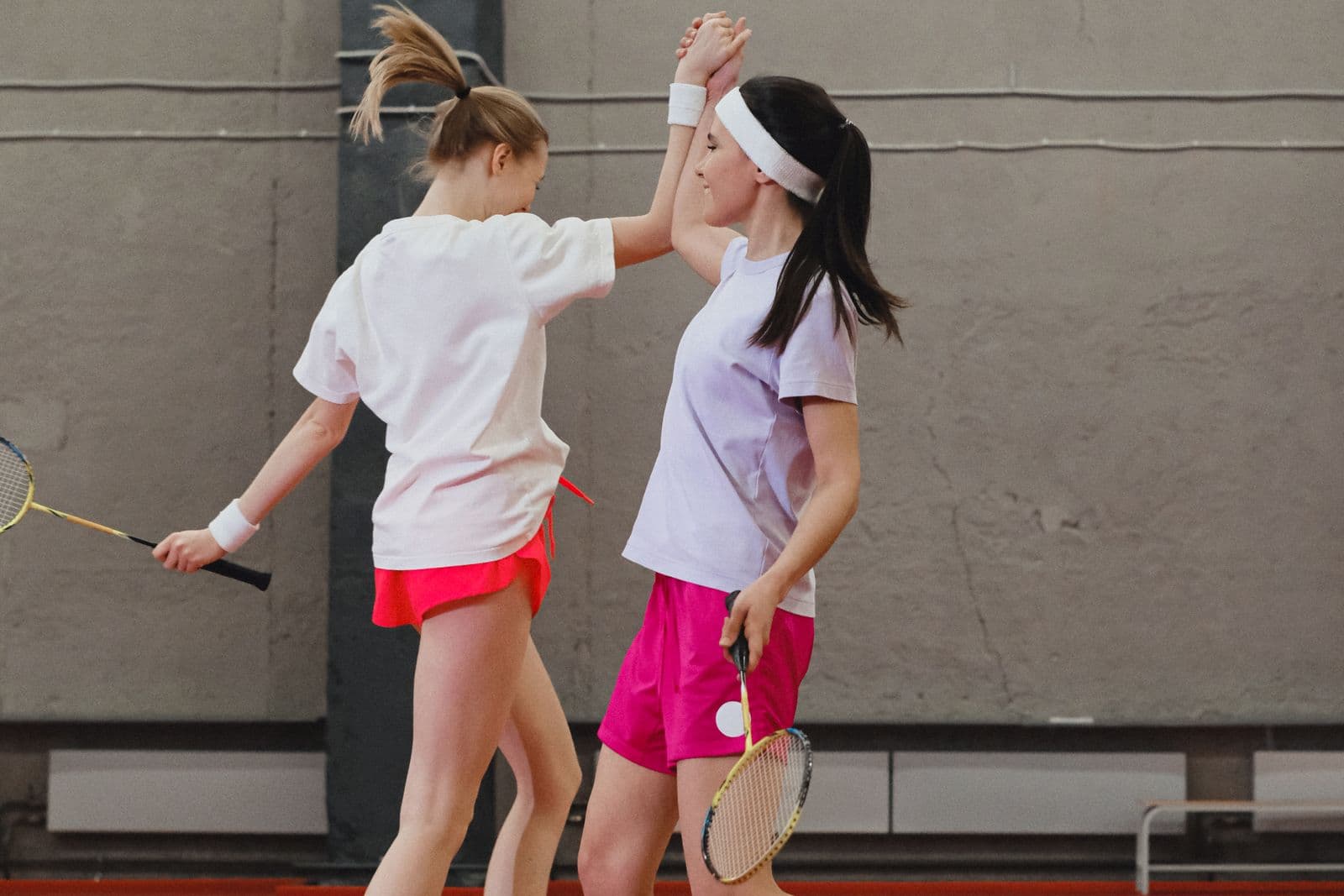
The first thing almost every new left/right pair does is put the left-hander on the left side of the court. It feels obviously correct. It's also wrong most of the time, and the pairs who work that out early save themselves a season of unexplained collisions in the middle of the court.
I'm Imran Wadia, former Canada Men's Singles #1 and Thomas Cup team member, and most of my coaching hours since have gone into doubles. The left/right pairing is one of the few situations where a very simple piece of geometry decides a large chunk of your results, and where the default club instinct points the wrong way. It comes up constantly at club level, because roughly one player in ten is left-handed and nobody has ever explained to either of them what that means for the pair.
This is the guide to playing it on purpose. Which side each player should take and why the obvious answer is usually backwards, what having both forehands in the middle actually buys you, how serving and receiving change, the rotation problem that only left/right pairs have, defending side by side when your backhands are on the outside, and what a good opposing pair will do to you once they've noticed.
What changes when your partner is left-handed, and what doesn't 
Start with what doesn't change, because pairs waste a lot of energy here. The rotation logic is identical. Front and back in attack, side by side in defense, whoever lifts goes back, whoever plays the tight net shot stays forward. None of that cares which hand your partner holds the racket in. If your rotation is broken, handedness isn't why, and the doubles attack rotation guide is the fix rather than anything on this page.
What changes is one thing only: where each player's forehand points.
A right-hander's forehand covers the space to their right. A left-hander's covers the space to their left. In a right/right pair, the two players are mirror images of each other and their forehands always point the same way, so the pair's strong side and weak side are consistent no matter who is standing where. A left/right pair doesn't work like that. Depending on which side each player takes, you either have both forehands meeting in the middle of the court, or both backhands meeting there.
Those are two completely different teams. Same two players, same skill, opposite strengths. Most club pairs pick one by accident and never notice they made a choice.
Choosing sides: why "lefty on the left" is usually backwards 
Put the left-hander on the left side and the right-hander on the right, and both players' forehands point at the sidelines. Your backhands meet in the middle.
Swap them, left-hander on the right and right-hander on the left, and both forehands meet in the middle instead. Backhands now point out toward the tramlines.
There's a real case for the first arrangement, and you'll hear it made: with both forehands pointing outward, each of you covers your own tramline with your stronger stroke, and the pair has no weak flank at the sidelines the way two right-handers do. That's true, and it's why plenty of left/right pairs play that way happily.
I still think the second one is right more often, for a reason that has nothing to do with either player's preference: most doubles shuttles come through the middle. Flat drives, smashes aimed at the body, defensive blocks that sit up in the centre, the whole tight exchange that decides who gets to attack. If you're going to have a strong side and a weak side, put the strong one where the shuttle actually goes.
There's a second reason, which is that the middle is also where the confusion lives. Two backhands meeting in the centre creates a genuine dead zone, because both players are weakest exactly where they most need to be decisive, and hesitation there is worth more points than the technical weakness is.
The other objection I hear is that a player has always played one side and feels lost on the other. That's real, and in my experience it's worth about three weeks of feeling odd before the new side stops registering as unusual. The side you're used to is a habit. The geometry doesn't change.
Both forehands in the middle: the advantage and the collision 
Here's the part that gets undersold. With both forehands meeting in the centre, a left/right pair has something no right/right pair ever gets: two attacking rackets pointing at the same space, and that space is the one most exchanges run through. A flat drive down the middle that a right/right pair takes on somebody's backhand is a forehand for both of you. In a fast exchange, that's the difference between blocking and hitting.
Now the bill. Two players who both want the middle shuttle, both able to reach it comfortably, both with the stronger stroke available. Left/right pairs don't lose middle shuttles because nobody takes them. They lose them because both players take them.
You need a rule, decided away from a match, and it needs to be about position rather than ability.
In defense, side by side: the shuttle down the middle belongs to whoever is on the side it's travelling toward, not whoever can reach it. A middle smash angled slightly to the left is the left-side player's, even if the right-side player's forehand covers it. Direction of travel decides, because that's the only cue both of you can read at the same time.
In attack, front and back: the front player takes anything they can reach at or above net height, the rear player takes everything else. Standard, but it needs saying explicitly in a left/right pair, because the front player's forehand now covers a part of the middle they aren't used to owning and they'll start reaching for shuttles that were never theirs.
When both of you are square and the shuttle is dead centre at chest height: pre-agree one player. Not the better player, just a player. The point is removing the half-beat of mutual hesitation, and either answer beats no answer.
Serving and receiving as a left/right pair 
Serving sides rotate with the score, so you'll both serve from both courts and there's nothing to decide there. Receiving is different. Most pairs fix their receiving sides and keep them all match, which makes it a real choice rather than something the scoreline hands you.
A left-hander receiving in the right service court has their forehand pointing at the T. That's a genuinely strong position, because the low serve to the T is the most common serve in doubles and now it gets attacked with a forehand racket coming down on it rather than a backhand jab. Pairs who get this right start winning the first three shots of rallies they used to lose.
The trade is the flick. With the lefty receiving in the right court, a flick serve over their backhand shoulder goes toward the outside rear corner, and that's a harder shuttle to attack than the same flick against a right-hander in that court. Expect good servers to find it by the middle of the first game, and expect to need a plan for it: either a straighter, faster reply that keeps the exchange flat, or a lift that buys the pair time to reset into side-by-side defense rather than trying to counter-attack from a bad position.
The rotation problem only left/right pairs have 
This is the section that no other article on this topic covers, and it's the most common breakdown I see in these pairs.
In a right/right pair, the front player's positioning after their partner attacks becomes automatic within a few months. Your partner smashes from the rear left corner, you know which line the smash travels down, you know which side the block is likely to come back on, and you shade there without thinking. That habit is built entirely from playing with right-handers.
Put a left-hander behind you and every one of those learned positions is mirrored. A left-hander attacking from the rear left corner is hitting from the same shoulder position a right-hander occupies in the rear right corner, so the straight line, the cross-court angle, and the likeliest block reply all flip. Front players don't consciously get this wrong. They shade to the side their body has learned over years, which is now the wrong side, and the block goes past them into space they were standing in five seconds ago.
The tell that this is your problem: you're getting beaten by blocks and drives that go past your front player rather than through the middle, and it happens more when your left-handed partner is attacking than when you are.
The fix is not complicated but it does take reps. The front player has to position off the shuttle and the hitting shoulder rather than off memory. Watch which shoulder your partner is hitting from, then cover the straight line from that shoulder. Ten minutes of shadow rotation with your partner attacking from each rear corner in turn, front player calling out which line they're covering before each shot, sorts it out faster than months of matches will.
The second half of the problem is the lefty stranded in the wrong rear corner. Every player has a weaker rear corner, the one where the shuttle ends up behind their backhand shoulder. For a right-hander that's the rear left. For your left-handed partner it's the rear right, the opposite corner, which means your pair's weak rear corner has moved to the side you're not used to protecting. Good opponents find it by pushing you into rotations that leave the lefty deep on their backhand side, and the answer is that you take that corner when the rotation offers it rather than defaulting to whoever is closest.
Defending side by side with your backhands on the outside 
The forehands-in-the-middle setup has one real cost and it shows up in defense. Side by side against a smash, both of you are covering the sideline with a backhand.
Don't try to solve this by drifting outward to get your forehand across. That opens the middle, which is the whole thing you set the formation up to protect, and it gives the attacker the easiest target in doubles.
Stand where you'd normally stand and change what you're prepared for. The wide, flat smash to the tramline is the shot to expect, so hold the racket slightly earlier and slightly wider on that side, and accept that your reply out there is a block rather than a counter-drive. Blocking a wide smash tight is a perfectly good outcome. Trying to drive it off a stretched backhand is how you feed the next smash. The doubles defense guide covers the block, drive, push, and lift choices in full, and everything in it applies here with the single adjustment that your wide-side options are narrower than a right/right pair's.
One more thing that pairs miss: your defensive strength is now the middle, which means you should actively want opponents to attack down the centre. Good defensive pairs make the middle look inviting and then punish it. Two forehands waiting for a body smash is a bad thing to smash into.
What good opponents do to a left/right pair 
Once a decent pair notices your handedness, they'll do a version of the following, and knowing it in advance is half the counter.
They attack the seams rather than the players. With forehands in the middle, the seams are the two outside tramlines, and you'll get a diet of wide smashes and drives that never come near the centre. Expect it, and understand it as a compliment to your middle rather than a hole in your defense.
They use repeated cross-court to force rotation, because rotation is where your pair is most likely to end up in the wrong shape. Every cross-court is an invitation for the two of you to swap sides, and a left/right pair that swaps sides has just given up the forehands-in-the-middle arrangement it built everything on. The counter is to rotate back deliberately rather than staying wherever the last rally left you. Between rallies, check you're on the right side. It sounds trivial and it's the single most common thing I have to tell these pairs during a match.
And the serve gets used to move the lefty around: flicks over the backhand shoulder, low serves that pull them toward the side they cover worst. If you're getting served the same way six times in a row, that isn't a coincidence, and it's about as clear a signal as you'll get that you've been read. Reading it back is a skill in itself, and the singles version of playing a left-hander is worth a look for what your opponents are seeing when they look at your partner.
Why this is hard to see from inside the pair 
Every problem on this page produces the same feeling on court, which is that something went wrong in the middle and neither of you is sure whose fault it was. That feeling is useless as a diagnosis, and it's the only information you get while you're playing, because both of you are watching the shuttle rather than each other.
Film one match and you'll see things you'd swear didn't happen. Both rackets going to the same shuttle three times in a game. The front player shading left when the left-handed partner is attacking from the left, which puts them exactly where the straight smash isn't. A rotation midway through the second game that left you on the wrong sides for the next eleven points, unnoticed by either player.
None of that is a skill problem, which is why drilling harder doesn't fix it. It's a shape problem, and shape is visible from outside the court and nearly invisible from inside it.
Get sides right, agree who owns the middle before the match rather than during it, and give the front player a season of reps at reading a left-handed shoulder. Most left/right pairs I've coached were carrying all three problems at once and thought they simply weren't very good together. They were fine together. They were standing in the wrong places.