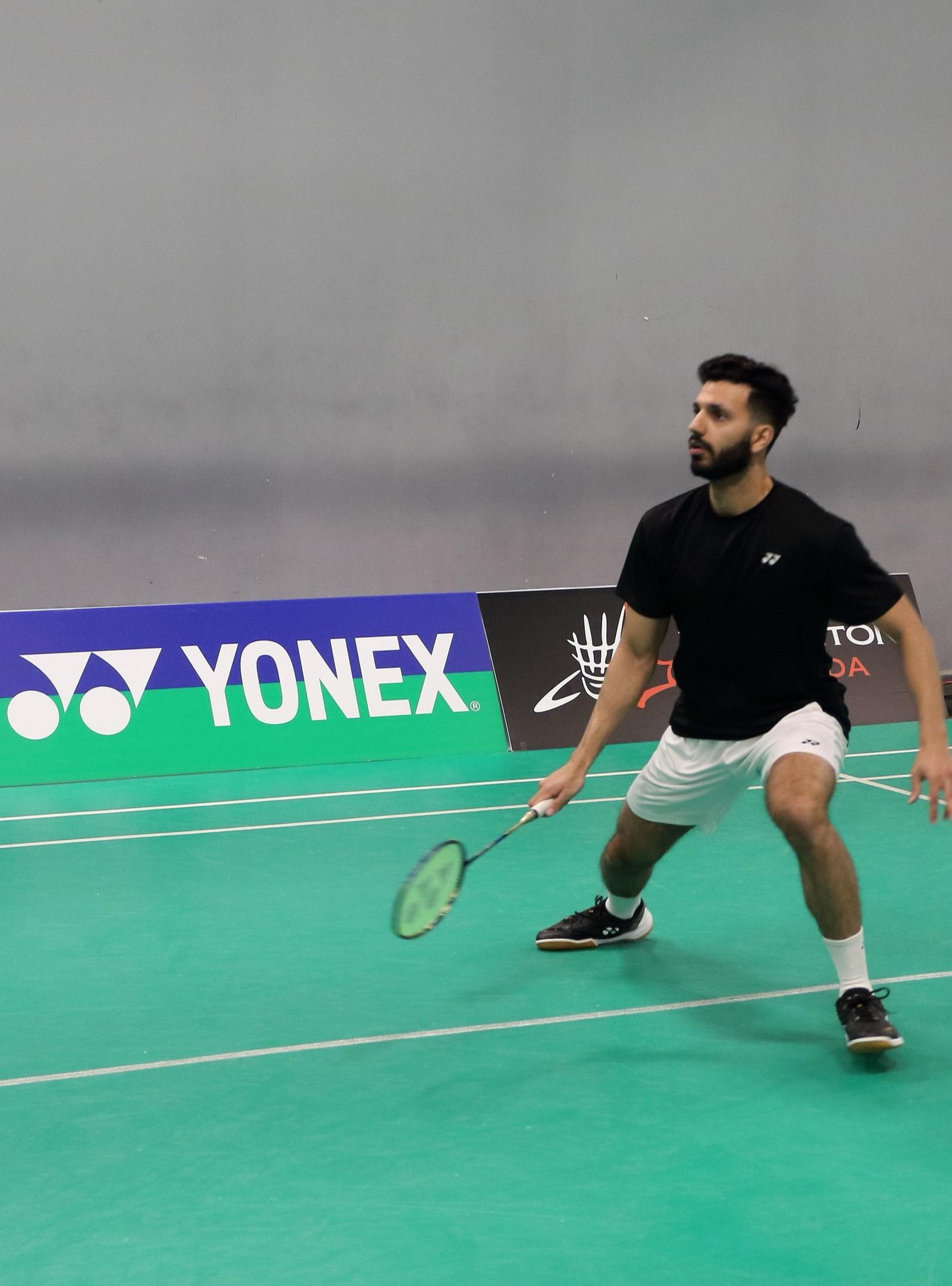
Watch a club doubles game from the side and look only at the receiver, not the shuttle. Most of them stand somewhere comfortable, a step or so behind the short service line, racket around waist height, weight sitting back. The server looks at them, sees all of that, and plays a gentle low serve to the T. The receiver lifts it. The serving pair attack.
Nobody in that rally did anything wrong that you'd notice. The receiver didn't miss. They just lost the start of the rally before the serve was hit, by standing where they stood.
I'm Kevin Barkman, former Canada Men's Singles #1, BWF World #147 peak. Between me, Justin Ma and Imran Wadia, we've gone through a lot of club doubles footage inside Shuttle Lab, and the receive position is one of the most consistent faults in it. It's also one of the cheapest to fix, because it's the one moment in doubles where nothing is moving yet. You get to set it up exactly how you want, every single time.
What you hit off each serve is a separate question. Everything here is about the half-second before it: distance, feet, weight, racket, and what your partner is doing behind you.
Why club players lose the serve before it's hit 
The receiver in doubles has a lot of power over the start of the rally, more than the server does. A good receive position takes most of the low serve away, which leaves the server with two bad options: a low serve tight enough that they're risking the tape, or a flick, which you're waiting for.
A poor position hands all of that back. Stand a step too deep and every low serve becomes something you have to reach for below the tape, which means you push it up or lift it. Stand with your weight back and the low serve to the T arrives before you've moved. Hold your racket low and you've told the server you're not going to attack the serve, so they can play it a little higher and safer.
The server notices all of this, even at club level. Most of them aren't thinking about it consciously, but they serve differently to a receiver who looks ready than to one who doesn't. A good receive position changes the serve you get.
How close to stand 
In level doubles, most receivers should stand closer to the short service line than they do now. The typical club position is about a racket-length behind it. Most players can move that up to somewhere between half a racket-length and a foot behind the line and still cover the flick, once their feet and weight are set properly.
The trade is the same for everyone. Closer means you take more low serves above the tape, where you can push them flat or kill them. Further back means you have more time for the flick. The right spot is the closest one from which you can still get behind a good flick, and for most players it's closer than they think, because they're judging it from a stance that's too upright and too flat-footed to push off well.
Two adjustments to that. Taller players and players with good rear-court footwork can stand closer, because the flick costs them less. In mixed doubles the receiving woman stands closer again, right up near the line, which Imran covers in the mixed doubles guide. In level doubles you can afford to be a touch further back than that, but not by the full step most club players give themselves.
Sideways, stand close to the centre line. Most low serves go to the T, and you want to take that serve with the shortest possible movement. You'll give up a little on the wide serve, which is a harder serve to hit well and easier to read.
Feet and weight 
The stance most good receivers use is simple. Non-racket foot forward, about a step in front of the racket foot. Front knee bent. Back heel off the floor or close to it. Weight mostly on the front foot, something like 60 to 70 percent.
That last part matters more than the rest. A receiver with weight forward can take a low serve early, at or above the tape. A receiver with weight even or back has to shift their weight forward before they can move, which adds a fraction of a second, and at club level that fraction is usually the difference between pushing the serve flat and lifting it.
The obvious worry is that weight forward makes the flick harder. It does a little, but less than people think, because covering the flick isn't about where your weight starts. It's about pushing off the front foot quickly and turning, which a loaded front leg actually helps with. The players who get caught by flicks are mostly the ones standing upright and flat-footed, not the ones leaning in.
One rule to remember: both feet have to stay in contact with the floor and stationary until the serve is struck. So the load is a lean, not a bounce. You can't split-step the way you would in a rally. You set your weight, you stay still, and you move on contact.
Racket height and what it tells the server 
Hold your racket up, head above the height of the net tape, out in front of you. Not by your waist, not resting on your shoulder.
This does two things. Mechanically, it puts the racket where the low serve is going to be, so you can push or tap the shuttle without having to bring the racket up first. Less movement, earlier contact.
The second effect is what the server sees. A raised racket says you're going to attack anything that floats. Servers respond to that by trying to serve tighter, and a tighter serve is a riskier one. Some of them start flicking more to get away from it, which is fine if you're ready. Either way you've changed their serve before they've hit it.
A dropped racket says the opposite. It's the most common thing I see in club footage, and it usually happens right as the server prepares, when the receiver relaxes for a moment. If you watch yourself back and your racket drops in that half-second, you're inviting the serve you least want to receive.
Covering the flick without giving up the low serve 
The flick is the server's answer to a good receive position. You'll get more of them the better you stand, which is a sign it's working.
To cover it, the move is a push off the front foot and a turn, so you travel back sideways rather than backpedalling, then a jump or scissor step if the flick is good. Justin's video below shows the flick from the server's side, and it's worth watching for one reason: the flick and the low serve look the same until very late, so you can't guess. You have to be set to go either way.
If a server is flicking a lot and getting away with it, you can step back a little. Half a foot, not a full step. Make the adjustment early in the game and tell your partner you've done it. Then, once the flicks stop working or stop coming, move forward again. The mistake club players make is stepping back after one flick and never moving forward again for the rest of the match. That gives the server exactly what the flick was for.
The other half of covering the flick is not leaving early. Players who've been flicked twice start stepping back as the server swings, and good servers see that and serve low into the space they've just left. The receive stance only works if you stay still until contact.
Right court, left court, and a left-handed server 
The basic stance doesn't change between courts, but the shots that hurt you do.
In the right service court (for a right-handed receiver), the centre line is on your left. The low serve to the T comes in on your backhand side, and so does the flick down the middle, which goes back toward your round-the-head corner. The wide flick goes to your forehand rear. Set your racket slightly toward the backhand so you can take the T serve early, and know that the middle flick is the one you have to turn hardest for.
In the left service court, it flips. The T serve and the middle flick both come on your forehand side, which is the easier pair to handle. The dangerous one is the wide flick to your backhand rear corner, and it's where most receivers in the left court get caught. Some players stand a fraction deeper or a touch wider here for that reason. Try it and check whether it costs you anything on the low serve to the T.
Against a left-handed server, the angles flip, and the serve to the T arrives from a slightly different direction than you're used to. The fix is just to notice it in the first few serves and adjust your feet a little. Imran's post on doubles with a left-handed partner covers how handedness changes doubles more generally.
What your partner does while you receive 
Your partner's job during the serve is to be ready for whatever comes after your return, not to watch you.
In level doubles that usually means standing somewhere around the middle of the court behind you, slightly toward the side you're not covering, racket up, weight forward. If you take the serve early and attack it, your pair is already in an attacking shape with you at the front. If you get flicked, you go back for it and your partner adjusts to cover the front or goes side by side, depending on where your reply goes.
The thing I see most often in club footage is a partner standing flat-footed and watching the serve, as if their part of the rally starts when the shuttle crosses the net. It starts before that. Two players set and ready makes the server's job harder in a way one ready receiver doesn't, because the server can't find an easy place to put the shuttle.
The stance faults that only show up on video 
What you hit off the serve is the part most players think about, and it matters. Planning your return in advance is covered in the post on being targeted in doubles, and under 15-point scoring every rally start counts for a little more. But the return only works if the position before it is right, and the position is the part you can't see yourself.
From inside the receive, you feel ready. You think you're close to the line, your weight feels forward, and your racket feels up. On video it often looks different.
The faults I see most:
Creeping back. The receiver starts the game in a good spot and drifts a little further back after every flick, until by the middle of game two they're a full step deep.
Weight back at the moment of serve. The stance looks right while the server is setting up, then the receiver rocks back slightly as the server's racket moves. That's the worst possible moment for it.
The racket drop. Covered above, and it's the one most players are surprised by.
Leaving early. A small backward movement as the server swings, after being flicked once or twice. Good servers see it and serve low.
Film a game from behind the receiving court and pause on the moment of contact on ten serves. Look at the feet, the weight and the racket. If those ten frames look the same, your receive is consistent. If they don't, the differences are probably where your rallies are being lost before they start.