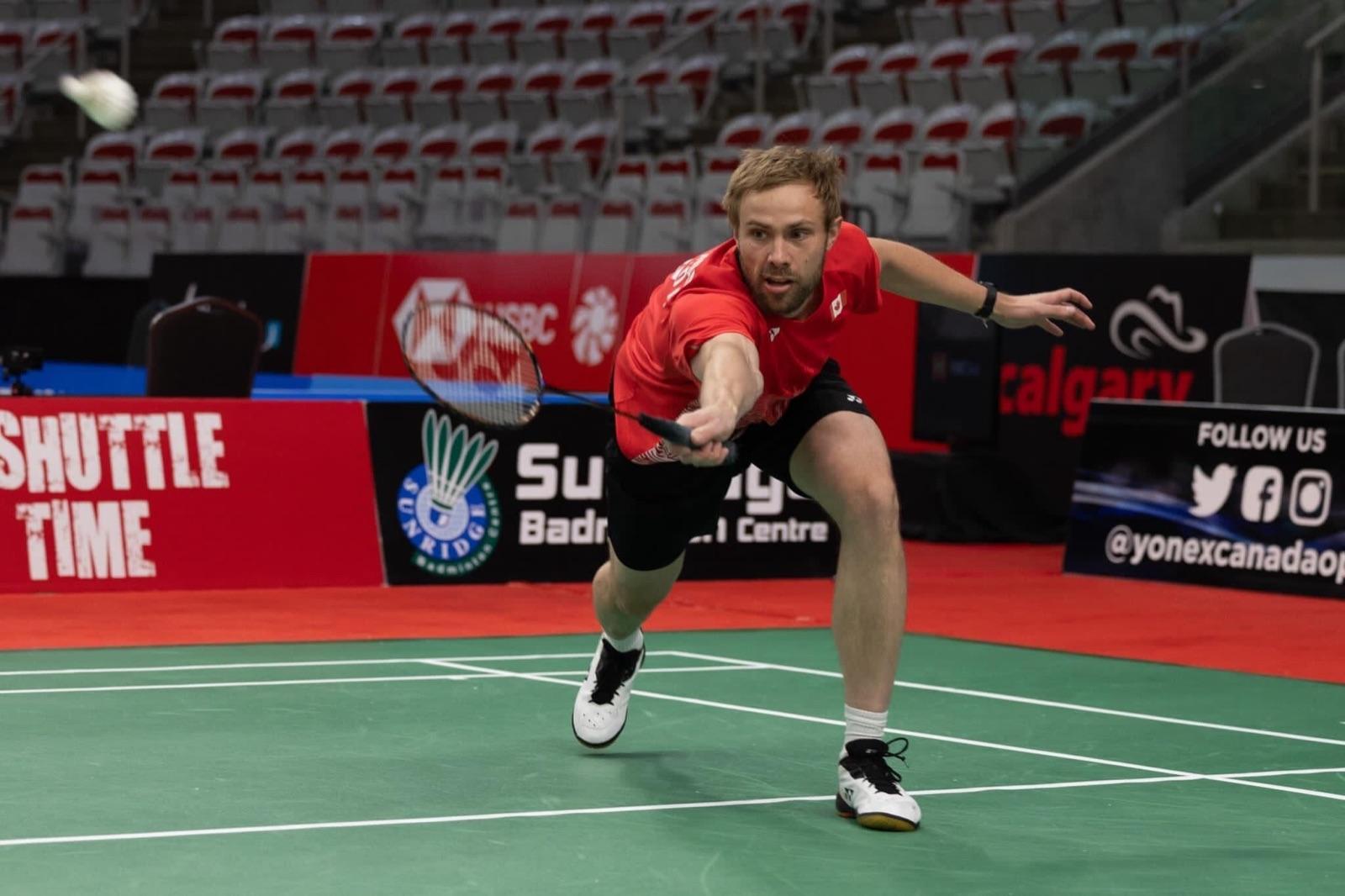
You go to the net, your partner goes back, and you feel it straight away. The other pair is close. Someone over there hits hard. The first drive comes at your chest, you turn your head and throw a hand up, the shuttle hits the frame and goes into the net. Next rally you stand half a step further back. The rally after that you're barely at the front at all.
Nobody talks about this much, but a lot of adult doubles players are scared at the net. Not terrified. Just uncomfortable enough that they flinch on fast shuttles, back away from the front, and let their partner take things they should have killed.
I'm Imran Wadia, former Canada Men's Singles #1 and Thomas Cup team member. I've coached a lot of doubles, and when players send in footage the flinch is easy to spot: the head turns, the racket drops, the feet go backwards. Almost always, the fear is a symptom. The player is standing in a position where fast shuttles really do arrive too quickly to handle, so their body is making a sensible decision. Fix the position and most of the fear goes with it.
The flinch is a positioning problem first 
When you flinch, your body has decided that a shuttle is arriving faster than you can deal with it. That decision is usually correct, given where you're standing and how you're holding the racket.
At club level, three things set this up.
Standing too close. The closer you are to the net, the less time a flat shuttle gives you. Players who've been told to "get to the net" often stand right on top of it, a foot or two from the tape, where a hard drive from mid-court reaches them in a fraction of a second.
Standing too upright. An upright body with straight legs is slow to react and has a lot of exposed chest. Most shuttles that hit people at the net hit them in the chest or shoulder, at exactly the height an upright player has the least coverage.
Racket too low. If your racket is at waist height when a drive comes at your chest, you have to lift it a long way in very little time. Usually you can't, so you turn away instead.
Put those three together and you have a player who can't get the racket to a fast shuttle in time. The flinch is their body's alternative. It isn't a courage problem, and telling someone to "be braver" at the net doesn't change any of the three.
Where the shuttle actually goes 
A lot of net fear is fear of the wrong shot.
When you're at the front in doubles, almost nothing is hit straight at your face on purpose. What comes at you is mostly flat: drives and pushes from the opposing front player, and replies to your partner's attack that come back low and fast. Those arrive at body height, usually chest to hip, because that's where they're aimed. A body shot is hard to play, so it's a sensible target.
The shots that do arrive high and hard at the front player mostly come from one source: your own pair's mistakes. If your partner lifts short, or you play a net shot that floats up, the other pair gets to hit down at you from close range. That's the one genuinely dangerous situation at the net, and you can see it coming, because your side created it.
So the fear is usually tied to a real situation: a loose shot from your own side, followed by a hard hit from close range. Part of the answer is not playing the loose shot. The other part is what you do when it happens anyway: get lower and get the racket up in front of you, rather than turning your head away. Turning away is what gets people hit.
Where to stand and how to stand 
The default front-court position in doubles is roughly on or just behind the short service line, in the middle of your half, not hugging the tape. That gives you enough time to react to a flat drive while still letting you take net shots early.
From there, you move forward when the opposing pair is clearly going to play soft, for example when your partner has just hit a steep smash and the likely reply is a block. You hold your position, or even take a small step back, when the reply is likely to be flat and fast. Being at the right depth for the shot that's coming is most of what "comfortable at the net" means.
Then the body:
- Knees bent, weight on the balls of your feet, so you can move and get lower.
- Upper body slightly forward, chest over your knees rather than behind them.
- Racket up and in front, head at or above the height of the tape, roughly between you and the net.
The racket position matters most. A racket up in front of you covers your chest and face without you having to think about it. A lot of shuttles that would have hit you hit the racket instead, and some of those go back over the net.
Don't turn round when your partner hits 
This is the habit that causes most of the actual hits.
When your partner is attacking from the back, you're in front of them with your back to their shot. The natural instinct is to turn round and watch. Don't. Turning round means you can't see what the opposing pair is about to do, and it puts your face toward a shuttle your partner might hit flat or mishit. It also takes your racket out of position for the reply.
Keep facing forward. You'll hear your partner's contact, and the opposing defenders' bodies tell you where the shuttle is going: their racket preparation, their stance, which of them is moving. The front player who reads the defenders instead of watching their partner gets to the reply earlier, which is what you're there for. The doubles attack rotation guide goes through what the front player should take and leave once the attack is running.
The other common hit comes from your partner playing a flat drive or push from mid-court that passes you at head height. That's mostly a communication issue. If you're at the front, your partner shouldn't be hitting flat shots through your space without warning, and both of you should agree on that before the match.
Blocking a body shot without thinking 
The shots that make most people flinch are flat drives into the body. Body shots have a simple default answer.
Use your backhand. With the racket up in front of you and a relaxed grip, most shots at your chest and racket shoulder can be taken on the backhand side, with the racket face just angled to block or push the shuttle back. You don't need a swing. You need the racket to be in the way, with the face pointing roughly where you want the shuttle to go.
The hip on your forehand side is harder. Most players take it with a quick forehand push, or step slightly across. Either is fine. What isn't fine is standing still and hoping.
Justin's video on drive defence covers the different replies to a flat shuttle coming at you. For a player who's been flinching, the first step is simpler than any of them: get the shuttle back over the net at all, with the racket in front. Variety comes later.
The drive exchange itself, once the rally turns flat and fast on both sides, is covered in its own post on the doubles drive exchange. This section is just about not letting the first fast shot beat you.
Rebuilding the reflex 
Fear of the net is learned, and it can be unlearned with practice that starts easy and builds.
Get a partner to feed flat shots at you from mid-court while you stand in a good front-court position. Start at half pace, aimed at your chest. Your only job is to keep the racket up and get the shuttle back over the net, usually with the backhand. Twenty or thirty feeds, then up the pace a little. Then aim some at the forehand hip. Then mix in the occasional soft shot so you have to move forward as well.
Two rules make this work. Stop each set before you start flinching again, so you're practising the good response, not the old one. And keep the pace honest. Feeds that are too slow don't transfer to a match, and feeds that are too fast just rehearse the flinch.
Most players who do this for a few sessions are surprised by how quickly it changes. The reflex they were missing was mostly a racket position they hadn't trained.
When opponents target your nerve 
Club players notice when someone flinches. Once a pair sees the head turn or the racket drop on a fast shot, they'll start hitting more of them at you. That's not personal. It's just the obvious thing to do.
The best answer is to make it stop working quickly. Get two or three body shots back cleanly, even softly, and most pairs move on to something else. Being targeted in general, and how to work out whether it's a stroke, a position or a habit that's drawing it, is in the post on being targeted in doubles. For the front player, the cause is usually one of the three set-ups at the top of this post.
In mixed doubles, this happens a lot. The front player, often the woman, faces drives from a male opponent who hits harder. The position is the same, the racket is the same, and the answer is the same. A good front player in mixed is very hard to drive through, because every flat shot that comes their way meets a racket that's already there.
What your footage shows that you can't feel 
Most players who flinch at the net don't know how much they're doing it. They know they feel uncomfortable at the front. They don't know that they've drifted back to mid-court by the middle of game one, or that their racket drops to their waist every time their partner goes back to smash.
From inside the rally, the flinch feels like a reaction to a hard shot. On video it usually starts earlier: the step back as the opposing player prepares, the head turning before the shuttle has been hit, the racket coming down while the rally is still neutral.
Film a game and watch only yourself at the front. Pause on every fast shuttle that comes your way and look at two things: where your racket is when the opponent makes contact, and where your feet are compared with where they were two shots earlier. If the racket is low and the feet have moved back, you've found the problem, and it isn't courage.