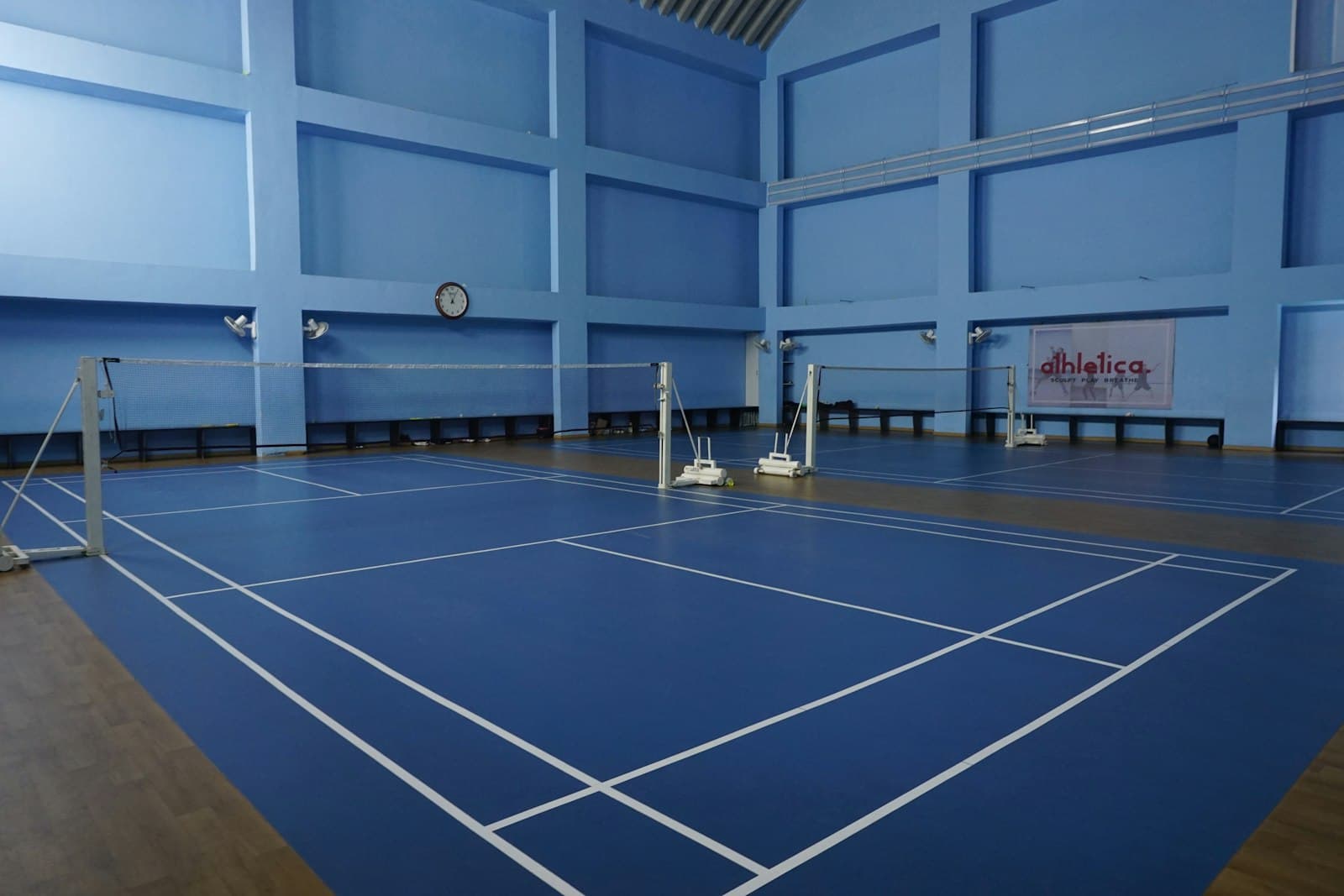
You can hit a cleaner clear than the guy across the net, a tighter drop, a harder smash, and still lose 21-15, 21-17, and walk off not sure how it happened. I see it on tape every week. The shots were good. They kept landing where he already was. He never had to move more than a step, so he was never out of position, so he had time for everything you hit, and the rally only ended when you got bored and tried to drill a winner past a player who was balanced and waiting for it.
That's the whole problem, and it's the most common one in adult singles. Players practice shots. They don't practice moving the opponent. So they arrive in a match with a good clear and a good drop and no idea where to put them, and they spend an hour hitting quality shots into a stationary target.
I'm Kevin Barkman, former Canada Men's Singles #1, BWF World #147 peak. Most of my playing career was singles. Together with Justin Ma (7× US National Champion) and Imran Wadia (Thomas Cup), I've reviewed thousands of singles clips inside Shuttle Lab, and the single biggest gap between the players who win their division and the players who plateau isn't shot quality. It's whether they understand that every shot is supposed to move the opponent, and they have a plan for where.
This is the field guide to that. Why moving the opponent beats hitting winners, the court geometry that decides which shots actually cost your opponent, the difference between a shot that builds and a shot that finishes, the patterns that pull a player out of position, how to set up the smash so it stops getting blocked back, and the movement leak you can't see from inside your own rally.
Why moving your opponent beats trying to hit winners 
Here's the principle the whole game runs on. You don't win singles rallies by hitting a shot your opponent can't reach. You win them by hitting a series of shots that pull your opponent so far out of position that the last shot lands in a space he had no chance of covering. The winner is the end of the process. The process is the movement.
Adults skip the process. They look for the winner on every shot, which means they're hitting toward the lines and the corners hoping to catch the opponent flat, on shot one, every rally. Against anyone decent, that's a low-percentage way to play. You miss a lot of those shots, and the ones you don't miss get returned, because the opponent was in position to cover them.
The mental switch is to stop asking "can I win the point with this shot" and start asking "where does this shot make him go." A clear isn't a holding shot. It's a shot that sends him to the back corner. A drop isn't a winner. It's a shot that drags him to the net. Once every shot has a destination for the opponent attached to it, you stop hitting hopeful winners and start building rallies that end with the opponent stranded.
The good news is this is the most learnable part of singles. Footwork takes years. A real smash takes years. Learning to move an opponent with shots you already own takes a few weeks of thinking about the court differently, and it wins more matches than another mph on your smash ever will.
The court geometry: which corners actually cost your opponent 
Singles is played from a central base, the spot near the middle of the court that gives the shortest distance to every corner. After every shot, your opponent is trying to get back there. Your job is to make him pay to get back, and to hit your next shot before he's arrived.
There are four corners that matter: deep forehand, deep backhand, net forehand, net backhand. Those four points are the furthest you can push a player from his base. A shot to the middle of the court is a shot he covers with a step or two. A shot to a corner is a shot he covers with a full movement, a lunge or a chassé and a recovery, and the recovery is the part that costs him. Every corner you send him to, he's a fraction slower getting back to center than he was the shot before.
The most expensive line on the court is the long diagonal: from one deep corner to the opposite net corner. That's the length of the court plus most of its width, the maximum distance a single shot can force. A player who just lunged into his deep backhand and has to scramble to a tight net shot on his forehand has covered more ground than any other pair of shots can make him cover. That diagonal is the backbone of moving a singles player, and most adults almost never use it because both shots are hard to hit well.
What you're attacking isn't the corner itself. It's the recovery. A player who reaches a corner late is a player whose next recovery is late, and late recovery compounds. Move him to one corner and he's a half step slow to the next. Move him again and he's a full step slow. By the third good corner shot, the fourth corner is wide open, not because he can't reach it in theory, but because he hasn't finished paying for the last three. The smart understanding of footwork, the six-corner movement system, is the same map read from the other side: the corners that are hardest for you to cover and recover from are exactly the ones you want to send your opponent to.
Building shots versus finishing shots 
Every shot you hit is one of two kinds, and confusing them is what makes adults lose rallies they had already won.
A building shot moves the opponent and asks nothing of itself. A deep clear to a corner, a slow drop that drags him to the net, a controlled push to a sideline. It doesn't try to win. It tries to make him travel and arrive a little late. Building shots are high-percentage. You should be able to hit twenty in a row without an error, because they're not played to the line, they're played to the corner with margin.
A finishing shot ends the rally: the smash, the net kill, the fast push into open court. Finishing shots are lower-percentage and higher-reward, and they only work when the building shots have already done their job. A smash hit at a balanced opponent is a building shot that you mistook for a finisher, and it comes back.
The mistake is finishing too early. Adults hit one good building shot, see the opponent move, and immediately try to finish, before the opponent is actually out of position. The opponent was moved one corner. He's a half step slow, not stranded. The finish gets returned and now you've spent your best shot and you're back to neutral, often worse, because you committed to a smash and didn't recover.
The discipline is to keep building until the opening is real, and the opening is real when the opponent is visibly late or stretched, not just moving. One corner moved is not an opening. Three corners moved, with the recovery breaking down, is an opening. Hold the finish until you see the second one.
The patterns that actually move people 
Random corners don't move a good opponent, because a player who's just guessing covers the average position fine. Patterns move people, because a pattern sets an expectation and then breaks it. Three I use constantly.
Straight, straight, then change the line. Play two or three shots straight down one side, drop straight, clear straight, so the opponent settles into expecting the straight ball and starts recovering toward that side early. Then change the line cross-court. The cross-court shot isn't special on its own. It's deadly because you trained him to lean the other way for three shots first. The repetition is the setup. The change is the kill.
The double to one corner. Hit the same corner twice in a row. This works because the opponent, after you move him to a corner, recovers anticipating that you'll exploit the open space, so he cheats back toward the middle hard. The second ball to the same corner he just left catches him leaning away from it. Adults never do this because hitting to the same corner twice feels like you're wasting the open court. You're not. You're using his own recovery against him.
The front-back stretch. Stop thinking side to side and move him net-to-rear instead. A tight net shot followed by a deep clear, or a deep clear followed by a drop, makes him cover the length of the court, and vertical movement, lunging forward then sprinting back, is more tiring and slower to recover from than running side to side. The up-and-back stretch breaks down endurance faster than anything, and it's where most singles matches are actually decided in the third game.
These aren't the only patterns, and against specific opponent types they get adjusted. The patient defender who returns everything needs a different sequence, which I broke down in the defender matchup guide, and the fast attacker who's trying to rush you needs you to slow the rally first, covered in the aggressive matchup guide. The four-corner engine is the same underneath. The patterns are how you bolt it onto whoever is across the net.
Setting up the smash without firing it too early 
The smash is the shot adults waste most, and they waste it the same way every time: they hit it at an opponent who's in position. A smash at a balanced player is a gift. He blocks it back tight, you're stuck mid-court having spent your biggest shot, and the rally resets with you worse off.
The smash is a finishing shot. It needs the building done first. The right time to smash is not the first time the shuttle sits up. It's the moment the opponent is moving, or has just changed direction, or is recovering from a corner and hasn't reached his base. You smash into movement, not into a set position. A player who's still traveling when your smash arrives can't set his defensive base, and his block floats or sits up for your follow.
So the sequence isn't "lift comes up, I smash." It's "I've moved him to the deep backhand, he's scrambling back to center, the next shot sits up while he's still mid-recovery, now I smash into the space his recovery left." The smash lands where he was going, not where he is. It's the identical shot you were going to hit anyway. The only thing that changed is the half second you waited for him to be out of position.
The placement follows the same logic. Don't smash to the corner the textbook tells you to. Smash to the space his last movement opened, or straight at the body when he's stretched and can't get the racket across. A body smash at a moving player is far higher percentage than a line smash at a set one, and adults pick the line smash every time because it looks more decisive.
Reading where your opponent breaks down under movement 
Every player has a corner he's slow to and a recovery he's slow from. Find it in the first few rallies and your whole pattern game gets sharper, because now you know which corner to make the last one.
The diagnostic is to move him full-court early, on purpose, even at the cost of a couple of rallies. Send him to all four corners in the first three or four points and watch what happens. Most players are slowest to the deep backhand, because it's the corner that needs a round-the-head or a backhand from the worst position. A lot of players also have a recovery bias: they drift back toward their forehand after every shot, which means the backhand side is chronically a step further away than they think. Some get to the corners fine but are slow coming forward, so the net shot after a deep clear is the one that strands them.
Whatever it is, it shows up under movement and stays hidden when you let him play from his base. Once you've seen it, you build toward it. If his deep backhand is slow, your patterns end with a shot that makes him take the previous ball on the forehand side so the backhand corner is the one he has to scramble to last. You're not hitting to a corner anymore. You're hitting to his corner, the one his body doesn't want to cover, and you're arriving there at the end of a sequence when he's already late. The full framework for spotting these tendencies is in the reading-your-opponent guide. Under movement is when they become impossible for him to hide.
Drills to build the four-corner game on two sessions a week 
You can't learn this in match play, because in a match you default to the patterns you already own. It has to be drilled until the patterns are automatic, then they show up under pressure. Three drills, fifteen minutes each, twice a week.
Drill 1, pattern reps with a feeder. Pick one pattern, straight-straight-change, or the double-to-one-corner. Run it ten times with a partner feeding the replies the pattern is built to produce. You're hardwiring the sequence so that in a match you recognize the setup and run the change without thinking. After two weeks the pattern stops being something you decide to do and becomes something you notice is available.
Drill 2, corner-to-corner with a recovery rule. Play cooperative singles rallies with one rule: every shot has to land in a back or front corner, nothing to the middle, and you have to touch your central base between every shot. The base-touch rule is the important half. It builds the habit of recovering after every shot you hit, because moving the opponent does nothing if you don't recover to hit the next one, and late recovery is the leak that turns your own good pattern into his counterattack.
Drill 3, six-before-the-winner. Play points where neither player may attempt a finishing shot until at least six building shots have been hit to the corners. No early smashes, no hopeful winners. If you finish before six, you lose the point. This rewires the impatience directly. The first session feels absurd. By the third, you'll notice you were finishing three shots too early in real matches your whole career.
The movement game you can't see from inside the rally 
Here's the part that makes this so hard to fix alone. From inside the rally, you can't tell the difference between a shot that moved your opponent and a shot that just got returned. Both feel like "I hit it, he hit it back." You don't feel that your clear landed two feet short and let him take it from his base instead of from the back corner. You don't feel that you've fed the same diagonal he's been reading for four rallies. You don't feel your own recovery arriving a half second late. All of it is invisible at the speed you're playing.
Then you watch it on tape and it's obvious in the first ninety seconds. There, your "attacking" clear landed mid-court and he stepped into it. There, you smashed at a balanced player and he blocked it for a winner. There, you moved him beautifully to three corners and then recovered late and lost the rally you'd already won. The shots aren't the problem. The problem is that moving an opponent is a thing you do to someone else, across the whole court, over a whole rally, and you are the one person in the building who can't see the whole court while it's happening.
That's the entire case for an outside eye. The first time I put a singles player's match on the screen and we counted how many of his shots actually moved the opponent versus how many landed where the guy already stood, the number shocks them every time. Usually it's less than half. The other half were good shots hit to bad places, and he'd been doing it for years without knowing, because there's no way to know from inside the rally. You fix it in one viewing and the next match looks like a different player who suddenly has a plan for every shot. The plan was always available. He just couldn't see the court he was standing on.